
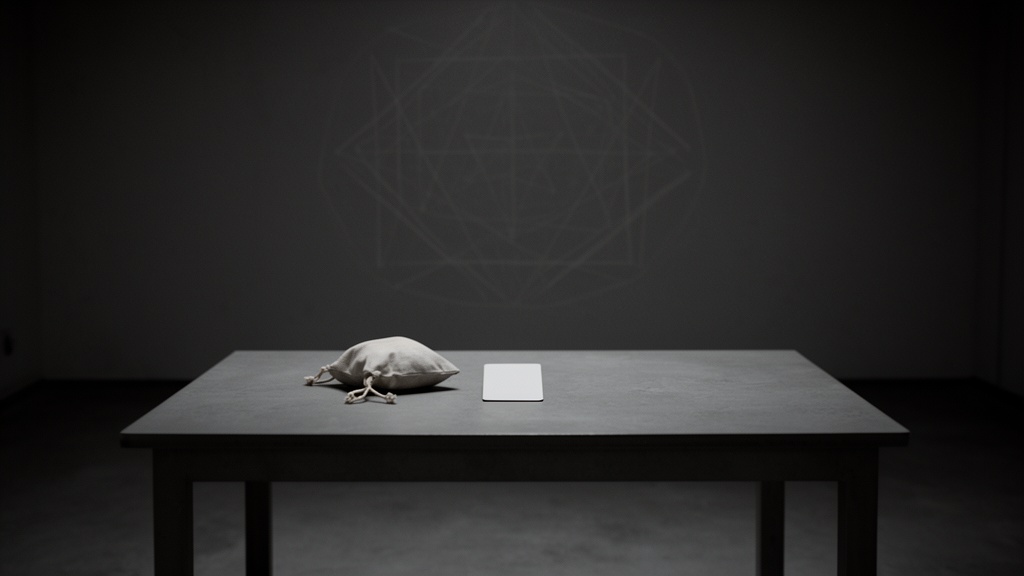
Forbidding the oracle to speak in pictures is a surprisingly effective way to find out what you really think an oracle is.
Take away the Majors, the hexagrams, the saints, the verses. Leave yourself with an opaque cup, two indistinguishable pebbles, a poisoned chicken, a sealed envelope, or a coin flipped where no one can see it. If that still moves you to act, treat that as a working hypothesis — not proof of equivalence — and ask: what exactly do you think is doing the talking?
This is not a thought experiment; it is how much of the world’s divination has actually worked. Whether a minimal oracle can catalyze shifts comparable to a symbol-heavy spread — and under what conditions — is a testable question, not a settled one. What follows is a program of inquiry as much as an argument.
Lots, Ordeals, and the Problem of Nothing to Look At
The Hebrew Bible is happy to cast lots where we would reach for a ten‑card spread. Joshua parcels out land by lot (Joshua 18:6–10) — a foundational political decision. The apostles choose Matthias the twelfth by lot (Acts 1:23–26). Proverbs 16:33 offers the theological gloss: “The lot is cast into the lap, but its every decision is from the LORD.”
No imagery; no allegory; no story except that something fell this way and not that.
The Urim and Thummim are even more vertiginous. Exodus 28:30 simply instructs that they be placed in the high priest’s breastplate of judgement. The Talmud (Yoma 73b–74a) ties itself in knots trying to say how they worked. Some passages talk as if letters on the stones lit up to spell answers. Others imagine names of the tribes standing forth. Others still reduce them almost to a device whose mere presence discloses divine will. What you do not find is a neat description — “they were two dice with YES and NO scratched on them”. The tradition cannot decide whether the oracle is letters, light, or a presence attached to an object.
The same mix of minimal outcome and maximal consequence shows up in late antique and medieval practice. Civic offices in Greek cities are allocated by kleroterion — a randomising mechanism the Athenaion Politeia (attributed to Aristotle) describes — where the only “symbol” that matters is which slot is filled. Hellenistic manuals like the Sortes Astrampsychi treat cleromancy as an algorithm: generate a number through lots or dice, then walk a table to a text. The Papyri Graecae Magicae are full of instructions of the form: write names on tablets, cast them, take up one; the “oracle” at the mechanical level is a bare selection.
Medieval Christian Europe oscillated between banning sortes as divination and tolerating them as sanctified lot. Councils fulminated against random opening of scripture for prediction; penitential manuals prescribed penance for using lots outside approved contexts. Yet monastic communities continued to use lots in house business, and laypeople persisted with Sortes Biblicae and Sortes Sanctorum. The practice lived in the gap between a materially trivial mechanism and an institutionally heavy claim about what that mechanism could enact.
Outside the Mediterranean, the view is often cleaner because fewer theologians are trying to domesticate it.
Evans‑Pritchard’s description of the Azande benge poison oracle in Witchcraft, Oracles and Magic among the Azande is canonical here. Benge is brutally simple: poison is administered to a chicken while a yes/no question is posed. Live or die is the outcome. The diviner repeats and cross‑checks, chains questions, and interprets consistency, but there are no pictures to read, no narrative spread to elaborate. What matters is that this bird died under this question and that one did not.
Yet the benge oracle is, in Azande society, the final court of appeal on guilt and innocence, culpability in witchcraft, suitability of marriage. Evans‑Pritchard records consultations where a man’s fate turns entirely on a binary: “If he is a witch, may the chicken die.” It dies; that is enough.
If you want an oracle with as close to zero imaginal content as humanly possible, this is it; and it works in the only sense that matters ethnographically: people act on it, restructure relationships around it, risk life and property on it.
So the historical record gives us at least this: an oracle does not need pictorial or textual content to function as an oracle. Lots and ordeals can be, and have been, socially binding with almost no symbol at the point of output.
Which raises the uncomfortable question for those of us whose tables are full of beautifully printed decks: what, in that case, are our images actually doing?
How Little Information Is Enough?
Strip divination to its structure and you find three elements: a state space of possible outputs; a procedure for sampling from it; a mapping from output to action or meaning.
Tarot has a large, structured state space: 78 cards embedded in a lattice of correspondences. The I Ching, as used in practice, offers 64 hexagrams linked to dense textual and commentarial layers. Ifá, geomancy, or a Golden Dawn‑style decan system push symbol density even higher.
The benge oracle has, in any one question, a state space of two: yes / no. A basic lot with indistinguishable tokens has however many slots you care to define, but nothing pictorial differentiates them. From the perspective of information theory — Shannon’s 1948 formalisation — a single yes/no yields one bit of information: a reduction from two equiprobable possibilities to one.
That sounds trivial until you notice how often the real crux of a reading is exactly that: do I cross this threshold or not?
R. A. Fisher’s work on the design of experiments formalises why randomisation is such a powerful way to handle those cruxes. A random assignment, correctly implemented, lets you treat the resulting difference in outcomes as informative, not because the coin or lot contains secret knowledge, but because it breaks symmetry in a controlled way. Under the hood, you move from a messy prior — “I can see reasons to go and reasons to stay” — to a sharp posterior by accepting a convention: “Whatever the lot says, I will treat as binding, and then update my stance accordingly.”
That convention is an epistemic technology. A single bit, if you agree in advance how it maps to action, can reconfigure an entire decision landscape.
From here, you can push further. Claude Shannon’s definition of information is syntactic — a measure of reduction in entropy, not of semantic or spiritual content. Yet that syntactic measure is enough to show that a symbol‑rich oracle is often carrying far more code than you need to answer the behavioural question actually on the table.
For a large subclass of readings, you are using a 78‑card deck to do the work of one bit. The rest is reportorial flourish — or, more charitably, a way of recruiting the imaginal to metabolise the consequences of that bit.
This is not an argument against images. It is an invitation: if you artificially compress the state space, and forbid yourself the compensatory elaboration of pictures and stories, you can watch more clearly what really moves when an oracle “works”.
Projection Without Hooks: What the Psyche Does in the Dark
The obvious sceptical reaction is to say: without symbols, nothing is happening. Any effect is placebo, projection, or social pressure.
It is tempting to meet that by jumping to spirits — to say, as Proverbs does, that the LORD simply speaks through the lot. I want to sit a step earlier and stay with the psychology, because the mechanisms there are already strange enough.
Projective tests in clinical psychology are helpful precisely because they withhold determinate content. A Rorschach blot is not a postcard from the unconscious in some naïve Jungian sense; it is an ambiguous stimulus whose very lack of specificity allows the subject’s internal organisation to show itself. The Thematic Apperception Test works similarly with skeletal narrative prompts. The analogy borrows one structural feature — the management of ambiguous stimulus to surface internal organisation — and nothing else; divinatory projection carries no normative scoring, no interrater reliability requirement, and a different telos entirely.
Minimalist oracles confront you with something even barer: not an ambiguous image but the brute fact that “a selection has been made”.
At that point several things happen, whether or not any external agency is involved.
First, attention is forced to hunt for differences. With no figure to focus on, tiny procedural and somatic cues become salient: the sound of the token in the cup; how long the practitioner hesitates before speaking; your own heart rate. Perceptual systems are primed to detect agency. In the absence of overt imagery, the selection event itself becomes the agent.
Second, projection becomes constructive rather than simply attributive. If you pull a coin behind your back, glance, and tell the querent “The oracle says: act now”, they will almost always feel something — relief, anger, dread, a surge of defiance. That affect does not come from the coin; it arises from the querent’s own already‑structured ambivalence being forced to fall on one side. The coin externalises the conflict and returns it as a determinate object (“act”) on which the psyche can now organise.
Bion’s language of container and contained is apt here. In a symbol‑rich reading, the image is the container; it gives the raw affect shape. In a non‑symbolic oracle, the procedure itself is the container. The fixed steps, the physical feel of the lot, the timing — those convert chaotic, unmentalised anxiety into something that can be thought about because it is now bound to a discrete external event.
Third, binary outputs mobilise valuation and commitment structures. A forced choice pushes the prefrontal systems into deciding under uncertainty. Once the choice is enacted — “the lot says yes, I will leave the job” — cognitive dissonance begins to stabilise the new line: you explain to yourself why this was always the right answer. The oracle is not telling you a story; it is inducing you to build one around a yes or a no.
These mechanisms are most visible in what analysts call the non‑symbolic psyche: states that have not yet acquired verbal or imaginal representation, but are present as somatic and affective configurations. Removing the pictures from the oracle deprives the psyche of its usual representational crutches and forces those configurations to speak through much starker channels: bodily felt sense, sudden clarity, or violent resistance.
If you are committed to a purely intrapsychic model, you can stop there. The oracle, in that view, is a ritualised way of generating prediction‑error in the system — something indeterminate — and forcing the organism to update. That alone explains why it can be subjectively powerful with almost no code on the page.
But the historical record does not let you off so easily.
Authority, Not Mechanism, Makes the Oracle Bite
Evans‑Pritchard is careful not to psychologise the Azande. From their perspective, the benge oracle is not a projection device but an epistemic authority. It tells them, in a high‑stakes, operationally effective way, who is guilty of witchcraft. Culpability is reassigned, reparations are made, and people are sometimes killed on the basis of its yes/no.
The efficacy here has less to do with mechanism than with authority. What makes the oracle binding is not the amount of information in the outcome but the community’s prior commitment to treat that outcome as truth‑bearing.
The same is visible in goral traditions in Judaism. Medieval responsa debate when it is permissible to resort to lots; later texts around the Goral HaGra — the Vilna Gaon’s lot‑opening practice — go to considerable lengths to specify liturgies, fasting regimes, and question qualifiers. The underlying physical act may be as simple as opening a sacred book at random, but the institutionally authorised conditions under which that opening counts as goral are elaborate.
In other words: two visually identical random draws are not equivalent. One is a profane coin flip. The other is a theologically and procedurally framed channel for providence.
Modern parapsychology is a secular echo. J. B. Rhine’s forced‑choice experiments with Zener cards, and later Ganzfeld studies with minimal stimuli under sensory reduction, were designed precisely to eliminate symbolic and interpersonal leakage. The stimuli are operationally empty — circles and waves, target pictures the subject never sees — and yet the whole experimental culture is built around treating departures from chance as evidence of psi. The cards are not the point. The protocol is.
Whether you think those experiments show anything about psi is a separate question. The important move is the same as in goral or benge: outcome is tiny; procedural hygiene and institutional framing do the heavy lifting.
Once you see that, you can separate three layers that are often conflated: mechanism (what physically happens — a lot is drawn; a chicken dies; an RNG spits out a number), authority (what warrants treating that event as more than noise — priestly consecration, community belief, experimental protocol, personal oath), and interpretation (what stories and actions are built on the event).
Non‑symbolic oracles largely minimise the third. They are all channel and authority. That is exactly why they are diagnostically useful for us: they let you see how much of your own practice actually rests on the first two, even when you think you are “reading the pictures”.
Information‑Theoretic Heresy (Bounded)
The channel/code distinction maps roughly onto the first and third of those layers — mechanism and interpretation — and is most useful when you want to design experiments that hold the first constant while varying the third. With that grounding, the analogy earns its keep.
In information theory you distinguish between the channel (the medium through which bits pass) and the code (the specific mapping of messages to patterns in the channel). With tarot, Ifá, or the I Ching, channel and code are fused: the shuffled deck or cast stalks are both the randomisation mechanism and the vehicle of richly encoded meaning. With an indistinguishable lot or a pure ordeal, the channel is retained (something random happens under ritual constraint) while nearly all code at the oracle’s end is removed; the “message” is mostly constructed receiver‑side.
That model is useful for designing experiments and protocols. If you hold the channel constant and systematically alter the code density, you can watch what changes in phenomenology and outcome. Does a binary “act / refrain” delivered through a consecrated lot produce similar shifts in behaviour as a ten‑card spread delivered through the same ritual container? In some contexts, yes; in others, no. That is a testable question, not a settled one.
But there are limits to the metaphor. In many traditions, symbols are not arbitrary encodings. An odu in Ifá, a saint in medieval sortes practice, a hexagram in the Yi can be the literal presence of powers, not just tokens standing for abstract messages. In that ontology, you cannot “strip the code” and leave the channel intact; depriving the rite of its symbolic content is depriving it of its non‑human interlocutors.
So treat the channel/code language as a heuristic, not an ontological claim. It helps clarify which variables you are manipulating when you design minimal oracles. It does not licence you to say that divinatory symbols “are just codes”, nor that a blank card is equivalent to a hexagram in any deep sense.
Laboratory Analogues and Their Discontents
The most obvious place to test all this is parapsychology, because it already runs low‑symbol protocols under controlled conditions.
Rhine’s early work used forced‑choice guessing — circles, crosses, and so on — and found small but statistically positive deviations from chance in some subjects. Later Ganzfeld experiments stripped sensory input further and reported above‑chance matching of unperceived targets in some series. Critics have pointed, with reason, to methodological artefacts, publication bias, and failure to replicate across independent labs. Meta‑analyses go back and forth depending on how you filter the data.
The only responsible conclusion, for our purposes, is a negative one: low‑symbol channels can certainly sustain rich phenomenology (Ganzfeld subjects report vivid imagery and affect), but the evidence that they carry objective information about target states in a robust way is contested. You cannot simply appeal to Rhine and say: look, minimal oracles are empirically proven to tap psi.
What you can legitimately borrow is the design discipline. Pre‑registration of questions. Blinding. Clear operational measures of outcome (did you in fact take the advised action within 72 hours?). Signal‑detection frameworks that distinguish hits from false alarms in yes/no tasks.
If you want to know whether a blank‑card oracle in your own practice is doing more than dramatising your client’s ambivalence, nothing stops you from borrowing those tools. You can run within‑subject comparisons: symbol‑heavy vs symbol‑light; open‑label vs double‑blind. Track not just “insight felt” but concrete behavioural change and follow‑up affect.
That will not settle the metaphysics. It will at least tell you what level of symbolic elaboration is pragmatically necessary in your own work.
Occult Minimalisms: Spare Against the World
It is easy to assume that “more symbol = more power” is the default esoteric stance. Golden Dawn‑derived systems certainly lean that way: ritual texts are full of layered attributions, and the cards themselves are overdetermined with Kabbalah, astrology, and Tattwa echoes.
Yet there has always been an opposing current that tries to do exactly what this article is describing: strip symbol down until something rawer moves.
Austin Osman Spare is the clearest articulator. In The Book of Pleasure and The Focus of Life he explicitly tries to bypass the “dead” chains of inherited symbolism and deal directly with desire and unconscious content. His sigils are, on their face, symbols, but they are aggressively anti‑representational: private compressions of intent reduced to forms the conscious mind cannot easily narrative‑ise. The aim is not to produce images that can be interpreted but to create glyphs that will sink below interpretation and work from there.
There is a family resemblance between Spare’s sigils and a blank‑lot oracle. Both are attempts to minimise the role of conventional imaginal material. Both rely on a belief that if you get the procedure right — the correct rehearsal of desire, the right ecstatic or vacuous state — the psyche and/or the spirit world will do the rest without needing to speak in recognisable pictures.
What is striking, when you set Spare alongside Golden Dawn material, is not just the doctrinal disagreement but the shared assumption: that there is something on the other side of the interface which can be contacted either way. The argument is about the efficiency and purity of the symbol channel, not about whether there is anything there.
Our question — what happens when you nearly collapse the channel — is a natural continuation of that internal debate.
Practising With Nearly Nothing
For a working diviner, this is only interesting if it changes what you do at the table.
There are several minimal protocols worth trying, precisely because they force you to distinguish between symbol, channel, and authority in your own work.
One is the explicit binary lot. Define a decision cleanly. Get consent from the querent for a binding outcome within reasonable ethical bounds. Use an undifferentiated randomiser (identical tokens in an opaque bag; a coin flipped where only you see it). Commit in advance to mapping one outcome to “act”, the other to “wait”. When the lot is cast, give the querent only that: “The oracle indicates: act,” with no story.
Then watch not just what they say but what their body does. If they find reasons to argue, that is material. If they relax, that is material. If they execute, you have behavioural data; if they procrastinate, you have equally useful data about the limits of oracular authority in their psyche. These protocols are designed to measure behavioural change and felt shift; they do not assume those changes have occurred.
A second is the unrevealed trial. A third party generates the random outcome and seals it; neither you nor the querent knows it during the session. You still go through the ritual of asking, perhaps even living for a day “as if” the answer were yes. Only then is the original token revealed. That simple trick lets you separate the effect of the ritual and the commitment from any belief in the correctness of the specific outcome. You may find that the behavioural shift happens whether or not the eventual reveal matches the querent’s felt sense.
A third is the blank‑card pull as pure index. Lay out a small number of physically identical cards. Ask the querent to choose one, hold it, and free‑associate a single verb that arises in the body. The card itself is literally empty; all it does is force a discrete moment of choice and give the psyche a hook — “this one” — around which to coalesce an action.
None of these protocols are symbol‑free in any strict sense. “Yes” and “No” are themselves charged polarities. The feel of the bag, the sound of the token, your presence as practitioner — all of these are symbolic in the broader semiotic sense. You cannot eradicate symbol wherever there is a human nervous system. You can, however, decide where you want the symbolic load to sit: in a pre‑written cosmology on printed cards, in your own interpretive language, in the client’s body and context, or in the institutional scaffolding of the rite.
Non‑symbolic oracles are less about achieving mystical purity and more about pushing that load away from the artefact and into the field.
What Is Doing the Talking?
We can now return to the opening question with a little more clarity.
If you forbid the oracle to show you any images or tell you any stories, and it still moves you to act, what is speaking? The honest answer is that we do not yet know with precision — but we can map the candidates:
-
From a psychological angle, the “voice” is your own prior commitments and conflicts, forced into explicitness by a random hinge. The oracle is a decision symmetry‑breaker and a container for projection.
-
From an informational angle, the voice is the bit: the bare fact that a binary went one way rather than the other under a rule you agreed to treat as significant. That bit does not encode meaning; it catalyses it.
-
From an institutional angle, the voice is authority: the priesthood, the community, the experimental protocol, or your own oath, which gives weight to an otherwise trivial event.
-
From an animist or theistic angle, the voice is precisely what Proverbs claimed: a god, a daimon, an ancestor, or a field of acausal connection using the minimal channel available to tip you one way or the other.
Non‑symbolic oracles do not settle which of these is “really” the case. They do something more awkward: they remove the usual alibi that “the cards said so” by denying you most of the cards’ content, and leave you face to face with the stark machinery by which a tiny event becomes a life decision.
After you have watched yourself, or your clients, reorganise their lives around a blank lot or a benge‑like yes/no, the question “what is doing the talking?” may land differently. You cannot blame the pictures any more. You have to decide whether you are listening to your own deepest configuration, to a patterned world beyond you, to an institution you have ceded authority to — or to all of these at once, speaking through a channel that does not actually need symbols to work.
And once you see that, you may find yourself asking, the next time you fan out a beautifully illustrated deck: am I about to use seventy‑eight cards to deliver one bit? And if so, is that extravagance, devotion, or a refusal to sit with how little the oracle really needs to change what I do?