
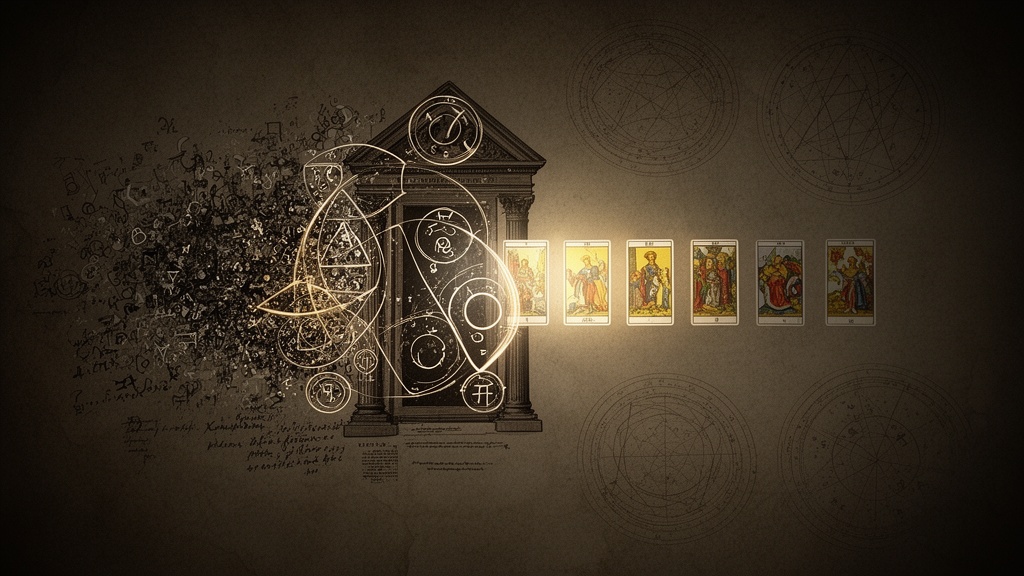
If every card you pull lands atop a mountain of things you already know but have not acted on, what exactly do you think the oracle is doing—adding one more fact, or deciding which fragments of your universe are allowed to become real?
That is the uncomfortable question divination must face under contemporary conditions. Not the romanticised conditions of “mystery and scarcity”, but the actual texture of practice now: twenty open browser tabs on trauma theory and astrological weather, six half-finished courses, a decade of journals, a phone full of screenshots of previous spreads, and a client who says, with perfect accuracy, “I already know all this—I just don’t know what to do.”
In that environment, “more information” is not neutral. It is a kind of violence.
From omens to feeds: where scarcity actually sits
The easy story is: once upon a time omens were rare and precious; now we drown in signs. The history is messier.
Ancient and mediaeval worlds were not low-signal. They were thick with symbols—liturgical cycles, local spirits, dream-interpretation, folk divination, state oracles, planetary hours. What was scarce was not meaning per se, but formal, binding oracular events. You did not consult the Delphic oracle ten times a week. You did not requisition a full astrological election for every minor decision. Even in cultures with everyday sortilege, there were practical limits: time, cost, ritual preparation, social scrutiny.
In other words: there has always been a sea of potential omens. Formal divination has always functioned as a bottleneck—a way of selecting a tiny number of signs that “count” in a way nothing else does, that can legitimately decide wars, marriages, treaties, journeys.
What has changed is not that we suddenly have symbols. What has changed is that the bottleneck has been relocated.
The contemporary practitioner sits in front of an effectively infinite scroll of material: social feeds, podcasts, PDFs, chat logs, magical journals, therapy notes, ancestral stories, divination apps. Most of it is personally accessible, personally archived, and personally re-openable at any time. There is no priestly college deciding which omen is “for the city” this year. There is you, your client, and an archive that never stops talking.
Under those conditions, the oracle’s old filtering function does not disappear. It becomes primary—and it becomes something we have to design for consciously, rather than receiving it for free from institutional scarcity.
Oracles as artificial scarcity in a saturated field
Look at the structure of classical sortilege:
- You throw a finite number of geomantic figures.
- You cast three coins six times and stop at one hexagram.
- You pull a limited number of cards into fixed positions.
- You open the book once and read the first verse your finger lands on.
These are not quaint quirks. They are deliberate constraints. They say: out of the practically infinite space of potential messages, this handful of marks is what we are going to treat as binding for this question, in this moment. Everything else is background noise.
Now put that next to the architectures you already live inside: social-media feeds, recommendation engines, notification systems. They, too, sit in front of an infinite archive. They, too, apply a ranking function to decide which tiny subset of items you will see, and in what order. They are also artificial scarcity-machines.
The parallel is structural, not moral. Algorithms optimise for attention and profit. Oracles, if they are doing their job, are oriented towards timing, meaning, and obligation. But in both cases, a formal mechanism cuts down an unmanageable field of possible signals to a handful of foreground items that will in fact govern what you do next.
A spread layout, with its positional grammar, is such a mechanism. Question discipline is a ranking function. Session protocols—how often you allow re-asking, how many cards you will pull, what kinds of queries you will refuse—are your equivalent of “mute”, “block”, “unfollow”.
Once you see that, a reading stops being “a way to get more information” and becomes “a ritual imposition of scarcity”. The question is no longer “What else can we find?” but “What tiny number of fragments are we willing to let matter, and what will we agree to ignore?”
Filtering is not a metaphor
At this point the word “filtering” risks dissolving into “intuition picks what matters”. That is not what is at stake.
Filtering, in the sense that is actually useful here, is operational. It is what your structure will and will not allow into play, regardless of anyone’s mood.
There are at least three distinct layers:
- Psychological triage – what the client can actually metabolise without decompensating.
- Magical / temporal constraint – what the wider field will support or engage with now; what is live in this window.
- Preference sorting – what the client (or you) would rather talk about.
If you do not distinguish these, “filtering” collapses into “whatever everyone feels like”, and you are back in the swamp of vague “guidance”.
A concrete example: a client arrives with a history of childhood abuse, actively in therapy; a messy break-up six months ago; three half-started magical projects; and a sense of spiritual “calling” they have been avoiding.
They want a sprawling “life audit” spread. You could oblige, pull twenty-one cards, and drown both of you. Or you can build a filter.
You might design something like:
- Card 1 – “The one thread that must be foregrounded and acted on in the next 90 days.”
- Card 2 – “The thread that must be consciously deferred: not for this 90‑day window.”
- Card 3 – “The unresolved story that may remain unresolved for now, without more excavation.”
- Card 4 – “The area that is not to be divined on again for 30 days.”
Notice what this does:
- It forces a singular priority. There is only one Card 1.
- It introduces an explicit deferral (Card 2) and a non-resolution clause (Card 3).
- It sets a temporal boundary on re‑divination (Card 4).
When the cards land, your job is not to spin more story. Your job is to treat those positions as binding constraints.
If Card 1 shows, say, the Eight of Pentacles around their actual paid work, and Card 2 shows Cups around the break-up, then under this protocol you say, in plain language: “For the next 90 days, the only thing you are allowed to treat as central spiritual work is stabilising and deepening your craft/income. The relationship processing is not your main project, even though it screams louder. We will not use the oracle to pick at it.”
Now the three filters:
- Psychologically, you are containing their tendency to ruminate on heartbreak instead of building a life.
- Magically, you are reading the field as saying: this is a season of Pentacles, not Cups.
- In terms of preference, you are refusing to collude with their desire to keep asking about the ex.
That refusal is the filter. It is not vague intuition. It is a structural “no” encoded in spread design and enforced in session.
If, instead, you keep pulling extra cards “just to clarify” because the client is anxious, you have abdicated the filtering function and reverted to content-maximisation. The reading may feel rich. It will also be useless.
Constraint satisfaction: from possibility explosion to one lived branch
Under overload, the core problem is not ignorance. It is that there are too many partially-owned truths and half-plausible stories.
Your client already knows, in some sense, that their job is draining, their relationship is ambivalent, their mother is intrusive, their Saturn transit is rough, their nervous system is fried. They have six different frameworks to explain each of those. They can narrate themselves into any outcome.
What they cannot do is live all those branches at once.
In computer science terms, this is a constraint satisfaction problem. You have a large space of possible configurations and a set of constraints. You are looking for one configuration that satisfies enough constraints to be viable.
A spread is a crude but effective constraint schema. Position labels are types of constraint: “Non‑negotiable”, “What must be faced”, “What can be dropped”, “Not yet ripe”, “Off‑limits for divination”. Drawn cards are instantiations of those constraints. The reading, if you treat it as more than entertainment, is a search for a small, liveable subset of commitments that can be enacted now, with everything else pruned or postponed.
Under this frame, the question “Was it accurate?” is less interesting than “Did it converge?” Did the spread narrow the client’s field to one or two enactable paths, or did it proliferate maybes?
A “good” reading, under saturation, is one that reduces the number of live branches. It says, explicitly or implicitly: “These three are now dead branches. This one is the branch you will actually live, at least until the next checkpoint.”
This is where the version-control analogy becomes surprisingly helpful.
Version control for a multi-branch psyche
Most serious practitioners now have some kind of archive: notebooks, digital grimoires, tagged notes, old spreads photographed and stored. Over time this produces not just a record, but a thicket of parallel storylines: the version of you who really was going to move to Lisbon; the version who was going to start the healing business three years ago; the version who forgave their father; the version who cut contact.
Each major reading, each ritual, each therapeutic breakthrough is a kind of commit: a snapshot of “the situation” and your intended direction at that point. Very few of those commits actually make it into “production reality”. Most remain as abandoned branches.
If you treat oracles merely as logging tools—more snapshots, more notes—you will eventually drown in your own repository.
The more interesting move is to treat some readings as release decisions. Not “here is one more perspective”, but “this is the branch that becomes canonical for the next X days; the others are archived as history.”
You can build that into the ritual: spread positions that explicitly compare branches (“If I continue as I am”, “If I drop project A”, “If I focus on relationship work instead”, “Canonical branch for the next 6 months”); a closing act that tags the reading (“This is v1.3 of my life story; this is the version I agree to treat as real until the next major release”); a conscious acknowledgement that older readings are now historical documents, not current scripts.
This is not just semantics. It is a way of resisting the very common defence of “I’ll keep all options open in my head and see what unfolds.” Under overload, that is a recipe for paralysis and self‑betrayal. At some point, one branch has to ship.
The oracle’s authority here is not in predicting which branch was “meant” all along. Its authority is in consecrating the commit: saying, “this is the one you will treat as law for this cycle,” and thereby making it possible for the others to die without endless haunting.
Version control gives the architecture. What it cannot supply is the psychological and spiritual mechanism that makes it possible to actually close a branch—to genuinely let go, rather than archive it as a live option dressed as history.
Divination as ritualised forgetting (with teeth)
The version-control frame helps us name what is happening structurally; the next step is to recognise what is happening psychologically and spiritually. Renunciation is not a fashionable word in contemporary spiritual discourse. Manifestation sells; letting go does not.
Yet every serious path has some form of it: monastic vows, rules of life, fasting, taking certain desires permanently off the table so that a coherent existence can emerge. The point is not moral purity; it is tractability.
Your psychic field under overload is not just cluttered with future options. It is overrun with past fragments: old wounds, half-integrated insights, previous workings, unresolved conversations, diagnostic labels, ancestral narratives. Many of them are important. None of them can be processed simultaneously.
Therapeutic work already knows this. Good trauma therapy is not “process everything at once”; it is carefully paced, selective re‑exposure, and explicit bracketing: “We are not touching that memory this month.”
Divination can operate as a parallel technology of ritualised forgetting—not erasure, but time‑bound, sacralised non‑engagement.
This is where the shadow risk is largest, so it is worth drawing hard lines.
- Using cards to declare an ongoing abuse history “done” against all somatic evidence is bypass and malpractice.
- Using cards to name one particular magical project as “over” so you can stop flogging it, even though the sunk costs hurt, may be exactly the renunciation needed.
- Using cards to say “no more readings on whether he’ll come back for 30 days” is often healthier than enabling daily reassurance pulls.
The ethical hinge is pacing and domain. Oracles are not clinical tools. They should not override therapy. What they can do, responsibly, is name which wounds are not for this season because the container is not there yet; identify which obsessions are compulsive archive-trawling rather than fruitful processing; grant permission not to revisit every open loop in every session.
Spread positions that help: “What I will not consult the oracle about again this month”; “Which magical project must be formally abandoned”; “Which unresolved story I am allowed to leave unresolved for now.”
The closing of such a reading is not a vague “let go and let the universe”. It is closer to a vow: “For the next 30 days, I will not seek divination on X, and I will treat Y as closed, even if I feel the itch to re-open it.”
You will, of course, have clients who break that vow. You will also have clients who feel a profound relief that someone finally gave them legitimate permission to stop using every spare moment to self‑analyse.
Authority, projection, and who gets to decide what matters
Once you frame the oracle as a filter and a vow-enforcer rather than an information pump, you run straight into questions of authority.
Who, exactly, is allowed to say “this is binding” or “that is off‑limits”?
In the room, this gets loaded with projection: the client may unconsciously want you to be the strict parent who finally says “enough, we are not talking about him again”; you may unconsciously enjoy being that figure, or fear it, and design your spreads to avoid having to say no; both of you may collude in endless “clarification cards” because the anxiety of commitment is too high.
Under overload, the temptation to avoid the Judge archetype is strong. It is easier to be the endlessly insightful Sibyl, producing layer after layer of nuance, than to be the one who says, “Three cards. That’s it. We are done.”
But if you refuse that archetype entirely, you leave the client alone with a surplus of half‑owned insights and no ritual mechanism for deciding which ones are allowed to shape their life.
There is no clean workaround. Someone has to hold the line.
One honest way through is to make the negotiation explicit: clarify at the start of a session, “Our aim today is not to surface everything, but to select a small number of threads to treat as real for the next X days. I will stop us from re‑opening everything else.” When the cards land against the client’s stated preference, name the tension: “You say you want to process the break‑up; this spread is insisting on your work. We can either obey the spread, or acknowledge that we are using it as a prop for what you already want.” If you do choose preference over spread, do it consciously: “We are going to override this position, and that has consequences. Let’s be clear about them.”
That level of transparency does not de‑sacralise the oracle. If anything, it honours the fact that oracular authority is not a blunt instrument. It is a live negotiation between psyche, symbol, and whatever you take to be on the other side.
Redefining a “good” reading under overload
If you accept that we are no longer in a world where the primary problem is lack of information, then the usual ways practitioners evaluate readings start to look thin.
Accuracy? Useful, but secondary. In a field of overabundant knowledge, an accurate restatement of what is already known is trivial.
Depth of insight? Also secondary. The client probably has more “insight” than they can use.
The more pertinent questions become:
- Did the reading enforce scarcity? Are there fewer live options on the table at the end than at the beginning?
- Did it produce a coherent, enactable configuration? Can the client state, in one or two sentences, what they are going to treat as central for the next period?
- Did it legitimise letting most things not matter—for now? Is there explicit permission, backed by ritual authority, to not act on or obsess over the majority of their archive?
- Did it generate real commitments, including commitments to non‑action? Are there clear “I will” and “I will not” statements that feel binding, not just aspirational?
By that standard, a brutally simple three‑card reading that says “Work, not love; no more Tarot about him for a month” may be far better than a twenty‑one‑card Celtic Cross that touches on every area of life and leaves nothing decisively pruned.
This is not a call to minimalism for its own sake. It is a recognition that, under saturation, the oracle’s highest function is not revelation but editing.
A reading that does not cut anything away is not neutral. It is colluding with the overload.
Practising in a world where almost everything is already known
Most technical literature on Tarot, runes, I Ching still writes as if we inhabit a low‑information, high‑mystery environment. The implicit model is: the client comes in ignorant; the oracle reveals; the practitioner interprets.
You know that is not what actually happens now. Clients arrive with language from therapy, astrology, attachment theory, trauma discourse, witch‑Tok, systems theory. They have read more than Agrippa and Lévi. They can describe their patterns with exquisite nuance. They are not short of maps. They are short of permission to let most maps be wrong for them, at least for now.
If you take that seriously, your craft shifts from revelation to curation, from insight-generation to disciplined exclusion. You become less interested in what the cards say and more interested in what they allow you to stop saying. The spread is no longer a window into hidden truth; it is a ritual gate that decides which fragments of an already-known truth are allowed to cross into binding reality, and which must wait outside.
That is the oracle’s real power under overload: not to tell you more, but to let you finally commit to less.