
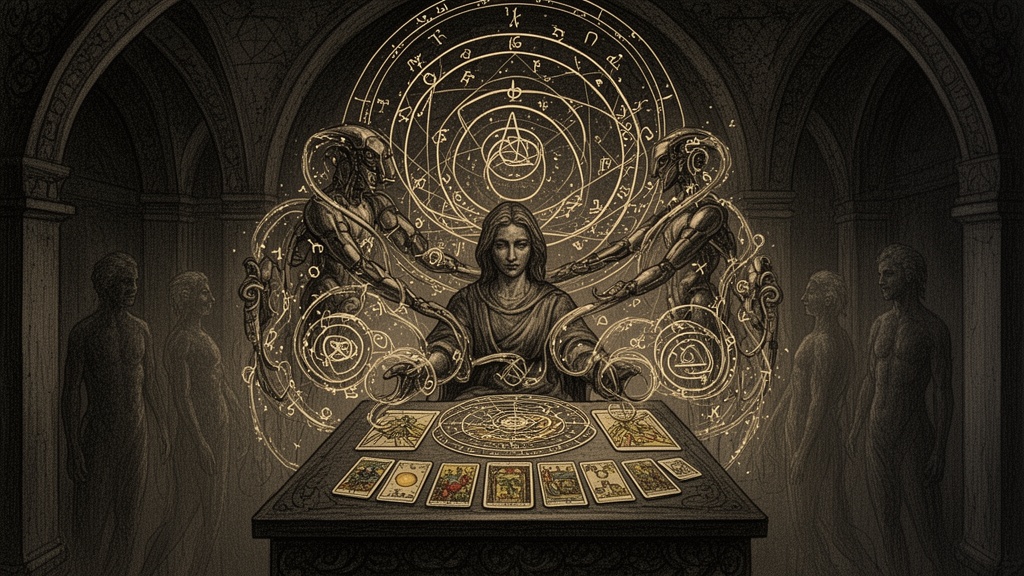
If the deck keeps “missing” in ways that leave your worldview intact and your client carrying the fallout, you’re not having a run of bad luck. You’re finding out who the oracle actually works for.
Not who it speaks for in a theological sense. Who, in practice, its errors protect.
Most of us were trained to treat a failed or harmful reading as a matter of technique: bad question, muddy field, tired operator, querent in denial. Useful categories — but incomplete. There is a whole class of misses that are neither random noise nor simple incompetence. They are structured. They have a profile. They are biased toward keeping one thing stable: the operator–oracle system itself.
In client-centred work, a reading that protects you at the querent’s expense is a breach.
Call it homeostasis if you like the cybernetics. Call it the egregore (in the 19th–20th century occult sense: Lévi, Papus, order‑soul, not medieval angelology) defending its priest. Call it your magical self‑image doing whatever it must to survive. Functionally, the move is the same: accuracy and relevance migrate away from the querent’s explicit situation and towards stabilising you.
The advanced problem is not that this happens. It’s that you can get very good at divination and never learn to see it.
Who the oracle is “for” was never neutral
Client-centred oracular ethics is the anomaly, not the baseline. Delphi did not exist primarily for Croesus’ self-actualisation; the Pythia spoke for Apollo, and the institution served the polis. If the king misread and lost his empire, the temple remained intact.
Plutarch, in On the Pythian Oracles, is explicit that the god uses the prophetess’ nature and condition as instrument. Her temperament, health, and imagination colour the message. When an oracle appears to miss, he does not imagine Apollo thwarted; he points to the mixture of human and divine, the variability of the vehicle. The oracle serves the god and the sanctuary; the fallible component is the human medium and those who consult it.
Likewise in De Mysteriis, Iamblichus insists the divine influx is pure; distortion enters through the soul of the medium. The solution is to render the operator passive, imaginally empty, so that personal forms don’t intrude. The entire theurgic hygiene regime is built around preventing the operator’s structure from bending the message back toward itself.
Medieval grimoires are less philosophical but no less pointed. The Picatrix and the Munich Manual warn that spirits will deceive the magician in precise accordance with their ignorance and ego. Agrippa, in Three Books, treats the imaginative faculty as both the channel through which spirits and celestial influences descend and the generator of phantasms that impersonate that influx. If the imagination is unpurified, he says bluntly, it projects its own forms and mistakes them for revelation.
None of these authors are talking about “client-centred readings.” They are mapping the same terrain from different sides: oracles operate through human vehicles; those vehicles have their own drives; the system will default to reinforcing those unless you actively interfere.
In early modern horary, the cosmos itself is said to signal “don’t.” Bonatti’s and Lilly’s “considerations before judgement” — void-of-course Moon, late degrees rising, Saturn in the 7th — are not post-hoc excuses but technical flags that “the astrologer is likely to err or be deceived.” The chart does not merely answer the question; it comments on the condition of the operator and the act of consultation. In effect, the system is protecting itself from being used under the wrong conditions, and part of what it’s protecting is you.
By the time you reach Golden Dawn tarot, the bias is explicit. Waite speaks of the cards as a book of moral and spiritual reflection and tells you quite calmly that they speak to the soul of the reader. Crowley frames Thoth as a book of the magician and uses it as a gymnasium for his own magical memory and Qabalistic architecture. Within certain temple instructions — often attributed to figures like Florence Farr or Mathers rather than laid down as a single dogma — tarot divination is framed as an exercise within the operator’s sphere of sensation. The client, if present at all, is introduced as a variable into the magician’s field.
So when a reading goes bad in a way that cushions you and costs the querent, that is not a glitch against a pristine client-first tradition. It is your modern ethics colliding with structures built for gods, kings, and initiates.
Three layers: bias, system, spirit
Before we talk homeostasis, we need a clean separation of levels.
-
Plain psychological bias. Confirmation bias, motivated reasoning, transference and countertransference, shame-avoidance, trauma defences. No spirits, no egregores, no cybernetics required. You don’t want something to be true, so you don’t see it. Or you see it and you sand the edges off.
-
Emergent system behaviour. Once you add procedural habits, training, institutional norms, and repeated interactions, you get feedback loops. Certain moves are rewarded (clients come back, peers approve, your nervous system calms); others are punished. Over time, your practice acquires attractors. The oracle tends to do X in situation Y because everything in the triad — operator, tool, context — has been trained to converge there.
-
Explicit spirit or egregore agency. The “spirit of the deck,” the presiding intelligence of a temple, a tutelary daimon, the order’s group soul. This layer talks as if there is a someone on the other end who has preferences and will sometimes steer, censor, or withhold in their own interest and yours.
You can model “the oracle protects the operator” at any of these three layers. They are not mutually exclusive. The danger is collapsing (1) into (3) and deciding that your defences are the will of the gods.
The sceptical floor: Cicero and the self-protecting ego
Cicero’s De Divinatione is still the cleanest classical attack on our tendency to insulate oracles from their own failures. In Book 2 he walks through case after case of misses quietly ignored, hits loudly remembered, statements so vague they must land somewhere, and operators reinterpreting outcomes so that they were “right at a higher level” even when flatly wrong.
The reader has a strong investment in being insightful, ethical, and “guided.” When a reading misfires in ways that would threaten that self-image — perhaps it downplays an abusive situation, offers false reassurance before a disastrous choice, sacralises a dynamic that is simply exploitative — the reader almost never says, “I harmed my client.” They say, “the client wasn’t ready,” “the deck showed them the lesson they needed,” or “Spirit didn’t want to reveal more.”
At level (1), that’s enough. The oracle protects the operator because the operator repurposes it as a shield against shame. The cards don’t need to do anything. Your interpretive habits do it all.
But if you pay attention over decades, you start to notice that the misses aren’t random. They cluster around particular topics, clients, or configurations. They recur even when you explicitly intend not to soften, even when you know the psychology and are trying to catch yourself. That is the point where talk of systems and homeostasis starts to earn its keep: when you’ve corrected for the obvious individual defences and something in the circuit still resists being used against certain structures.
Homeostasis in the oracular circuit
Strip the cybernetics down to the bones. A homeostatic system is one that tracks certain variables, prefers them within specific bounds, and reacts to deviations with compensatory moves that push things back toward the preferred range. Thermoregulation is the stock example: get too cold, you shiver; too hot, you sweat. The goal is not perfection; it is survivable stability.
I am not claiming that your reading table instantiates literal control loops you could write as differential equations, nor that there is a measurable “set-point” you can instrument. The point of importing this vocabulary is more modest: it gives us a disciplined way to talk about stability, feedback, and defended invariants in patterns practitioners already report. The “variables” here are inferred from behaviour, not read off a dial. This is a modelling stance, not an ontological claim about what divination “really is.”
Apply the structure to a live reading. What, in practice, are the invariants the system tends to defend?
Your identity as a non-harmful, non-directive, non-fatalistic reader. Your status as competent, spiritually advanced, magically effective. Your current worldview — that karma always balances, that suffering has meaning, that true love is worth any cost, that magic always works if done right. The emotional temperature in the room: not too much rage, not too much despair, nothing that smells like liability-triggering panic.
When the client’s question or situation threatens any of these, you feel it as arousal. Bodily discomfort. The urge to change spread, re-frame the question, crack a joke, or say “let’s focus on what you can learn” instead of answering what they actually asked.
You can stop the analysis there at level (1): defence mechanisms, affect regulation. But watch what happens to the oracle in those moments.
The question starts to drift — from “Is my partner likely to escalate to physical violence?” to “What is the deeper lesson in this relationship?” The shuffle behaviour changes — longer or shorter; you stop when you “feel better,” i.e. when arousal dips. Your choice of spread suddenly favours ones that foreground “spiritual path” and soften concrete outcomes. In the layout, you linger on certain cards and skate past others. You reinterpret a blunt 7 of Swords as “self-betrayal” rather than “they are lying to you” because one implicates the client and the other implicates your willingness to say, out loud, that someone is a predator.
From the outside, the oracle now behaves as if it has been wired to regulate your psychic climate. It reliably reallocates the sharpest, most destabilising accuracy away from the querent’s real risk and back toward your existing stories.
Call this “degraded mode.” In safety engineering, critical systems are designed to fail safe: if pressure spikes, the reactor scrams, the circuit breaker trips. From the user’s perspective that’s a failure — the lights go out — but from the system’s perspective it’s a success. The system survived.
In divination, degraded mode is not designed; it’s emergent. Your psyche, your training, your tools, and whatever you’re plugged into spiritually conspire to keep the session within bounds you can survive. The client may not fare as well.
From the system’s point of view, a reading that gently spiritualises a situation of severe abuse is a success. It protected you. From an ethical diviner’s point of view, it is a failure, no matter how pretty the narrative.
“Mutual information hijack”: when the deck reads you instead
This next move is the most speculative synthesis in this piece. Treat it as a phenomenological model to test against your own practice, not as a settled account of “what is really happening.”
Information theory talks about mutual information: how much structure in one stream can be used to predict structure in another. You don’t need the equations. Just hold the intuition that a spread can, in practice, carry more detailed pattern about one party than another.
In a clean client-centred reading, most of the informative structure in the pattern of cards tracks the querent’s situation and question. Of course the cards also reflect you; Crowley is quite happy to say they mirror the magician’s preoccupations, and Golden Dawn exercises explicitly use divination to probe the operator’s own sphere of sensation. That is not the problem.
The problem case only emerges once you’ve acknowledged simpler explanations. You can always say: “I’m reading egocentrically.” Or: “I am carrying far more emotional charge into this than the querent, so my material is flooding the field.” Or: “As the professional interpreter, I’m doing most of the meaning-making, so of course my patterns are over-represented.” Those are level-(1) and level-(2) accounts and they should be exhausted first.
What remains, in some sessions, is stranger. The layout misses the querent in all but the vaguest ways, but if you slyly pretend the spread is about you, it is laser-accurate about your current Work, your fear, your marriage, your initiation crisis. You were not consciously thinking about that issue five minutes ago. You are not gratuitously shoe-horning it in. The symbolic configuration fits your situation with a tightness it lacks for the client.
The channel has silently re-tuned to your stream. The session has become an unasked-for reading on you, using their life as raw material.
Traditional Ifá actually reserves a place for this. Orunmila “knows” the diviner; odu are drawn that speak directly to the babalawo’s habits, failings, or unfinished obligations, even in client sessions. Sometimes the session is explicitly turned into a mirror on the diviner’s stance. The Yoruba tradition, as documented in ethnographic sources like Bascom’s Ifa Divination, shows the oracle working on the operator first — though the formal institutionalisation of this as a rule is less clear than the phenomenon itself.
Western ceremonial work never formalised it in quite those terms, but it lives in the lore: the deck “trolling” you with your own unresolved mess, the geomantic shield chart that is inexplicably about your health, the horary that starts answering “should you be answering this?” If you are going to borrow the mutual-information metaphor at all, keep it on this level: as a way of naming the empirically familiar situation where the spread is more specific to you than to the paying client.
And then keep the boundary: this should never be an excuse to turn a client’s session into your self-analysis without their consent. If the oracle has just read you, you still owe them clarity about that disturbance of the frame.
Astrological strictures and divinatory “no”
Consider horary again. Saturn in the 7th warning the astrologer of error; an early or late ascendant suggesting that the question is not ripe; Moon void-of-course implying, in some lineages, that “nothing will come of the matter” or that judgment should be withheld.
From a naïve sceptic’s view, these are face-saving devices: get-out clauses that insulate the technique and the practitioner from falsification. Inside the tradition, they function as something more subtle: the chart itself commenting on the reading act.
Bonatti will tell you that certain configurations mean “the astrologer will err.” Not “the client won’t like it.” Not “God refuses to answer.” The technician is compromised; proceed at your peril. Lilly is haunted by “playing with mens lives” and uses these considerations as ethical brakes as much as technical ones.
Translate that into cybernetic terms and you get a very simple rule: when certain thresholds are crossed, the system throws a flag that says “degraded mode.” You can muscle through and answer anyway, but you do so against the warning lights.
Tarot lacks a codified equivalent, but we all know the signatures: every card bland, the spread narratively too neat, the déjà vu of “this exact story again,” the querent’s question sliding inexorably into the one you are comfortable answering. If you never treat those moments as structural warnings, you will explain them away as “Spirit knows better” — and you will never see how often they correlate with your own thresholds of discomfort.
Not every miss is homeostasis
By now the sceptic is entirely justified in asking whether we have actually added anything. Why not just say “bias” and be done?
Sometimes that is all that is happening. If you can fully explain a failure in terms of your fear, your ideology, your incentives, or your trauma history, you do not need “egregore homeostasis” on top. The responsibility remains squarely with you.
The systemic language only earns its keep under certain conditions.
First, the pattern is specific and repeatable. You don’t just soften harsh messages generally; you specifically misread abuse dynamics, or money cons, or pregnancy questions, even when you think you’re being blunt. You’ve had feedback. You’ve done Work around that theme. The skew persists.
Second, the behaviour involves the whole circuit. You change decks, spreads, question forms, states of consciousness. You consult colleagues. Across variations, the oracle continues to slide away from certain destabilising content. That starts to look like an emergent property of the operator–oracle–context loop, not just one person’s psyche.
Third, there is an element of refusal or redirection that is disproportionately keyed to your state. Cards literally falling out when you phrase the question in one way but not another; particular decks going “dead” with certain clients but not others; a series of I Ching consultations that keep returning to hexagrams about the sincerity or correctness of the diviner rather than on the situation ostensibly being asked about.
The Great Treatise (Dazhuan) of the Yijing does talk about cheng — the sincerity and alignment of the diviner — as a condition for resonance, and later commentators like Wang Bi sharpen the point that the oracle mirrors the interpreter’s mind. The familiar experience that the text “speaks past” the surface question until the caster’s stance is rectified is, strictly speaking, a gloss built out of that commentarial line, not a verbatim doctrine. Whether or not that is what the Dazhuan intends, it is what practitioners consistently report — and the claim here is phenomenological, not doctrinal. Either way, it is not an invitation to abdicate responsibility. It is the opposite: an insistence that your state is a limiting factor, not a neutral channel.
When protection is legitimate
The most dangerous move in this whole conversation would be to aestheticise operator-protective failures as “the oracle knows best.” In client-centred work, a reading that protects you at the querent’s expense is a breach.
There are, however, forms of protection that are not breaches.
You refuse certain classes of questions outright — medical diagnosis, legal outcomes, third-party spying — not because the oracle “won’t answer” but because you have chosen not to put yourself or your client in those positions. That is not degraded mode; it is you setting the parameters in plain language.
You notice, mid-session, that your system is slipping into safety mode — flattened cards, compulsive spiritualisation, odd evasions — and you name your limit: “I’m not getting clear signal on this; I think we’ve hit the edge of what I can read well today.” You stop, or you narrow the scope, or you refer.
You are in a context where your safety actually does come first: hostile or boundary-violating querents, magical warfare, situations where you are being pressured into saying what someone wants to hear. In those sessions, allowing the oracle to “protect” you — by going opaque, evasive, or insistently shifting the focus back to you — is not necessarily pathological. It may be the only reason you are still standing.
The line is not metaphysical. It is ethical and declared vs. covert. The problem is not that systems defend invariants. The problem is when the invariant being defended is your ego or brand, and the defence is silently offloaded onto “the cards.”
Practices for breaking the loop
This matters only if it changes how you sit at the table. A few practical moves follow naturally from treating operator-protective misses as systemic, not just as personal failings.
-
State the optimisation out loud — before you shuffle.
Not “for the highest good,” which is content-free, but something with teeth:
“This session is for maximal clarity and usefulness to N, even at the cost of my comfort, my worldview, or my image of competence. If I can’t serve that, let the system stall hard enough that I notice.”
You’re not binding the gods. You’re putting a constraint on your own bias. -
Build in a role-reversal test.
When a spread feels oddly washed-out for the querent but subjectively charged, take ten seconds in your head: “If this were about me, in my current situation, does it snap into focus?”
If the answer is yes, you are in a mutual-information hijack. The ethical responses are limited:
– Briefly acknowledge (“this layout is also hitting my own stuff; I need to tread carefully”),
– Re-focus with a much more concrete, narrow question, or
– Stop and reschedule/hand off. -
Learn your vulnerable themes and pre-declare them.
If you know that particular topics — abuse, cults, pregnancies, money — pull your system into degraded mode, do not discover that in real time at someone else’s expense.
Decide in advance:
– “On these, I use shorter, more concrete spreads, less room for narrative drift,” or
– “On these, I refer unless I’ve done recent Work and have supervision.” -
Use structural perturbations as tests.
In engineering, you poke systems to see where they break. In divination that looks like:
– Switching decks or oracular systems mid-topic (tarot to Lenormand, Yijing, or geomancy) when things go suspiciously smooth.
– Reformulating the question in a way that directly confronts the avoided content: “What am I refusing to see about X?”
– Introducing another operator: co-reading, or getting a blind second opinion later.
If the same evasive pattern reproduces across decks, framings, and readers precisely around the points that threaten you, you’ve got a strong candidate for emergent homeostasis rather than a one-off bias.
-
Treat “failed” client readings as material for your Work — after, not during.
When a reading clearly harmed or misled a client and, in retrospect, preserved you, don’t rush to exonerate yourself by invoking trickster spirits or the inscrutability of fate.
Write the spread down. Map exactly where your interpretation bent. Ask:
– What invariant of mine was being defended?
– Where did the cards start reading me instead?
Then take that to your journal, your teacher, your therapist, your lodge — not back to the next querent as some kind of meta-story about “how Spirit sometimes works.” -
Normalise explicit “no” as a service, not a failure.
If you train yourself to recognise degraded mode and then override it just to avoid awkwardly stopping, you have learned nothing. There is nothing mystical about saying, “For whatever reason, I’m not able to read this clearly today.” Within traditional frames, you can even invoke the systemic language honestly: “The signs are that the oracle is not answering this in a way I trust. Blaming you or the cards would be self-serving; the ethical move is to stop.”
Who, or what, is actually being protected?
Behind all the models — astral light, egregores, cybernetic feedback loops — there’s a brutally simple diagnostic question that is easier to ask than to live with:
In this pattern of misses, who benefits?
If the answer is always “my role,” “my myth,” “my avoidance of certain conflicts,” you do not need to decide whether it’s an egregore, the unconscious, or “the gods” pulling the strings. You only need to decide whether you are prepared to let that continue.
There is a point in a practitioner’s development where the deck stops being primarily a way to look outwards and becomes a highly sensitive instrument for reading the structure of your own Work. That shift is initiatory gold — if you notice it, and reserve it for your own Work.
If you don’t, you’ll keep running client after client through what is effectively a self-calibration loop for your psychic system, telling yourself you are helping them while the oracle quietly, faithfully, protects the only configuration it has really learned to trust: you, as you already are.
At that point the question is no longer “does divination work?” It is whether you are willing to have it work on the one person in the room who did not come asking for a reading.