
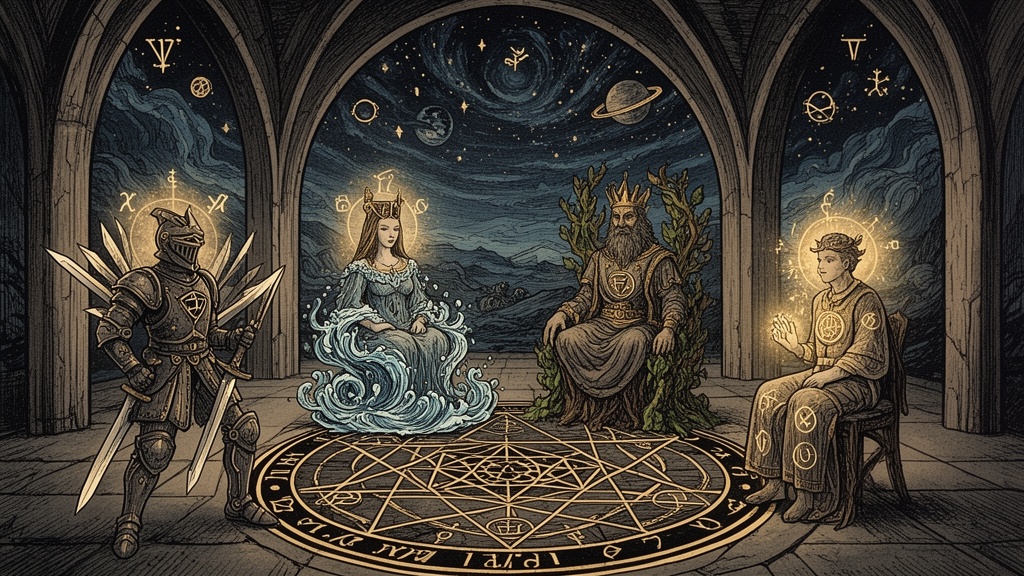
If the Knight of Swords walks into your spread and you treat him as a badly behaved aspect of your personality, he will dutifully perform as such. If you treat him as a being with his own will, habits, and history, your reading quietly reconfigures itself around that decision.
This is not a question of “belief”. It’s a question of how you choose to relate.
Most of us were trained to treat court cards and significators as people-substitutes: “you”, “them”, “the boss”, “the lover”. At best, they’re typologies. At worst, they’re filler. Meanwhile, contemporary magic has moved back toward an ensouled cosmos: spirit work, animism, daimonic guidance. Tarot, oddly, often remains stuck in a late-20th-century Jungian cul-de-sac.
So what happens if we catch tarot up?
Not by pretending the Page of Cups is now literally a medieval servitor floating in your living room, but by working with courts and significators as semi-autonomous agents in a spirit ecology. Agents you can negotiate with, cultivate, and occasionally refuse.
That move is sharper, and stranger, than it looks.
What “semi-autonomous agent” actually means
If this is just fancy language for “I personify the card in my head”, nothing has changed. So we need some minimal criteria.
When I say “treat the Knight of Swords as an agent”, I mean:
- He shows persistence across time. He doesn’t just appear in one reading and dissolve; he has a recognisable “feel” in March and in November.
- He displays initiative. He “turns up” uninvited in spreads where you didn’t assign him a role, or intrudes into imagination and dream outside formal readings.
- He has capacity to surprise. He offers responses or angles you did not consciously script, often cutting across your preferences.
- He can be addressed and negotiated with. You can ask, “What are you doing here?” and get something back that behaves like a reply, not a rehash of the LWB.
Psychologically, this is the autonomy of a complex. Magically, it is the minimal behavioural profile of a low-level spirit. Phenomenologically, it’s an “other” that shows up and keeps showing up.
You do not have to decide whether this “other” is “inside” or “outside”. In practice, the work sits in the tension between those options. The point is not ontology; the point is that you engage with the card as if it has its own centre of gravity, and you watch what that does.
Contrast three stances:
Strict psychologism
All courts are facets of your psyche or projections onto others. Agency is an illusion; the work is reclaiming the projection.Hard animism
Courts are literal spirits, akin to named daemons or saints. The King of Wands is as ontologically independent as Michael or Ogun.As-if agentive practice (the stance I’m arguing for)
You bracket the question of “what it really is” and treat the card as an agent in your working ecology when that proves operationally fruitful. You allow it to behave like a daimon, whilst maintaining reflective distance.
If you’re waiting for a metaphysical guarantee, you’ll never move past (1). If you collapse into (2) without reflection, you’re courting delusion. The interesting work happens in (3), where you risk encounter without demanding a final theory.
Courts and significators as daimons, not just types
The court cards already sit in a liminal position: not quite Major, not quite Minor. They’re rank, not number. They mediate between suit-element and human situation. The archetypal structure is already daimonic: Pages as thresholds, Knights as vectors, Queens as matrices, Kings as thrones.
When you treat them as agents, these are no longer just roles you or your querent “embody”. They become persons carrying those functions in your divinatory ecosystem. Likewise, the significator is no longer a cardboard stand-in for the querent. It becomes an axis mundi: the living centre of orbit for the spread. If you let it, it will behave like a presiding daimon for the working.
What we are doing here is not reconstructing a lost orthodoxy. We are taking a latent potential—the daimonic structure of the courts—and making it explicit for a magical culture that has already rediscovered spirits elsewhere.
From projection to dialogue: the psychological mechanism
Standard court-as-personality reading is projective. You know this. The card functions as a surface onto which self and other are cast.
Once you take an agentive stance, the operation shifts.
You are no longer saying, “This is you.” You are saying, “This is someone you are in relation with.”
In Jungian terms, you move from simple projection to active imagination: you allow the figure to speak back. The psyche’s tendency to personify its own forces—the autonomy of complexes—is not suppressed but given a stage.
The Knight of Swords, in this frame, is not “your impulsive side”. He is a force of cutting, charging, over-clarifying. He may ride you. He may oppose you. He may insist on his own agenda. You can ask him why.
This requires double consciousness. Within the reading, you treat the Knight’s voice as experientially real. Outside the reading, you remain capable of saying, “That was my psyche speaking in a Knight-shaped mask,” without collapsing the experience into “just me”.
If you lose that double consciousness, the practice becomes either flat (“it’s all just archetypes”) or psychotically literal (“the Queen of Wands told me to quit my job today, I had no choice”).
Held properly, the deck ceases to be a mirror and becomes a theatre. Courts and significators walk on and off stage, argue, ally, sulk, refuse. Your role shifts from interpreter to negotiator.
What actually changes in a reading?
If this is not just narrative gloss, it should lead to different moves at the table.
Take the given example: relationship reading, Celtic Cross, “What blocks me from deeper intimacy?” Position 7 (“You”) is the Knight of Swords.
In a personality frame, you say: “You’re coming in hot; you argue, over-analyse, rush to fix. That’s the block.”
In an agentive frame, you pause. You address the Knight, silently or aloud: “Why are you here in this position? What are you doing in their relational field?”
You attend—to image, sensation, stray thought, the querent’s micro-reactions. Suppose what comes is: “I’m protecting them from humiliation. I get in first with the cutting remark so no one can cut them.”
That is not in the standard keyword set. It is not simply “you are argumentative”. It is a motivation and a logic that belongs to the Knight as a personified force.
The interpretive outcome shifts:
- You can now say to the querent: “There is a Knight-like force in you that thinks it’s protecting you by attacking first. You may want to negotiate with that, rather than just ‘stop being argumentative’.”
- You can design a specific intervention: a ritual or imaginal exercise in which the querent thanks the Knight, sets new terms (“you don’t need to jump in every time”), perhaps gives him a more appropriate task.
The decision you or the querent make may be different. Instead of suppressing a trait, you are reassigning a relationship.
In predictive or operational work, the difference sharpens further. An agentive court can:
Refuse a request. You design a working keyed to the Queen of Pentacles for financial stability, and in divination she turns up inverted, flanked by disruptive cards. In a symbolic frame, that’s “blockages around nurturance and material security”. In an agentive frame, you can ask, “Are you willing to do this under these conditions?” and get “no, not like this”. You can then alter terms: offerings, timing, scope.
Propose alternatives. You intend to use the Knight of Wands for a rapid career push. In session, the Knight of Swords keeps showing up instead. Treated as agent, he’s not just “more mental energy”—he is an entity saying, “If you want speed and cutting through bureaucracy, I’m the one, not him.”
Withdraw. A court that has been a regular ally in your readings simply stops appearing where you’d expect, or shows up in positions of loss. Again, symbolically this is “you’re losing touch with this aspect”. Agentively, it can be, “I am stepping back because you’ve been ignoring my conditions.”
You can re-describe all of this as “structured imagination” if you like. The operational profile is still different from a flat typological reading. You are making decisions based on negotiation with a perceived other, not simply on applying a fixed list of meanings.
Significators as presiding intelligences
Extending this agentive principle to significators opens another layer. Most readers either don’t use significators or use them perfunctorily. Once you move into an ecology of agents, the significator becomes interesting again.
Treat the significator as:
- The host of the reading.
- The primary daimon mediating between querent, reader, and whatever else you’re tapping.
If you choose a significator deliberately (e.g. Queen of Cups for a querent doing deep emotional work), you’re not just picking “a card that looks like them”. You’re inviting that Queen-intelligence to preside.
Practically, that can look like:
- Addressing the significator at the start: “Queen of Cups, you are host for this working; keep the waters clear.”
- Noting how she behaves during the spread. Does she appear elsewhere? Crossed? In outcome? How does she “comment” on her own hosting role?
- Tracking that Queen across multiple sessions with the same querent. Does she remain the host, or does another court insist on taking that role as the work evolves?
Over time, some readers find that certain courts become their default significators for certain types of work. Not just “water sign women get Queen of Cups”, but “when I’m doing grief work, she comes; when I’m doing boundary work, the Queen of Swords insists”. This is where an ecology starts to emerge: different agents prefer different territories.
You don’t have to assert that these are “real spirits” in the strong sense. You only have to notice that treating them as if they were produces a pattern of persistence and differentiation that behaves like a small pantheon.
From individual cards to an ecology
Once you stop reading courts as interchangeable personality tokens, the deck’s internal politics become visible.
Some examples from actual practice:
A reader notices that the Page of Pentacles appears reliably at the start of any new study or magical project, regardless of question. Over a year, the Page becomes the reader’s “apprentice daimon”: when he shows up reversed, the project will stall unless offerings of time and attention are made.
A practitioner working heavily with spirit evocation finds that the Knight of Cups starts turning up in spreads immediately before successful contact, even when the spread is formally on a different topic. Over time, the Knight is treated as a herald: when he rides in, the practitioner cleans the space and tightens boundaries.
In each case, the court is doing something more than “representing a personality”. It is occupying a niche in a living system of relationships.
Working with courts as agents means mapping that system:
- Which courts show up as allies, which as antagonists, which as ambivalent tricksters?
- Which courts seem to be linked to specific external spirits, deities, or ancestors in your practice, acting as their masks or couriers?
- How do courts of the same suit relate? Are your Swords courts cooperative or at war with each other? Do your Cups courts form a family or a set of estranged individuals?
This is not just an intellectual exercise. It informs how you design spreads (“I want to invite the Pages to comment on this new venture”), how you structure magical work (“I will seat this ancestor in the throne of the King of Pentacles for this operation”), and how you interpret anomalies (“Why is the Queen of Wands refusing to appear in any of this client’s readings?”).
At that point, your deck is no longer a neutral tool. It is a small, patterned ecology you are in long-term relationship with.
Pacts, protocols, and the edge of delusion
Once you start talking about “pacts with courts”, ethical and psychological alarms should ring. They should.
The move from “this is a helpful metaphor” to “I am making agreements with this being” is not trivial. It changes how responsibility, agency, and sanity are distributed.
Some boundaries are non-negotiable:
If working with a card-agent undermines your sense of agency, that’s a red flag.
If you find yourself saying, “The Knight of Swords made me do it,” you have already gone too far. A daimon worth working with does not erase your will; it sharpens the field within which you choose.If this practice feeds intrusive fear or paranoia, stop.
If you begin to experience the courts as persecutory presences outside readings, criticising or commanding you, you are not deepening your magic; you are destabilising yourself.If you have a history of psychosis, dissociation, or fragile reality boundaries, this is advanced work.
It is entirely valid, and often wise, to keep the cards as symbols and keep spirit work elsewhere.
“Pact”, in operational magic, is not a romantic surrender. It is a contract: specific, time-bound, with terms, offerings, and exit clauses.
A sane pact with a court agent looks like:
“For the next lunar month, I will treat the Queen of Pentacles as patron of my finances. I will light a candle and speak with her every Thursday. I ask her to help stabilise my income and guide me away from foolish expenditure. In return, I will donate 5% of any extra income to a cause aligned with her values (e.g. land, food, care). At the end of the month, we review. Either of us can withdraw consent.”
Note the structure:
- Defined scope (finances, not whole life).
- Defined duration.
- Defined offerings.
- Explicit review and revocability.
If, during that month, you start to feel compelled, shamed, or micromanaged by the “Queen”, you end the pact. Out loud. You clear the space. You reclaim your authority. If you cannot do that, you are not in a pact; you are in a fantasy of possession.
This is why basic spirit-work hygiene is a prerequisite: banishing, grounding, consent, the ability to say no. The courts are a relatively low-risk arena to practise these skills, but they are not risk-free.
Scepticism that bites, not blunts
A rigorous sceptic will say: all of this is still happening in your head. The “agency” of the Knight of Swords is your own unconscious surprising you. The persistence across time is confirmation bias. The negotiations are dramatised self-talk.
Fine. Assume that for a moment. Even on that assumption, the agentive stance does something distinct:
- It externalises inner dynamics enough that you can negotiate with them, not just introspect about them.
- It constrains free fantasy by tying it to a stable image-set (the deck) and a consistent behavioural profile (how that card has shown up over time).
- It creates a third term in the reading relationship: not just you and the querent, but the Knight as a shared other. That can de-personalise difficult material and allow it to be worked with more safely.
From a purely psychological angle, you are formalising active imagination within a divinatory container. That is already different from “the Knight means you’re impulsive”.
From a magical angle, the sceptical reduction doesn’t touch the core mystery: that when you treat the world as populated by intelligences, it tends to respond in kind. Whether those intelligences are “inside” or “outside” is not a question the cards can answer for you.
When not to do this
There are situations where the agentive approach is contraindicated:
Querent cannot tolerate ambiguity.
If they need clear, literal answers and are already anxious, introducing “spirits in the cards” will not help.Querent is prone to externalising responsibility.
If every problem is “someone else’s fault” or “Mercury retrograde”, giving them a pantheon of court-spirits to blame is malpractice.You are exhausted, ungrounded, or resentful.
Working with agents requires presence. If you’re on your fifth back-to-back reading and running on fumes, keep the courts as symbols and close the shop early.
Agentive work with courts is optional. It is an advanced layer, not a requirement. There is no virtue in forcing it where it doesn’t serve.
So what, exactly, gets rewritten?
Not the printed images. Not the Golden Dawn attributions. What shifts is:
Your role.
From interpreter explaining people to themselves, to mediator negotiating between humans and a small ecology of intelligences.The temporality of readings.
From one-off snapshots to chapters in ongoing relationships with recurring agents.The design of your magic.
From generic “tarot-spell with a money card” to targeted collaboration with specific court-intelligences whose preferences you’ve learned over time.The ethics.
From “I told them what the cards said” to “I participated in a conversation that included beings whose agendas may not be identical to mine”.
The deck becomes less like a book you consult and more like a village you live in. Some villagers are easy; some are difficult; some you barely see until you need them. The courts and significators are no longer cardboard cut-outs; they are neighbours.
If you let them, they will remember you.
The next time a familiar court steps into a spread, you can either flatten it back into a trait, or you can risk asking what it wants. The answer may be nothing more than your own unconscious in costume—or it may be the beginning of a relationship that slowly rearranges how you understand “self”, “spirit”, and who, exactly, is sitting across the table when you read.