
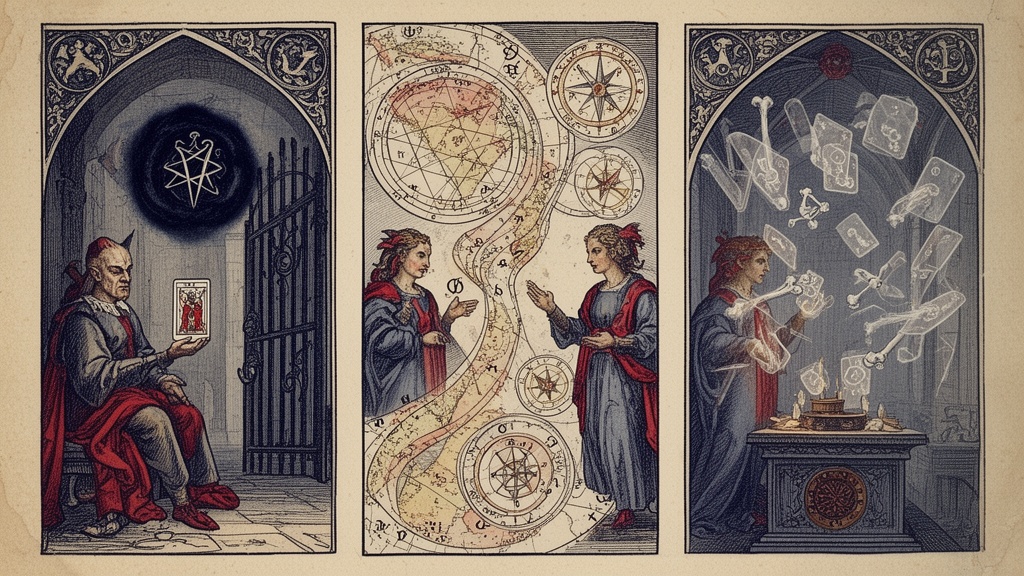
If your spell and your spread do not agree, you do not have a “mixed message”. You have a conflict in your magical stack, and something in your operation is lying, blind, or being overruled.
Most people handle that by shrugging and calling the cards “guidance”.
That shrug is where the trouble starts.
Treating divination as a soft-focus advisory layer around spellcraft blurs two operations that, in practice, run on different logics: one intervenes, the other interrogates. Once you stop pretending they are the same thing, three distinct roles for oracles in ritual work become visible: diagnostic veto, tactical adjustment, and ritual co-execution. And once you see those, you also see how collapsing them into generic “guidance” reliably generates muddled decisions, self-sabotage, and the feeling that your magic is both doing too much and not enough.
Divination and spellcraft are not the same operation
Let us be explicit about the distinction, before the sceptic in the back of the room quite rightly objects that “different vibes” is not an argument.
Functionally, spellcraft is interventive: you are attempting to alter conditions — inner, outer, or both. The act is performative; the working itself is the thing that changes the field. Divination is diagnostic: you are attempting to model or reveal conditions — present, likely, hidden. The act is inferential; the working produces information, not change, as its primary output.
Epistemically, a spell is a commitment. It is your declaration that “this is what I am doing to the situation”. A divination is a claim: it is your best available picture of “what the situation is like”, or “how it tends to go if I do X”.
Phenomenologically, in spellcraft you occupy the Magician: projective, directive, future-oriented. In divination you occupy the Oracle: receptive, interrogative, liminal.
That is the clean functional carve. In lived practice the boundary is porous. Sigil work doubles as self-diagnosis. A geomantic chart both describes and bends the field. A tarot spread pulled mid-operation becomes an enchantment in its own right.
But for the purpose of understanding why your spell and your spread can contradict each other in structurally meaningful ways, the functional distinction matters. It lets you ask, at each step: am I trying to change this, or see this? Am I speaking, or listening?
Once you frame it that way, “the oracle said no” is not just an awkward moment. It is a clash between two different engines you have chosen to run in the same ritual ecology: one that asserts, one that reports.
Three roles, not one mushy “guidance” layer
When you bring an oracle anywhere near spellcraft, you are implicitly assigning it a role. Most practitioners never make that explicit. They shuffle, pull a spread, “see what comes up”, and then retrofit the reading into whatever they were going to do anyway.
If you watch what actually happens across serious practice, three recurrent patterns emerge. I am not claiming these are metaphysical natural kinds. They are operationally distinct roles that show up again and again in how people actually use cards, shells, charts, and bones around ritual work.
- Diagnostic veto: “If this comes up wrong, we do not do the thing.”
- Tactical adjustment: “We are doing the thing, but the oracle will inform how, when, and with what emphases.”
- Ritual co-execution: “The divination is not commentary on the spell; it is a live operator inside it.”
There are other uses — post-hoc narrative repair, emotional regulation, client management — but those do not structurally alter the working itself. These three do. They decide whether the operation happens, how it is shaped, and what is actually doing the heavy lifting.
If you do not know which role you are assigning, you will not know how to respond when the oracle and the spell disagree. You will improvise in the moment, under pressure, usually in the direction of whatever your ego most wants. That is where the “epistemic confusion” enters: you lose track of which part of the system is allowed to overrule which, and why.
Diagnostic veto: when the oracle can say “no”
Historically, this is the most straightforward. You divine before you act. If the signs are adverse, you do not proceed.
The PGM is full of “if the sign is X, it will succeed; if Y, it will not — desist”. Renaissance magicians threw geomancy or interrogated the horoscope before electing a time. In African-diasporic work, cowries or obi are consulted before major operations; a bad odu or a firm “no” from the shells means you go back to the drawing board, or you do not touch it at all.
Functionally, the oracle is assigned hard authority over whether the working goes ahead in its current form. You are saying, in effect: my desire to intervene is conditional on this diagnostic check.
Psychologically, this is the ego submitting its will to a reality-test. The Magician sits down in front of the Oracle and says: “I want this. Is this aligned, viable, permitted?” The answer may surface all the things the ego has edited out: the fact that the target has a restraining order, the fact that the practitioner is exhausted and ill, the fact that the situation is already collapsing on its own.
When the veto comes, it can feel like sabotage. “The cards are blocking me.” But what is surfacing is the split between the conscious drive and the unconscious commentary — or, if you prefer a less psychological frame, between the operator’s plan and the wider field of spirits, currents, and timing.
A composite example from client work:
- Querent wants a spell to bind an abusive ex from contacting them.
- Practitioner has a standard protocol: pre-working tarot, question framed as “What are the likely consequences if I perform this binding as described?”
- Spread throws Devil in the “spell” position, 8 of Swords as outcome, with 6 of Swords reversed in “environment” — the picture is of entanglement and escalation, not relief.
- By prior contract with themselves, the practitioner treats that configuration as a red flag veto: they will not run a binding that appears to deepen the bind.
Note the structure: the oracle’s role was specified before the spread. “If it shows clear harm or blowback, we halt.” That is diagnostic veto in clean form.
What happens if you do not specify that? You get the familiar wobble: “Well, it could mean my client is already bound, and the spell releases them…” and within five minutes the reading has been massaged into permission for whatever the client wanted.
From inside a magical worldview, this role-confusion has predictable consequences. You cannot tell whether a “failed” operation was blocked by adverse conditions you chose to ignore, by your own divided will, or by external factors. Everything blurs into “sometimes it works, sometimes it does not”, and the oracle becomes a Rorschach you consult to feel spiritual, not a tool with teeth.
Tactical adjustment: when the oracle is your strategist
The second role is softer in authority but just as structurally important. Here, the spell is not up for debate — you are doing the working — but the oracle is allowed to shape its tactics: timing, method, targets, concessions.
Traditional electional astrology is the clear historical analogue. The operation (say, a business launch) is a given. The astrologer does not veto the business; they choose the best available time, warn of likely snags, and suggest mitigations. The same logic appears in geomantic “judge the figure, then choose the remedy” work.
In contemporary practice, tactical adjustment looks like pulling cards to choose between planetary days or hours, using a spread to identify which part of a situation to enchant (money vs. reputation vs. legal outcome), or asking the bones what offering will smooth a working with a particular spirit.
Here the oracle is not a gatekeeper but a field map. It tells you where the terrain is swampy, where the winds are with you, and where you are kidding yourself.
Psychologically, this is a dialogue between the ego’s plan and the deeper patterning of the psyche and the world. The Magician says: “We are going to war.” The Oracle replies: “Fine. But you are marching through a valley with archers on both sides. Armour the flanks or change route.”
If you collapse this into vague “guidance”, you lose the ability to distinguish between “do not march at all” and “march, but take the ridge path”. You either over-obey the oracle (“the spread was tense, so I cancelled everything”) or under-obey (“it looked rough, but I am sure it will be fine”).
Again, the structure matters. If you define in advance that the oracle has tactical authority but not strategic veto, you know what to do with a mixed or difficult reading: you do not abandon the working, you adjust it.
For example, you have committed to doing prosperity work for a client’s business launch on a fixed date. A pre-working spread shows 5 of Wands (conflict) crossing 3 of Pentacles (the work), with 7 of Pentacles as outcome. Under a tactical-adjustment contract, you interpret this as: the launch goes ahead, but there is competition and delay; the spell should focus on differentiation and stamina, not a quick windfall. You might add Mars-flavoured competitive edge work, or extra offerings to smooth out the bickering in the team.
If you had assigned the oracle veto power, the same spread might have led you to advise postponement. Same cards, different role, different action.
Ritual co-execution: when the oracle is part of the spell
The third role is where the lines blur most, and where the “two engines in one stack” metaphor reaches its limit. Here the divination is not commentary at all; it is a live operator in the working.
In some geomantic and Ifá-type practices, the casting that diagnoses the situation also prescribes the exact offerings, verses, and actions. The oracle is not outside the spell; it is the spell’s script. In chaos-magic-inflected tarot work, the draw itself is treated as an enchantment: “Whatever card falls here will become the dominant influence on the situation.” The reading is a sigil, not a report. In spirit-led work, you might cast lots repeatedly inside a ritual to negotiate with a deity or the dead: each throw is both answer and micro-operation, shifting the field as you go.
Functionally, the oracle is a co-conspirator. It is another Magician in the room, not just an Oracle. The Trickster archetype is strongly present here: each draw or throw can destabilise your plan, force improvisation, or reveal that the “spell” you thought you were doing is not the working that is actually happening.
Psychologically, co-execution makes the inner multiplicity explicit. Different parts of the psyche, different spirits, different logics are all allowed to act in real time. The cards on the altar do not just speak; they move.
In this mode, conflict between “spell” and “spread” is not an error condition. It is the mechanism. You build contradiction into the working deliberately, as a way to shake loose fixed patterns.
The risk, of course, is that you pretend you are co-executing when you are actually just letting random noise steer your operation. Without clear boundaries, “let the cards decide” becomes abdication of agency dressed up as mystical surrender.
So again, role clarity matters. If you say, “This reading is part of the engine; I will bind the result into the working,” you are making a different kind of contract than, “This reading is a check on whether I should proceed.” The same tool, entirely different function.
Why “guidance” muddies the waters
The contemporary occult internet tends to fold all of this into the language of “guidance”.
Tarot is “guidance” for your magical path. Oracles offer “guidance” about whether and how to cast. Even quite hard-edged traditional systems get softened into coaching-speak when they cross into social-media discourse.
The problem is not the word itself; it is its vagueness. “Guidance” does not tell you whether the oracle can veto your plan, whether it can only tweak your tactics, whether it is being invited in as a co-operator, or whether it is just there to soothe you after the fact.
So when your spell and your spread contradict each other, you have no protocol. You oscillate between ignoring the reading because you are attached to the spell, cancelling the spell because you are attached to the reading, or trying to reinterpret one or both until they no longer obviously disagree.
From inside a magical framework, this has predictable downstream effects.
Operationally, you end up with contradictory instructions (“Do this binding” vs. “This binding will trap you”), muddled chains of causation (did the spell “fail” because the oracle warned you and you ignored it, because the oracle was wrong, or because the operation was never viable?), and non-learning (every outcome can be rationalised after the fact, so your model of how your magic interacts with the world never sharpens).
Epistemically, you lose track of what counts as evidence. If oracles and spells are both treated as vague “guidance”, then any outcome can be bent to fit any narrative. The reading that said “no” becomes “it meant not yet“; the spell that misfired becomes “it gave me what I needed, not what I wanted”. You may be right. You may also be insulating yourself from feedback.
None of this requires a materialist sceptic to tell you your magic is “not real”. It is an internal critique: within a magical worldview, you still need to know which part of your system is allowed to overrule which, and on what basis, or you cannot meaningfully say what you are doing.
The psyche is not a monolith, and neither is the cosmos
There is a psychological way to tell this story that does not cancel the esoteric one.
On the psychological side: spellcraft and divination recruit different ego functions. Spells mobilise fantasy, agency, future-orientation: they are how the psyche pushes back against helplessness. Divination ritualises receptivity: it is how the psyche lets in constraint, nuance, and the possibility of “no”.
When the oracle contradicts the spell, you are seeing a split in the psyche made visible: one part insisting, another cautioning, another perhaps sabotaging. The Trickster shows up as the part of you that enjoys throwing a spanner in the works, or that uses “signs” to avoid commitment.
On the esoteric side: oracles and spells are interfaces to different aspects of the magical cosmos. A geomantic chart might be more “plugged in” to planetary intelligences, whilst your candle spell is primarily riding ancestral currents. Spirits disagree. Currents cross. A “no” from one part of the field does not necessarily mean a universal veto, but it does mean you are not moving in a homogenous medium.
You do not have to choose between these accounts. They are parallel descriptions. Either way, the contradiction is not a glitch — it is a signal that multiple logics are in play. Treating everything as undifferentiated “guidance” flattens that multiplicity into a single, vague authority called “the Universe” or “my intuition”, which then has to be right about everything or nothing.
Protocols: deciding who gets to overrule whom
If you accept that divination and spellcraft are functionally distinct, and that oracles can occupy at least three structurally different roles, then the practical implication is simple and demanding: you have to decide, in advance, which engine you are privileging at each step.
That means building explicit contracts with yourself (and with clients, if you work for others) such as:
- “For love work, I treat pre-spell divination as a veto: if the spread shows clear harm or obsession, I do not proceed.”
- “For career magic, I use astrology as tactical adjustment only: I will not cancel a major move for a bad election, but I will adjust timing and remedial offerings.”
- “In this ancestor working, the bones are co-executors: whatever they ask for in the course of the rite, within my ethical limits, I will provide, and their throws will shape the operation live.”
You also need a default for conflict:
- If the oracle (in veto mode) says “no” and your desire says “yes”, which wins?
- If the oracle (in tactical mode) shows turbulence, do you lean into more work, or pull back?
- If the oracle (in co-execution mode) repeatedly derails your planned operation, do you treat that as a Trickster-driven transformation, or as a sign that you are out of your depth?
Without these pre-commitments, every contradiction becomes an occasion for motivated reasoning. You will tend to declare the part of the system that supports your current desire “the real one” and demote the rest to noise.
With them, you at least know when you are breaking your own rules — and you can then track what happens when you do.
The sceptic’s question, and why this is not just taxonomy for its own sake
A fair sceptical pushback is: is this not just a clever three-fold schema imposed on a messy continuum of practice?
To some extent, yes. The roles are a model, not a revelation from on high. But they are a model that tracks actual decision-points practitioners face: do I let this reading stop me? Do I let this reading change how I work? Do I treat this reading as part of the work?
Those are not abstract questions. They are the forked paths you hit whenever the cards are awkward, the shells are recalcitrant, or the chart is dire.
What the model does is force you to surface those forks explicitly, instead of smoothing them over with “guidance” and hoping for the best. It gives you language to notice when you are quietly switching roles mid-stream — when a veto you did not like is being downgraded to “just advice”, or when “just advice” is being granted veto power because you are afraid to act.
As for “magical failure”: no, you cannot run a controlled trial in which fifty spells fail because the practitioners mis-categorised their oracles. But you can notice patterns in your own work. How often does hand-waving around divination’s role correlate with operations that feel muddled, outcomes that are hard to interpret, or cycles of repeated work on the same stuck situation?
Even if you bracket metaphysics entirely, clearer role definition reduces internal contradiction. It aligns your stated intent, your diagnostic picture, and your actions. In any system that takes will, symbol, and attention seriously, that alignment is not trivial.