
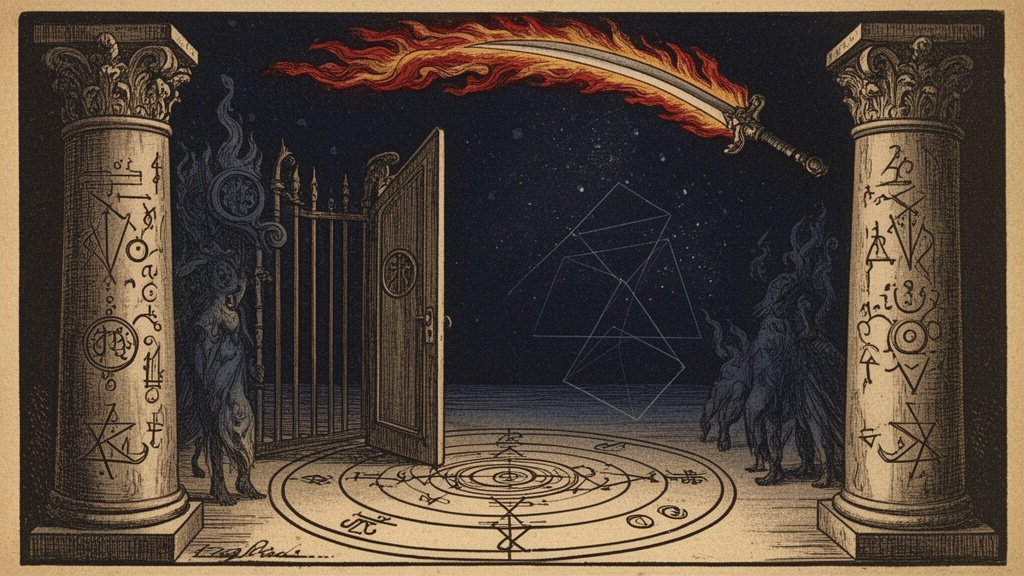
Some readings are not about what will happen. They are about who is allowed to happen near you at all.
We already use oracles this way, mostly without naming it. “Should I cut contact?” “Is this spirit safe to work with?” “Can this person be in the circle?” The language is predictive or advisory; the function is judicial. A line gets drawn. Someone, or something, ends up on the far side of it.
This piece takes that function seriously: divination not as information-gathering, but as boundary‑making. Not “tell me the story,” but “where is the wall, who holds the keys, and what is being shut out?”
Once you treat that as a distinct mode, a few things stop being background noise and come into focus: spread architecture that literally partitions space, evaluation criteria that have nothing to do with accuracy, and ethical problems that do not arise in a standard “what’s coming in my career?” layout.
This is not a new invention. It is a lens on something oracles have been doing for a very long time.
Oracles that sort, not foresee
To avoid hand‑waving, let us start structurally.
Call a reading boundary‑setting when three conditions are met:
-
The operative question is inclusion/exclusion or access.
“In or out?”, “permitted or forbidden?”, “inside my field or outside it?”—whether that field is a body, a house, a coven, a temple, a timeline. -
The spread encodes a partition, not a trajectory.
Positions are not “past / present / future” or “situation / obstacle / advice”, but “inside / outside”, “admitted / barred”, “mine / not‑mine”, “this side of the river / that side”. -
The result is treated as a rule to be enacted, not just information to ponder.
The reading culminates in an act: a door closed, a ward set, an invitation rescinded, a role relinquished. The oracle’s verdict is taken as binding unless consciously overruled.
Plenty of ordinary decision spreads graze this territory. “What if I stay, what if I go?” can function as boundary work in practice. But their architecture and evaluation still centre prediction: which branch looks less disastrous, which timeline carries which likely consequences.
In a boundary spread, you are not asking the system to simulate futures. You are using it to ritualise a choice about permeability. The question is not “What happens if I bar this person?” but “Does this person belong inside my perimeter at all?” The spread does not map a causal chain; it enacts a sort.
If that sounds like a distinction without a difference, pay attention to what you count as ‘success’ afterwards. A predictive spread is vindicated when the described pattern unfolds. A boundary spread is vindicated when the line you drew holds—or when you consciously revise it.
Historical precedents: lots as gatekeepers
We can find clear examples of oracles acting as gatekeepers.
-
Casting lots to assign the scapegoat.
In the Levitical ritual, two goats are brought; lots are cast, one becomes “for YHWH” and is sacrificed, the other “for Azazel” and is driven into the wilderness bearing the community’s sins. The lot does not predict an outcome; it decides which creature is exiled, which is retained. It is a ritualised act of partition: pure/impure, inside/outside, ours/not‑ours. -
Oracles determining ritual access.
In various Greek contexts, oracles were consulted not only about what would happen, but about who could legitimately do what. “Is it ritually correct for X to hold this office?” “Is the city pure enough to proceed with this sacrifice?” The response could exclude a candidate or delay a rite. Again, the function is not to forecast but to permit or withhold. -
Geomancy and forbidden ground.
In Islamic and later European geomantic practice, figures are cast to determine the suitability of land for building, burial, or habitation. Certain figures at specific houses do not say “if you build here, X will occur” so much as “this place is forbidden ground for this purpose”. The chart marks a no‑go zone.
We could add lots used to assign monastic cells, divination to decide who draws the short straw for a dangerous task, or omens determining whether a campaign may proceed. In each case, the oracle is not simply describing hidden realities; it is integrated into the machinery that allocates people to spaces and roles.
Do these actors think in terms of “boundaries”? Not in the contemporary psychotherapeutic idiom. But the pattern is recognisable: a sacred mechanism that separates, assigns, and excludes, with real consequences. That is enough to justify taking “oracles as boundary arbiters” as more than a modern metaphor.
Three levels: psyche, society, spirits
The moment you say “this reading is an act of excommunication” you are operating on at least three levels at once. Confusing them is how people get hurt.
-
Intrapsychic.
The cards help someone crystallise and commit to a boundary they already half‑know they need. The “excommunication” is internal: I am no longer available for this pattern, this role, this form of contact. The deck is a projective surface for ambivalence about saying no. -
Social / institutional.
A group uses divination as a formal procedure to decide membership, office, or access. “We will draw lots to see who joins the inner working group.” “We will cast to see whether this initiate is ready.” The oracle’s verdict is treated as collectively binding. -
Metaphysical / ritual.
The divinatory act itself is part of magical containment. Casting before circle to see who or what may enter. Drawing a line of figures or cards that is understood as an actual ward. Using a reading to identify and then banish a spirit or pattern.
You can work on any one of these planes without committing to the others. A therapist‑practitioner might use tarot purely at level one. A coven might operate at levels one and two, but remain agnostic about three. A ceremonial magician will almost certainly assume all three are in play.
This article is not going to pretend there is empirical proof for level three. It will simply note: within esoteric practice, many of us proceed as if boundaries drawn in oracular space do something beyond the psyche. We act as though cards turned face‑down and dismissed, names written and burned, or figures cast outside a circle have effects in the subtle architecture of a working. Psychological language can map the ego work involved; it does not exhaust the phenomenon.
What matters ethically is not resolving the metaphysics, but being explicit about which level you are invoking when you say, to a client or a group, “the cards say no.”
The oracle as threshold
Once you treat a spread as a gate rather than a mirror, different archetypes come to the fore.
There is the Guardian at the Threshold: Hecate at the crossroads, Janus at the gate, the angel with a flaming sword. In a boundary reading, you or the oracle—or both—stand in that role. You are not narrating; you are deciding what passes.
There is the Circle or Mandala: the perimeter that creates sacred space by enclosing and excluding. Any spread that marks a literal inside and outside is invoking that structure.
There is the Exile: the one who is cast out, the scapegoat, the outcast. Every time you use a spread to say “this energy / person / spirit must go,” you are stirring this archetype. If you do not acknowledge it, you risk sliding into unconscious scapegoating.
And there is the Lawgiver: the one who says “thus far and no further.” Many querents experience the oracle in this guise when boundaries are at stake. The cards are not a chatty friend; they are a bench handing down a ruling.
These patterns give boundary‑setting readings their emotional charge—and their danger. You are not playing with neutral information. You are staging, in miniature, the drama of sanctuary and banishment.
Spread logic: drawing the line on the table
If boundary‑setting is a distinct mode of divination, it should show up in how we lay cards or cast figures. Not as decorative flair, but as functional architecture.
Some examples, all of which you can adapt to your own system:
-
Inside / Outside ring.
Place a significator for the self, the group, or the working in the centre. Around it, lay two concentric circles of cards or figures: an inner ring for “what is admitted / what I welcome”, and an outer ring for “what is at the gate / what seeks entry”. Beyond the outer ring, optionally, a discard pile for “what is explicitly barred”. You can physically move cards from outer to inner ring as you negotiate boundaries, or flip them face‑down to signify exclusion. The layout is not a narrative; it is a map of permeability. -
Threshold spread.
Visualise a doorway across the middle of the reading cloth. The left side is “current domain—what is already inside”, the right side is “beyond the threshold—what lies outside / what I step into if I open”, and cards laid on the threshold represent “gate conditions / guardians / price of passage”. This is particularly useful for “Do I let this back into my life?” questions, or “Is this spirit / path allowed in my temple?” The focus is on the qualities of the threshold, not on forecasting the entire journey. -
Mine / Not‑Mine cross‑section.
For enmeshed relationships or family systems, one column is “mine to hold, mine to repair, mine to grieve”, the other is “not mine—return to sender, leave at the edge”. Each row can represent a domain: emotional labour, financial responsibility, spiritual work, ancestral baggage. You do not ask “what will happen if I set this boundary?” but “which column does this belong in?” The act of sorting is the work. -
Circle admission.
In group work, if you are going to let the oracle speak to membership at all (more on the ethics later), the spread should make the structure explicit: one position for “what this person brings inside the circle”, another for “what they would carry in that must stay outside”, a third for “what the circle offers them”, and a fourth for “what the circle cannot contain”. The decision is then a human one, informed by this map. The spread does not say “yes/no to initiation”; it lays out the boundary tensions.
Note what is missing in all of these: there is no “outcome” position in the predictive sense. The interest is not in forecasting consequences but in clarifying the line. If you want to explore likely fallout of enforcing that line, that is a second, separate reading, not smuggled into the boundary spread itself.
Evaluation without prediction
If you are not measuring success by “did the cards get it right about next March?” how do you assess whether your boundary‑setting work is any good?
A few criteria are more appropriate here:
-
Clarity of the line.
After the reading, can the querent state, in their own words, what is now inside and what is outside? Vague unease is not a successful boundary. A crisp “I will no longer answer calls after 9pm” is. -
Sustainability.
Does the boundary hold over time without constant crisis? A line that collapses within days may have been aspirational rather than grounded. That is not “failed prediction”; it is a diagnostic about ego‑strength and context. -
Alignment with values.
Does the enacted boundary feel congruent with the querent’s stated ethics and commitments? A reading that produces a hard cut‑off that the querent experiences as betrayal of their own integrity is a red flag. -
Reduction of leakage.
Over weeks or months, does the person report less unwanted intrusion, less resentment, less compulsion to over‑extend? That is a better indicator of boundary efficacy than whether some specific event occurred.
None of this is as neat as counting hits and misses. But if you are going to claim that your spreads help people hold their perimeter, these are the metrics that matter.
The central ethical hazard: abdication
The obvious shadow of boundary‑setting divination is that it can become a way to avoid taking responsibility for drawing lines.
“The cards say you can’t come to ritual any more.”
“The runes say this spirit has to go.”
“The geomancy says you’re not right for the group.”
You know how this works. The oracle functions as a ventriloquist dummy for decisions the human participants either do not want to own, or are not allowed to own within their own internalised scripts.
For trauma‑impacted querents, the risk is even more acute. If your history has taught you that saying “no” invites punishment, having the cards say it for you feels safer. But if every serious boundary decision is outsourced to an external authority, you never rebuild the muscles of self‑protection. You stay in learned helplessness, now with esoteric trappings.
If you are serious about trauma‑informed practice, you cannot treat this as a minor side‑effect. It has to be designed against from the start.
Some concrete protocols help:
-
Frame the oracle as lens, not judge.
At the outset: “These cards are here to help you see your own line more clearly. They do not get to overrule you.” Then act in accordance with that framing. Do not slip into “the cards have spoken” rhetoric when the going gets tough. -
Separate description from decision.
After interpreting, explicitly ask: “Given what we see here, what do you choose to do?” Have the querent articulate the boundary as an I statement: “I will…” or “I will not…”. The reading culminates in their decision, not yours or the deck’s. -
Refuse high‑stakes abdication.
When someone wants the oracle to decide whether to leave an abusive partner, to cut off a parent, to report a crime—be very cautious. You can map dynamics, highlight patterns, explore resources. You do not let the spread become a coin‑flip for life‑altering choices. If the querent keeps pushing for that, name the dynamic and, if needed, decline the reading. -
De‑mystify group procedures.
If a coven uses divination in admission or conflict processes, make the human agency explicit. “We use this spread as one input. The elders make the final call, and we own that.” If you cannot say that out loud, you probably should not be using the oracle in that context.
None of this eliminates projection or power games. But it at least keeps you from hiding behind the cloth when you are, in fact, the one drawing the line.
Boundary work as ego work
On the psychological plane, boundary‑setting readings are exercises in ego‑strengthening and differentiation.
When someone asks, “Who is allowed in my intimate space?” they are not seeking information they lack; they are asking for help sorting competing internal voices: the part that wants safety, the part that fears abandonment, the introjected parent that says good people never exclude, the traumatised child who expects retaliation.
Putting cards on the table externalises that mess. The querent can project onto them—this one is the draining sibling, that one is the guilt, that one is the fear of being alone—and you, as reader, can hold the container whilst they look.
The archetype of the Exile is particularly important here. Every time you say “this must stay outside,” some part of the psyche hears, “I am being cast out.” If you do not name and tend that, the boundary will often collapse later under the weight of shame or compensatory over‑giving.
A simple move: when a card is assigned to the “barred” position, ask, “What part of you identifies with this?” Not to soften the boundary, but to keep the rejected quality in view as inner work rather than letting it roam the neighbourhood as a projected monster.
On the other side, there is the risk of compulsive fortification. Some clients will want to use the oracle to justify increasingly rigid walls: “See, the cards say everyone is dangerous, I must isolate.” You are not obliged to collude. You can gently point out when every spread ends in total exclusion and explore what that is defending against.
At its best, boundary‑setting divination is rehearsal: the client practises saying no in a ritualised, symbolically rich space, with you and the oracle as witnesses. That is not trivial. For some nervous systems, that is the first safe “no” they have ever voiced.
Spirits and timelines at the gate
So far we have mostly spoken about human relationships. But the same mode applies to other domains practitioners actually work with, even if we rarely name it.
-
Spirits.
Many of us cast before allowing a presence into our space. “Who is knocking?” “By what right do you approach?” “What happens if I open this?” That can be exploratory. It can also be gatekeeping. A spread with explicit “permitted / barred” positions, followed by an actual banishing or invitation, is boundary‑setting in the metaphysical sense. -
Timelines.
Choosing between paths is usually framed as prediction: “If I take job A vs job B, what happens?” But you can also treat it as partition: “Which possible life do I feed, which do I starve?” A spread that culminates in you ritually closing off one line of probability—by burning its card, by turning it face‑down and excluding it from further work—is not just informational. It is a small act of world‑pruning. -
Roles and vows.
Oracles are often consulted about taking or releasing vows, stepping into or out of offices. Here again, the primary function is not to predict but to delineate: am I inside this role or not? A boundary spread that maps “what this role requires inside my life” and “what it excludes” can make the threshold vivid before you step over it—or consciously decline.
Whether you think these acts change anything beyond the psyche is, in practice, less important than whether you treat them as weighty. If you conduct them as if you are just playing with cardboard, you cheapen the very boundaries you are trying to fortify.