
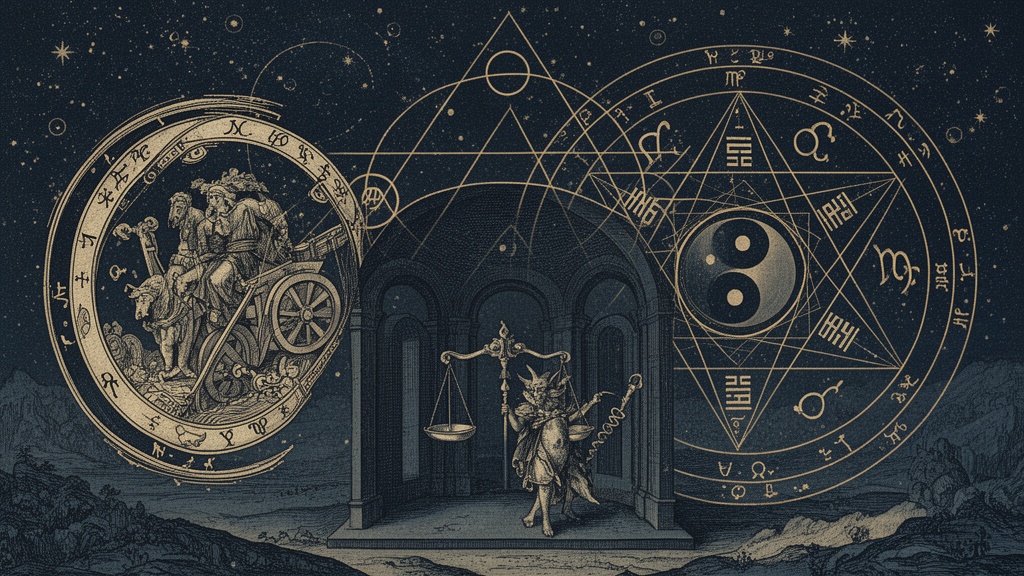
You trust your deck—but what do you do when the I Ching calls it a liar?
Not politely disagrees. Not “emphasises another angle.” I mean: Tarot says “go,” the hexagram says “stop,” and geomancy quietly mutters “this was doomed three questions ago.” Most readers treat that as a problem to be solved: someone must be wrong, or we need to blend until the edges blur and everyone can go home.
What happens if you don’t solve it? What if you force the disagreement and read that?
This is not about redundancy
Cross-system work is usually sold as belt-and-braces: throw Tarot and geomancy and the I Ching at a question and see where they converge. Confirmation is taken as reliability; conflict is noise to be smoothed over.
That is epistemically lazy.
If you are fluent in more than one oracle, you already know they do not see the world the same way. You feel it when you move from a Marseille line to a full chart, or from hexagrams to courts. Each system carries not just symbols but an implied metaphysics: what a “situation” is, what time is, how agency works, what can and cannot be said.
Engineered disagreement simply makes that explicit.
The move is simple:
- Ask the same question, as precisely as you can, of two (or more) systems.
- Record the results separately, interpret each as if it were the only reading.
- Then bring them into collision and refuse to harmonise them.
You are not looking for a composite answer. You are watching what breaks—inside the systems as you practise them, and inside you as the interpreter.
From “what’s true?” to “what am I doing when I call this true?”
On a strict empirical frame, there is nothing surprising about disagreement. If all oracles are random-output generators plus human pattern-recognition, then of course multiple throws will diverge. The sceptic is absolutely right on that level.
The interesting move is to change the question.
Instead of “which oracle is correct?”, treat the conflict as a stress test of:
- your interpretive habits;
- the operational assumptions you bring to each system;
- the points where the system’s practised metaphysics rubs against another’s.
You are not proving that Tarot’s worldview is truer than the I Ching’s, or vice versa. You are mapping the kind of world each system allows you to see when you actually use it, and how you, personally, try to live in that world.
The psychic cost of disagreement
Engineered conflict is a deliberate induction of cognitive dissonance. You are inviting your own psyche to be pulled in incompatible directions by authorities you normally trust.
With a single oracle, the mind is very good at smoothing. A harsh card can be reframed as “growth”; a forbidding hexagram as “necessary delay.” The narrative becomes coherent, and the discomfort drains away.
Put two oracles on the table that flatly contradict and that smoothing mechanism stalls. The tension has nowhere to go. That is the point.
Watch what you do next.
Do you: – quietly downgrade the system you feel less affinity with? – reinterpret one reading until it “fits” the other? – reframe the question post hoc so they are secretly answering different things? – or freeze, unable to move without a unified verdict?
Each of those is diagnostic. Not of the cosmos, but of you.
You are watching your own need for certainty, your hierarchy of trust, your intolerance for ambiguity, your preferred style of self-deception.
Trickster and Judge in the reading room
On the archetypal layer, this method summons two figures at once.
The first is the Trickster: Hermes messing with your messages, Loki swapping labels, the part of reality that refuses to stay in a single form. Forcing systems to disagree is a ritualised invitation to Trickster energy. You are breaking the tacit pact that “the oracle will make sense if I am sincere enough.”
The second is the Judge: the inner Justice card, the faculty that weighs incompatible testimonies and must rule anyway. Once you have two or more oracles giving divergent counsel, you are compelled into that judicial role. You cannot hide behind “the cards said so.” You have to decide which voice to privilege, or how to act in the absence of consensus.
Hold those together—Trickster and Judge—and you are very close to the Self in its paradoxical aspect: the centre that can contain incompatible truths without collapsing into one or the other.
If that sounds abstract, notice what it feels like the first time you tell a querent, quite calmly: “Tarot is saying ‘drive,’ geomancy is saying ‘you’re locked in.’ We are not going to resolve that. We are going to see what it shows us about how you imagine this choice.”
Formal structure vs interpretive overlay
Before we start reading disagreements, we need to be clear what is disagreeing.
There are at least three layers in any system:
-
Formal structure
The mathematics of the symbol set. The I Ching’s sixty-four hexagrams from six binary lines. Geomancy’s sixteen figures from four binary rows. Tarot’s seventy-eight cards, four suits plus trumps. This is just combinatorics. -
Historically attested tradition
The ways those forms have been read in actual lineages: the Ten Wings and the commentarial stream for the I Ching; the Latin geomantic manuals; Etteilla, Levi, the Golden Dawn, Papus, Waite, and so on for Tarot. -
Contemporary overlays
Jungian archetypes, chaos magic models, cybernetics, trauma theory, your personal gnosis.
When we say, for example, that the I Ching is “binary” and Tarot is “narrative,” we are mixing levels. Binary describes the formal structure of lines. “Narrative” is a modern psychological overlay on a historically layered image-set.
Engineered disagreement is most honest when you name which level you are working at.
If you notice that your Tarot work tends to constellate personal myth—identity, story, “who I am becoming”—whilst your I Ching work constellates process—timing, phases, dynamics—that is not a discovery about the essential nature of those oracles. It is a discovery about how you use them, which pieces of the tradition you emphasise, and which overlays you bring in.
That does not make it trivial. It makes it tractable.
You can change how you read. You cannot change the Book of Changes.
A concrete example: Chariot vs Carcer
Take a real-world-style scenario.
A querent is considering leaving a stable but deadening job to start an independent practice.
-
You throw a Celtic Cross. The Chariot lands in the outcome: focus, disciplined will, harnessing opposing drives. You read it as: “If you commit and steer, this move can work. The emphasis is on your agency and integration.”
-
You then cast a full geomantic chart. The Judge is Carcer, with heavy testimony from Saturnine figures in the relevant houses: restriction, confinement, structural limits. You read: “The situation is more locked than you think. External constraints, bureaucracy, perhaps debt or contractual obligations. Movement is heavily bounded.”
The usual move is to blend: “You can succeed, but it will be hard; there are obstacles.” That is anaesthetic. You have just removed the edge of both systems.
Instead, you say something like:
“Tarot is framing this as a question of will: can you marshal yourself, align your drives, and act decisively? Geomancy is framing it as a question of structure: what are the hard limits, the walls you cannot move?
Those are not the same map. Which one feels more like how you usually think about your life—do you default to ‘if I try hard enough, I win,’ or to ‘the system is fixed and I must navigate it’? And which one feels more uncomfortable here?”
You have turned the disagreement into a mirror.
Operationally, several things can now happen that are measurable over time:
-
The querent might realise they chronically overestimate their agency and underplay structural constraints; future readings can be checked against actual outcomes to see if this bias shifts.
-
Or the opposite: they habitually blame “the system” and avoid acts of will; you can track whether they start to take more decisive action when Tarot leans Chariot-wards.
-
You as reader may notice that you always, reflexively, side with the system that stresses agency, or with the one that stresses fate. Becoming aware of that bias changes future practice. You can deliberately read against your default and see what happens in subsequent cases.
You have not proven anything about whether the cosmos is more Chariot or more Carcer. You have sharpened your sense of how you and your querents locate yourselves between agency and structure.
Standards for “productive” conflict
Not every divergence is interesting. Sometimes you just have two vaguely different flavours of “maybe.” To keep this from degenerating into elaborate storytelling, it is worth setting some personal standards for when a conflict counts as diagnostically rich.
Three useful criteria:
-
Clear incompatibility of advice
“Act now” vs “wait”; “consolidate” vs “expand”; “cut ties” vs “repair.” If the implied behaviours cannot both be done in the same timeframe, you have a real conflict. -
Trackable consequences
The querent will make a choice that can be revisited. Did they act as if the Chariot-world was real, or the Carcer-world? What happened? You are not running a clinical trial, but you can keep a phenomenological log. -
Recurrent pattern
Over multiple experiments, you start to notice that this system regularly diverges in this way on these kinds of questions. For instance: your I Ching work consistently emphasises timing and gradual change where Tarot pushes for decisive identity shifts.
When those conditions hold, the disagreement is not just noise. It is a lens on your own metaphysics of practice.
Metaphysics of the oracle vs metaphysics of the reader
There is a temptation to say: “Geomancy is fatalistic, Tarot is about free will, the I Ching is processual.” That is too neat.
We need to distinguish:
-
Metaphysics of the system
What is implied by its texts, structure, and traditional usage. The I Ching is embedded in a cosmology of change, yin–yang dynamics, and correlative thinking. Medieval geomancy is soaked in astrological and often providential frames. Tarot, as it accretes from game to occult tool, takes on Christian, Hermetic, astrological, and later psychological layers. -
Metaphysics of practice
What you assume about causality, time, and agency when you sit down to read.
Engineered disagreement tells you far more, far faster, about the latter than the former.
If every time Tarot and geomancy disagree you find yourself saying “Tarot is right, because I believe in agency over fate,” that is not a discovery about the innate character of geomancy. It is a clear statement about your own commitments.
That is not a failing. It is precisely the kind of clarity serious practitioners rarely get without supervision or long-term journalling. Cross-training accelerates it.
When you want to push further towards the system’s own metaphysics, you have to leave your practice log and go back to the texts. How does the Ten Wings talk about “the superior man” responding to misfortune? How do the geomantic manuals handle questions of remedy and election? Where does your way of using the oracle align with that, and where have you drifted?
The disagreement on the table is then a prompt to do that work, not a substitute for it.
Active imagination with multiple logics
Psychologically, what you are doing is a form of active imagination under constraint.
Normally, you let one symbol system constellate around a question: the spread becomes a stage, the figures speak, the hexagram unfolds. Your psyche weaves a coherent pattern around that one logic.
With engineered conflict, you hold two incompatible logics in play at once. The mind does not like that. It will try to:
- collapse one into the other (“Carcer is just the shadow of the Chariot”);
- hierarchise (“the I Ching is older and wiser, Tarot is chatty and unreliable”);
- or split (“I’ll use Tarot for emotional things, I Ching for ‘real’ decisions”).
Watching which move you make is watching your own psychic defence in action.
Stay with the conflict instead. Let the images and line texts and figures argue in your imagination. Let the Chariot rider shout at Hexagram 12 (Stagnation). Let Carcer cross-examine the Fool. You are not doing this to be clever; you are inviting unconscious material that usually hides under a single, smooth narrative.
Shadow shows up here: your need for a single authoritative voice; your inflation around a favoured system; your tendency to use one oracle to bypass what another one is saying.
Querent dynamics: whose side are you on?
In client work, engineered disagreement is more volatile.
Many querents expect the oracle to sound like a single, benevolent authority. If you introduce multiple oracles, they expect a chorus, not an argument. When you present a genuine conflict, you will often see immediate projection:
- They side with the answer that matches their preconception and dismiss the other as “off.”
- They become angry that you cannot give them a single, clean directive.
- They split you: the “Tarot reader” part of you is wise, the “geomancer” part is suspect (or vice versa).
Handled clumsily, this just destabilises trust.
Handled well, it exposes the querent’s own epistemic habits. You can say, explicitly:
“Notice that you relaxed when we looked at the Chariot and tensed up when we saw Carcer. That tells us something about which kind of world you feel able to inhabit right now. Let’s sit with that, rather than rushing to declare one answer wrong.”
You are no longer just divining about “career.” You are divining about how this person relates to guidance, authority, risk, and uncertainty.
There is a limit, of course. Some contexts—acute crisis, trauma, time-sensitive danger—are not the place to induce more dissonance. Cross-training is advanced work. It presupposes your own capacity to hold ambiguity and your ability to gauge when a querent can join you there.
When it doesn’t help
It is important to admit that sometimes, forcing systems to disagree gives you nothing but a headache.
You ask a complex relational question. Tarot gives you a muddled spread, no clear directive, lots of minor arcana in mid-range positions. The I Ching gives you Hexagram 40 (Release) changing to 54 (The Marrying Maiden): a mixed, ambiguous movement. You try to force a disagreement and it just will not bite. Both oracles are essentially saying “it’s complicated, proceed with care.”
You can contrive a conflict by over-interpreting minutiae, but what you are then practising is not discernment; it is self-hypnosis.
That failure is useful data too. It tells you that not every situation wants to constellate as a clean polarity, that your method has limits, and that the hunger for sharp contrast can itself be a defence against staying with genuine ambiguity.
Cross-training is not about always having a dramatic split. It is about being honest when the split is there and disciplined when it is not.
What you can reasonably claim
Within this frame, some claims are robust; others are fantasy.
You can say:
- Engineered cross-system conflicts reliably expose your own interpretive biases—what you privilege, what you downplay, what you cannot bear to hear.
- Over time, you can track changes in those biases and correlate them with concrete decisions and outcomes in your and your querents’ lives.
- You can use the nature of the disagreements to clarify the operational assumptions you bring to each oracle—how you treat time, agency, causality when you read.
You cannot honestly say:
- That this method diagnoses which oracle’s metaphysics is “truer” in any ultimate sense.
- That your private field experiments have proven anything about the external efficacy of divination.
If anything transpersonal is at work in these systems—and many of us work as if there is—it is at least as likely that the contradiction itself is part of the communication as that one system is right and the other wrong.
The daimon that speaks through your deck may very well choose, on some days, to let the I Ching call it a liar, precisely so that you will finally look at how you handle being lied to.
You do not have to resolve that ontological question to benefit from the practice. The psychological and the esoteric frames can run in parallel without one collapsing into the other.
Where this leaves you
If you take this seriously, you will probably find that you trust your deck differently.
Not less, necessarily. But the trust will be less about “this oracle delivers the truth” and more about “this oracle reveals how I am relating to truth right now.”
You may also find that some of your cherished metaphysical stories about your systems—Tarot as a straightforward soul-mirror, the I Ching as impersonal cosmic law, geomancy as hard fate—start to fray under pressure. That fraying is uncomfortable. It is also where practice becomes interesting again.
The next time one oracle contradicts another, you could rush to patch the hole. Or you could pause and ask: what kind of world would I have to live in for both to be right? And what does my immediate answer to that question say about who, exactly, is doing the divining?