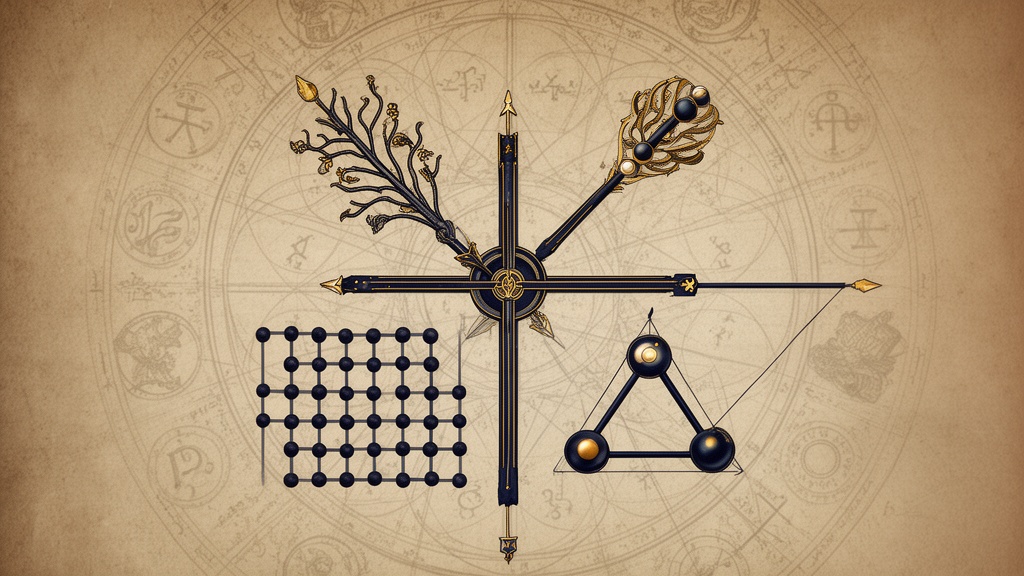
If every spread is a hidden theory of how reality works, what exactly is your layout forcing the cards to say?
Most of us inherited our first spreads the way we inherited our first decks: as faits accomplis. Celtic Cross, three-card line, horseshoe, perhaps a relationship spread from a book with yellowing pages. We learned positions, not premises. “Past / Present / Future” was a given, not a metaphysical claim.
But every time you lay cards into a structure, you are not just mapping a situation. You are choosing a world in which that situation is thinkable.
This is an article about treating spread design as ontology in practice: not “what reality is in itself”, but the kind of reality a reading presupposes and enacts as its working model. Once you see that, topology stops being a neutral aesthetic choice and becomes the main instrument with which you tune time, causality, and agency in the reading.
Not what you say with the cards, but what the layout has already said before you open your mouth.
Ontology, lightly: the world inside the reading
When I say “ontology” here, I am not claiming that moving cardboard around rewires the cosmos. I mean the operational ontology of the reading: the implicit model of time, causality, and agency that the spread makes available as you work.
A Celtic Cross and a Lenormand Grand Tableau can be applied to the same life situation and yet they do not inhabit the same world. One presumes a central subject and a linear arc from root to outcome. The other presumes a field of distributed relations in which “subject” is just another node. That difference is not cosmetic. It constrains what counts as a coherent interpretation before you even turn a card.
There are two directions of influence here:
- Your prior metaphysics shapes what you design and choose: if you secretly believe everything is fate, you will reach for spreads that centralise “outcome” and “external influences”.
- But once you have used a topology a few hundred times, it begins to shape you back. It habituates your sense of what a situation is. It stabilises certain reflexes about where agency sits, how time behaves, what counts as a cause.
Spread design is not the origin of ontology, but it is one of the main technologies by which a practice makes an ontology durable.
The question, then, is not “does topology matter?” but “what has your favourite spread been teaching you to believe?”
From positions to graphs: reading spreads as networks
To talk about topology without hand-waving, we need at least a minimal formal language. Network theory will do, if we keep it honest and light.
Take any spread. Abstract away the art and you have:
- Nodes: the positions (not the cards)—”Self”, “Outcome”, “Advice”, “Hidden Influences”, etc.
- Edges: the relations of influence or comparison between positions—sometimes explicit (“this crosses that”), sometimes tacit (we always read these three as a sequence).
You can then ask network questions:
- Is this graph linear, branching, or cyclic?
- Are the edges directed (“this leads to that”) or undirected (“these mirror each other”)?
- Which nodes are central (everything reads through them) and which are peripheral?
- Where are the bottlenecks—positions through which meaning must flow?
None of this requires equations. It does require you to stop treating spreads as flat arrays and start seeing them as information flows.
Let’s do the obvious case.
The Celtic Cross as a theory of time and self
Strip away the folklore and the Celtic Cross is a very particular graph.
There are many variants, but a common one runs:
- Present situation
- Crossing / challenge
- Foundation / root
- Past (receding)
- Conscious / goal
- Near future
- Self / attitude
- Environment / others
- Hopes and fears
- Outcome
Graphically, you have two main substructures:
- A cross: cards 1–6, with 1 at the centre, 2 crossing, 3 below, 4 behind, 5 above, 6 ahead.
- A staff: cards 7–10 in a vertical line to the right.
Treat the cross as one subgraph and the staff as another.
1. Centrality and the axis mundi
Position 1 is a classic central node. Everything is read in relation to it. Position 2 is not just adjacent; it is defined as crossing, an explicit directed relation of obstruction or modification. Positions 3–5 are anchored around 1 as temporal and psychological qualifiers (root, past, conscious aim).
This is not a neutral choice. It enacts a world in which:
- There is a clear centre, a subject-position or present-state around which everything constellates.
- Time is spatialised around that centre: past behind/under, conscious aim above, near future to the right.
- Causality is verticalised: roots underneath, conscious intention above, both feeding into the present.
You are inside a mandala with an axis mundi. It is very Jung-friendly: a Self at the centre, with shadow, past complexes, and teleological aims radiating around it.
2. Linear time and directed edges
The staff (7–10) is usually read as a more linear sequence: self → environment → hopes/fears → outcome. These are directed edges: each position is understood as feeding into the next. The outcome is not just another node; it is an attractor at the end of a line.
Again, this encodes a world:
- Time is linear and directed towards an outcome.
- The self is a node in that line, but not the only one: “environment” and “hopes/fears” are recognised as mediating factors.
- Nevertheless, there is a single-threaded future. You are not mapping branches, probabilities, or loops. You are reading where the line is going.
3. Agency distribution
Where does agency live in this graph?
- Positions 1, 5, 7, 9 are strongly agentic: present stance, conscious goal, attitude, hopes/fears.
- Positions 3, 4, 8 feel more fated: roots, past, environment.
- Position 10 sits ambiguously: an outcome partly shaped by agency, partly by those other forces.
The topology thus naturalises a mixed model: the querent is neither puppet nor omnipotent. They are a central node in a field of influences, moving along a largely determinate line.
You can of course interpret against this grain—stressing multiple possible outcomes, or reading “outcome” as “if nothing changes”—but you are swimming upstream against the topology. The graph wants a line.
Psychologically, this does several things at once:
- It contains anxiety by chopping time into digestible segments.
- It offers a projective aperture for fate (“outcome”) and mystery (“crossing”, “roots”).
- It enacts an inner dialogue between conscious aim (5), unconscious root (3), and environmental pressure (8).
Esoterically, it is a mandala of the incarnate subject: a cross of incarnation plus a staff of unfolding destiny. Whether you think of that as “true” is secondary. The point is: that is the world you are stepping into every time you throw a Celtic Cross.
If that is the only world you ever step into, do not be surprised if your sense of what readings can be starts to narrow to fit it.
Alternative topologies, alternative worlds
Consider three very different spread graphs: the three-card line, the Grand Tableau, and a deliberately designed “agency web”.
1. The three-card line: compressed determinism
The classic three-card spread, Past / Present / Future, is a minimal directed line graph: three nodes, two arrows.
- Time is strictly linear and irreversible.
- Agency is rarely explicit; it is usually smuggled into the interpretive gloss (“here’s what you can do about it”).
- There is no explicit place for environment, hidden influences, or multiple actors.
This is a brutally efficient ontology: a single subject moving through a single time-stream. No wonder it is the go-to for “quick answers”. It collapses complexity by design.
Change the labels, and you change the operational ontology. “Situation / Advice / Outcome” shifts the middle node from time to agency: the spread now presumes that advice is a meaningful intervention in the chain. Still linear, but with a different metaphysical emphasis.
The topology is the same. The ontology shifts with the semantics of the nodes. This is where semiotics matters: a position is not just a place; it is a sign-function. Call a node “Fate”, and you are doing something very different from calling it “What you are creating”.
2. The Grand Tableau: field, not line
Lenormand’s Grand Tableau is an 8×4+4 or 9×4 grid of 36 cards. Topologically, this is a lattice: a two-dimensional array where each node (card) is connected by proximity, knighting, mirroring, houses, and so on.
Key features:
- There is no single central node. The significator is important, but it is just one coordinate in a field.
- Time is not a simple line. Some readers treat left-to-right as past-to-future, but the dominant logic is spatial and relational, not temporal.
- Agency is radically distributed: people, events, qualities, and fates are all nodes in the same mesh.
This topology enacts a world that is:
- Networked: meaning emerges from patterns of adjacency and resonance, not from a narrative spine.
- Non-hierarchical: no card is structurally privileged except by convention.
- Open to entanglement: multiple storylines can be read simultaneously; causality is often mutual or circular.
If the Celtic Cross is a psychological novel with a protagonist, the Grand Tableau is a city map at rush hour.
Practically, working with this field over time changes how you experience readings. You start to see situations less as “my path from A to B” and more as “a web of interacting trajectories in which I am one vector.” That is an ontological shift in the experiential sense, and it is driven as much by the lattice topology as by any Lenormand manual.
3. The agency web: designing for distributed causality
Now take the career-change scenario: querent stuck between two opportunities, anxious about timing and influence.
You could default to the Celtic Cross. You would get a central subject, a line towards an outcome, some influences along the way. You would almost certainly tell a story of “if you do X, then Y will likely happen”.
But suppose you want to model not a path but a negotiation of agencies. You might design a simple three-node undirected graph:
- Node A: Querent
- Node B: Opportunity 1
- Node C: Opportunity 2
Place them as a triangle. On each edge between them, place one or more cards describing the relation:
- A–B: “How you and option 1 influence each other”
- A–C: “How you and option 2 influence each other”
- B–C: “How the two options interact in the wider field”
In the centre, where the three edges implicitly meet, place a final card or triad: “Emergent agency / how the situation is co-created”.
Topology:
- Three central nodes, no single protagonist.
- Edges are mostly undirected: influence is mutual.
- The central synthesis is not an “outcome” at the end of a line, but an emergent property of the network.
The world enacted here:
- Agency is distributed and relational, not owned.
- Time is less “before/after” and more “ongoing pattern”.
- Causality is reciprocal: you change the options, the options change you.
You have not changed the external situation by drawing a triangle. You have changed the interpretive world in which the querent meets that situation. The reading will tend to produce different kinds of insights: less “take job A, here is the outcome” and more “here is what each path does to you, and you to it, in a shared field”.
That difference is not reducible to “I explained it differently.” The topology itself forces you to look at relations you would likely skip in a linear spread (e.g., how the two options interact independently of the querent).
Archetypal geometries: mandala, journey, web
The graph structures we have been analysing are not arbitrary geometries; they carry archetypal weight.
Cross / circle (mandala): wholeness, centredness, integration. The Celtic Cross and similar layouts constellate the archetype of the Self surrounded by functions or complexes. They invite readings in terms of balance, integration, central coherence.
Line / horseshoe (journey): path, quest, ordeal. Linear or arced spreads instantiate the hero’s journey mythos: beginning, challenge, climax, return. The querent is almost inevitably cast as protagonist, even when the question is ostensibly about something else.
Grid / lattice (world): field, system, ecology. Grand Tableaux, magic squares, Kabbalistic diagrams treat the situation as a section of a larger fabric. The emphasis shifts from “what happens to me” to “how patterns propagate through a system”.
Dyad / mirror (relation): syzygy, shadow, polarity. Two-card or mirrored spreads foreground opposition and complementarity. They are ideal for inner/outer, self/other, ego/shadow work, but they also risk fixing a binary where more complex multiplicities exist.
These forms are not neutral aesthetic backdrops. They are containers for psychic material, and they invite specific mythopoetic dramas:
- The mandala spread invites you into a drama of integration.
- The journey spread invites you into a drama of ordeal and transformation.
- The web or lattice invites you into a drama of entanglement and complexity.
Again, none of this proves anything about how the world “really” is. It does shape the kind of world the reading makes available for the querent to inhabit for an hour.
Shadow, defence, and what spreads refuse to see
Every topology has its blind spots — not just informational, but psychological.
Canonical spreads are often defensive structures. They simplify what the psyche finds intolerable.
Linear spreads defend against the anxiety of non-linearity. Real psychic process loops, backtracks, spirals. A Past–Present–Future line pretends otherwise. That pretence can be soothing, but it can also collude with denial: trauma that returns, patterns that repeat, futures already seeded in the past are harder to see in a strictly forward-only line.
Mandala spreads defend against fragmentation by positing a coherent centre. Useful, often necessary. But they can also make it hard to see situations where there is no single subject, or where the “self” is itself in pieces.
Agency-labelled positions (“what you can control”, “what you can’t control”) can surface shadow material around power and victimhood — and also hide it. A querent who disowns their own agency will happily project it onto the “outside influences” card. A reader who is uncomfortable with randomness may overemphasise the “advice” node to restore a sense of control.
Topology, in other words, is part of the shadow work of a practice. Ask not only “what does this layout reveal?” but “what does it structurally resist revealing?”
Semiotics of positions: how labels legislate reality
Network shape is only half the story. The semantics of nodes, their labels, are where ontology bites.
A position called “Outcome” is not the same as one called “Trajectory if unchanged”. “Soul lesson” is not “Hidden variable”. But it is worth sitting with how violently those labels legislate what can appear.
Consider two spreads with identical topology—say, a simple plus sign of five cards: centre and four directions. Change only the labels:
Version A: Psychological mandala
- Centre: Ego state
- North: Superconscious / spiritual aim
- South: Unconscious root
- West: Past pattern
- East: Emerging future
Version B: Magical operation
- Centre: Operation as it stands
- North: Spirit / divine will
- South: Material base
- West: Banishing / what to remove
- East: Invocation / what to draw in
Same graph, utterly different ontologies. In A, reality is internalised; the spread is a psyche-map. In B, reality is externalised; the spread is a ritual control panel.
The cards will behave differently because you will behave differently. Your questions to the spread, your attention, your projections, the querent’s transference—all will be tuned to the labelled ontology.
This is where the Skeptic will want to collapse everything back into psychology: “It’s just framing.” But in practice, framing is not “just” anything. It is the difference between reading a Tower as a panic attack and reading it as a necessary banishing in an ongoing magical operation.
The cardboard is the same. The world in which it speaks is not.
Feedback loops: how topology trains your metaphysics
The Skeptic is right about one thing: your pre-existing metaphysics drive your design choices. A fatalist will not spontaneously invent a branching multi-timeline layout. A chaos magician is unlikely to settle naturally into a rigid twelve-house astrological wheel and never leave it.
But the causal arrow does not stop there. Work with any topology long enough, and it will start working on you.
Think of three long-term habits:
If you read almost exclusively with Celtic Cross–type mandalas, you are repeatedly enacting a world with a central subject, a coherent axis, and a single outcome line. Over years, you may notice your language drifting towards teleology: “where this is going”, “your path”, “the core issue”. Even when you consciously know life is messier, your divinatory reflex will be to recentre and linearise.
If you live in the Grand Tableau for a decade, your reflex flips. You start to see everything as a field problem. Clients come with “Should I leave my job?” and you find yourself laying out a whole ecology of workplace, finances, partner, health, and timing. You answer less in terms of yes/no and more in terms of pattern: “Here is how this move propagates through your network of relations.”
If you mostly use open clusters or webs — no fixed positions, cards read by association — you train yourself into a kind of phenomenological stance: “what is arising here and now between these images?” Agency becomes elusive, time becomes fuzzy, synchronicity takes centre stage. That can be liberating, but it can also erode your capacity to speak in clear causal terms when that is actually what the querent needs.
I have watched one reader move from twenty years of Celtic Cross as their default into a period of obsessive Grand Tableau work. The shift was not just technical; it rewired their sense of what a situation is. Previously, every question became a story about a protagonist grappling with challenges on a road. Two years into daily tableaux, their language had changed: they talked in terms of systems, feedback, “fields of influence”. They did not become less “accurate”. They became differently accurate, because the world they were reading had changed shape.
This is the feedback loop in practice:
- You pick a topology that fits your current sense of reality.
- You use it hundreds of times.
- The topology trains your attention, your metaphors, your sense of what counts as a good answer.
- That trained sense of reality then guides your next design choices.
At that point, “spread preference” is no longer a trivial aesthetic quirk. It is one of the main ways your practice sediments a cosmology.
For a practitioner, the actionable move is not to find the “right” ontology and freeze it in place. It is to become conscious of the training effect and to vary the topology on purpose.
If you notice that every reading ends up as a hero’s journey, spend six months forcing yourself into lattices and webs. If you find you have dissolved all structure into synchronistic flow, go back to a brutally linear three-card and see what it feels like to speak in straight lines again. If you have never once laid a spread that does not have a central “you” node, design one and sit with the discomfort.
The point is not to become eclectic for its own sake. It is to stop letting one inherited diagram dictate what reality is allowed to look like whenever the cards come out.
At some stage in a reading, the querent always asks, implicitly or explicitly, “What kind of world am I in?” Your spread has already answered. The only real choice is whether you know what it has said.