
Some of the most incisive tarot readers I know do their best work stone-cold sober, mid‑commute, on too much coffee and not enough sleep.
Others won’t touch a deck until they’ve dropped into a state they would, without irony, call possession.
If you recognize yourself in one of those extremes—or, more likely, somewhere in the messy middle—the real question isn’t “Which side is right?” but something sharper:
Whether you actively seek altered states, deliberately avoid them, or have never named what happens when you read, what role does consciousness itself play in your practice? Is it limiting you, liberating you, or simply there—unexamined?
This isn’t a lifestyle question. It goes straight to what you think you’re doing when you read, and what you think “authentic channeling” actually is.
What We’re Really Arguing About When We Argue About Trance
Before we can ask whether altered states are “necessary,” we have to stop using “altered state” as a vague compliment.
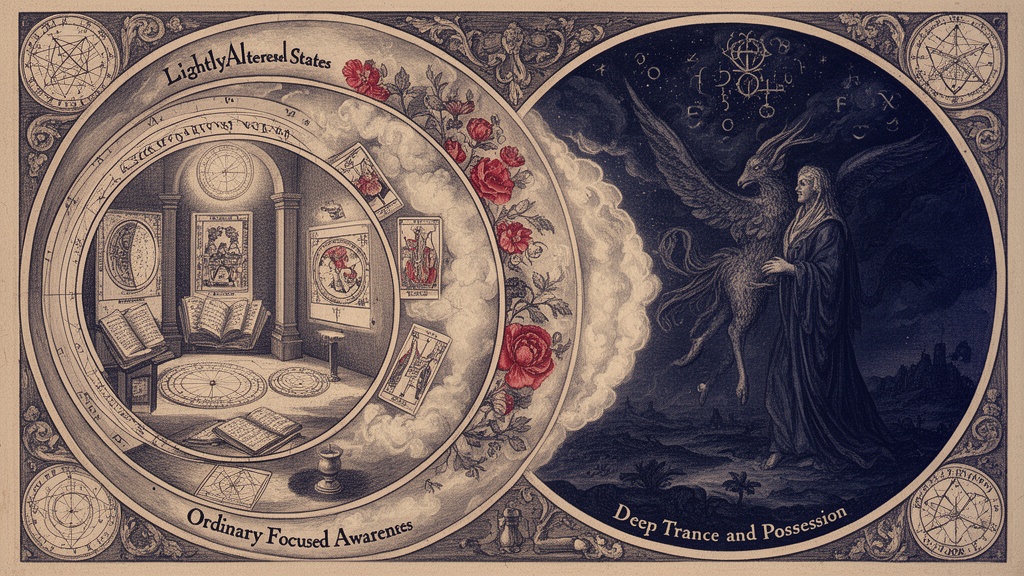
Psychologists are not unified here, but for our purposes we can draw a working map with three tiers. It won’t satisfy a lab manual, but it will let us talk precisely enough to matter at the table.
-
Ordinary focused awareness.
– You’re alert, tracking the querent, tracking the spread.
– Time feels normal. You know what you’re saying as you say it.
– You might feel “in the zone,” but you could stop and answer a text if you had to. -
Lightly altered states.
– Meditative absorption, hypnagogic drift, reverie, soft dissociation, light trance.
– The edges of the room blur; time stretches or compresses.
– Imagery, associations, and emotional tones feel more vivid, less edited.
– You’re still there, but the commentary track has gone quiet. -
Deep trance / possession / ecstatic states.
– Marked shift in sense of self or agency.
– You may speak in a different tone, language, or persona.
– Memory can be patchy or absent afterward.
– You and your querent both experience something “other” moving through.
When contemporary readers talk about “really channeling,” they’re usually pointing at tiers 2 and 3. The assumption—often unspoken—is that the further you are from tier 1, the more “authentic” the channel.
This article is about that assumption.
I’m not going to argue that altered states are fake or unnecessary across the board. I am going to argue that historical and phenomenological evidence simply does not support the idea that tarot (or divination more broadly) requires trance or possession to be real.
Once that universal claim is off the table, the question becomes more interesting: Which states support which kinds of authenticity, for whom, and at what cost?
Phenomenology: What It Feels Like From the Inside
Let’s start with the one thing we actually have access to: how reading feels from the inside.
When you drop into a lightly altered state (tier 2), several things typically happen:
- The analytic, narrativizing mind softens. You’re less busy deciding what to say and more watching what arrives.
- Symbolic associations proliferate. A single card flowers into multiple possible readings simultaneously.
- The sense of authorship blurs. You find yourself saying, “I don’t know where that came from, but it lands.”
From a depth-psychological angle, this looks like active imagination: a deliberate or semi-deliberate suspension of ego control so that unconscious material can constellate around the cards. The deck becomes a projection surface; the images “wake up,” and the unconscious speaks through them with less censorship.
In deeper trance or possession states (tier 3), the phenomenology sharpens:
- There may be a felt presence—ancestor, deity, guide, field—experienced as definitively “not‑me.”
- Language can become oracular, stylized, sometimes uncharacteristically blunt or poetic.
- The reader’s ordinary sense of self may recede so far that they later report the reading as if someone else did it.
From the outside, this looks archetypal: the Seer, the Sibyl, the Horse of the God. The reader is inhabiting a psychopomp role, mediating between visible and invisible.
None of this, by itself, proves that the content is more accurate, more predictive, or metaphysically superior. Phenomenology describes how it feels, not what it does. A reading that feels like channeled fire can still be wrong in every concrete detail. A reading delivered in tier‑1 “just talking” mode can be surgically on point.
So when we talk about “authenticity” here, we have to be precise:
- Internal authenticity: the reader’s felt sense of alignment, coherence, and contact.
- Communal authenticity: what a given lineage or scene recognizes as “the real thing.”
- External accuracy: whether the reading maps onto events, patterns, or psychological truths in a way that holds up over time.
Altered states clearly modulate internal authenticity and communal recognition. Whether they modulate external accuracy is, at best, an open question.
History: Ecstatics, Accountants, and Everyone in Between
If trance were universally necessary for divination, the historical record would be boring. It isn’t.
We do, of course, have the classics:
- Delphic-style oracles. Ecstatic utterance, fumes, possession by Apollo. The entire authority of the oracle rests on her altered state.
- Spiritist mediums and Victorian trance lecturers. Automatic speech, table-rapping, “controls” speaking through the medium. Again, the altered state is the credential.
- Possession cults across multiple cultures, where divination is delivered by a god or spirit riding the practitioner.
If you stop there, the case looks clear: channeling = altered state.
But in the same cultures, and certainly across others, we find parallel practices that are almost aggressively non‑ecstatic:
- Astrologers casting charts by hand, doing math and interpretive synthesis in what looks like tier‑1 awareness. The “channel” is in the symbolic system, not in a trance.
- I Ching consultation: throw coins, read text, reflect. The divinatory moment is in the pattern and its commentary, not in any visible altered state of the diviner.
- Medieval and Renaissance geomancers and cleromancers, working with lots, figures, and highly procedural rules. The legitimacy is in correct technique, not in ecstasy.
- Early modern and 19th‑century cartomancers—the line tarot eventually plugs into—working in cafés and parlors. Many accounts emphasize their shrewdness, memory, and social acuity, not trance.
Even within explicitly visionary traditions, we often see a division of labor:
- One person has the vision (sometimes in trance).
- Another, often more sober, interprets it.
Which of those roles maps more closely to what you do with tarot?
By the time we get to 20th‑century occult tarot, we see a spectrum. Lévi’s “astral light” and the Golden Dawn’s skrying practices sit closer to the ecstatic end; Waite’s published card meanings and Papus’ combinatory methods sit closer to the procedural. Crowley tries to have it both ways: highly structured correspondences and magical states that sometimes shade into intoxication or possession.
The point is not to catalog everything. The point is that even in cultures that valorize trance, divination has never been only trance. There have always been sober interpreters, technicians of symbol, and readers whose authority rested on knowledge, not ecstasy.
So when someone claims that authentic tarot channeling requires an altered state, they are not stating an historical fact. They are voicing a preference shaped by a particular lineage or subculture.
What Altered States Actually Do (Psychologically, Not Metaphysically)
If we bracket metaphysics for a moment and look through a psychological lens, altered states in tarot work do three main things.
-
They loosen egoic control.
The superego / persona relaxes. You’re less busy managing impressions, less invested in sounding reasonable. That allows riskier, less socially filtered material to surface—shadow content, intuition, emotionally charged truths. -
They amplify unconscious material.
Imagery, symbols, and affective tones become more vivid. The deck becomes a live theater for personal and archetypal dramas. This can be fertile or overwhelming, depending on your containment. -
They shift the sense of agency.
The more altered the state, the easier it is to experience the reading as coming from “elsewhere.” That can support humility (“I’m in service to something larger”) or abdication (“Don’t blame me, Spirit said it”).
From a trauma‑informed angle, the line between fruitful regression and defensive dissociation is thin. A light, mindful altered state can quiet hypervigilance and open symbolic play. A deeper dissociative state can simply be the nervous system checking out under the banner of “channeling.”
This is where the claim of “necessity” starts to fracture. If a given reader’s nervous system or history makes deep trance more likely to be dissociative than revelatory, insisting on trance as a requirement is not just wrong; it’s unethical.
Ordinary Consciousness Is Not the Enemy
Tier‑1 awareness gets a bad rap in mystical circles, as if being fully present and self‑aware is inherently “less spiritual” than being taken over.
But ordinary focused consciousness has its own virtues in divination:
- Discrimination. You can track which associations belong to you, which to the querent, which to the cultural field. You can choose what to voice and how.
- Responsiveness. You can adjust in real time to the querent’s reactions, clarify, reframe, or slow down when something hits hard.
- Memory and accountability. You remember what you said. You can revisit it, learn from it, and own it.
Psychologically, tier‑1 reading still involves unconscious processes. You are always projecting onto the cards; you are always drawing from layers of personal and collective imagery you did not consciously select. The difference is that the ego remains online as a co‑author rather than stepping back entirely. For many readers, that co‑authorship is not a bug; it’s the point.
If your practice has quietly assumed that “just talking” is somehow lesser than “going under,” it’s worth asking whose standard of authenticity you’re serving. A Victorian séance circle? A particular ceremonial lodge? An online aesthetic of witchcraft performativity?
The Shadow of Seeking—and Avoiding—Altered States
The pursuit of altered states can be its own form of defense.
Readers who build their entire legitimacy on trance or possession are exquisitely vulnerable to the charge that nothing “really” happened if the trance doesn’t show up. The temptation to exaggerate, perform, or unconsciously simulate an altered state is real. So is the temptation to attribute every uncomfortable truth to “Spirit” and every miss to “the energy shifted.”
On the other side, readers who insist on remaining strictly cognitive, hyper‑rational, or “evidence‑based” can be defending against their own irrational depths. The body, the imaginal, the numinous get walled off in the name of professionalism. The result is technically competent readings that never quite risk soul.
Both stances can be shadowy.
- The trance‑seeker may be avoiding owning their own authority, hiding behind the mask of the Oracle.
- The trance‑avoider may be avoiding surrender, control loss, and the possibility of being changed by what they touch.
Most practitioners, in reality, are not doctrinaire about this. They don’t wake up saying, “I shall seek trance today,” or “I shall avoid it.” They just read, and notice that sometimes the state shifts. Only later—if ever—do they name those shifts as “altered states.”
The value in naming is not to pathologize or prescribe, but to give you a more granular vocabulary for your own phenomenology. Instead of “that reading felt weird,” you can say, “My sense of agency shifted halfway through; my imagery spiked; my memory is patchy.” That’s actionable.
A Concrete Example: Reading Without Your Ritual
You’re running late. The previous client ran over, you haven’t lit a single candle, and the playlist you normally use to drop in is still paused at track one. Your next querent sits down for a career reading. Old you would say, “Give me five minutes to center; I’m not open yet.”
Instead, you decide to treat your current state—slightly rushed, fully awake—as sufficient.
You lay a Celtic Cross. You don’t invoke. You don’t breathe yourself into alpha. You simply attend.
What happens?
- You find that your recall of card structure and dignities is crisp. Years of study are right there.
- The querent’s body language and micro‑expressions are more available because you’re not half‑elsewhere.
- Associations still arise—The Chariot in position 10 hooks directly to the querent’s offhand comment about “driving this project”—but they feel more like quick, precise cuts than like waves.
Afterward, the querent says, “That was exactly what I needed.” You notice that while you didn’t feel “carried,” you did feel clear. The reading holds up in follow‑up sessions.
Does this disprove the value of your usual ritual? No. It does, however, puncture the belief that without a recognizable altered state you are somehow “not really channeling.”
You can now choose your state as a tool, not as a credential.
The Irreducible “Other” (And Why Psychology Doesn’t Get the Last Word)
Everything I’ve said so far can be contained within a psychological frame. Ego loosens, unconscious material surfaces, archetypes constellate, projections fly. We can talk about transference and countertransference between reader and querent, about how an altered state amplifies projection onto the “oracle” role.
That frame is useful. It keeps us honest. It forces us to distinguish between phenomenological richness and empirical accuracy, between felt numinosity and verifiable claim.
But it does not exhaust the experience.
Ask working readers about their strongest channeling moments, and you will hear stories that do not sit comfortably inside “it was just my unconscious”:
- The ancestor who shows up with verifiable details the reader had no access to.
- The deity who arrives uninvited through a deck not associated with that pantheon, speaking in a voice the reader does not recognize as their own.
- The field phenomenon where multiple readers, working independently, pull near‑identical spreads with near‑identical language for the same querent or situation.
You can, if you like, fold all of this back into an expanded model of psyche. Or you can say, “Something other moved through.” Both descriptions run in parallel. Neither cancels the other.
What matters for our question is this: even if there is a genuine “other” that sometimes speaks through the cards, the historical and phenomenological evidence still doesn’t show that it only speaks when you are in deep trance.
Readers report contact with that other in all three tiers:
- In tier‑1, as a quiet, insistent knowing that cuts across their own preferences.
- In tier‑2, as imaginal figures that feel autonomous, dialogical.
- In tier‑3, as full‑blown possession.
If the mystery can show up anywhere on that spectrum, “necessity” becomes a non‑starter. What we’re left with is compatibility: which states make you more available to whatever you understand as other, without burning out your nervous system or your ethics.
So What Do We Do With This?
Once the romance and the anxiety are both off the table, the strongest defensible claim is simple:
Altered states have often been valorized in divinatory traditions, but they are not universally required for meaningful or experientially authentic tarot reading.
If you accept that, a few practical implications follow.
- You can stop treating trance as a moral or spiritual obligation. If you don’t naturally drop into altered states, nothing is “wrong” with your channel.
- You can experiment. Do a series of readings deliberately in tier‑1 awareness. Do another series after a light meditative induction. Track differences in felt authenticity, client response, and long‑term accuracy.
- You can recalibrate your ethics. If you know that deep trance compromises your memory or discernment, maybe you reserve it for private work, not paying clients. If you know that staying fully present keeps you from saying things you can’t stand behind later, that matters.
- You can talk to your querents like adults. “Sometimes I go into a more altered state; sometimes I stay very conversational. Both are valid ways of working; today I’m going to… [name what you’re doing].”
None of this resolves the paradox between psyche and mystery, between symbol and spirit. It doesn’t tell you, finally, whether the voice you hear in the cards is “you,” “them,” “it,” or some entangled field.
What it does is remove one unhelpful constraint: the idea that you must either dramatize your otherness or apologize for your ordinariness to be a real reader.
Once that’s gone, you’re left with a harder, more interesting task: mapping, with some rigor, the actual topography of your own states of consciousness in practice. Not the states you were told to value. Not the ones that look good on social media. The ones that genuinely deepen your contact with symbol, self, other, and whatever you call the thing that sometimes speaks when the cards are on the table and the room goes very, very quiet.
If you take that map seriously, you may find that the most radical altered state available to your tarot practice is not ecstasy at all, but an unembellished, fully awake presence that no tradition can quite claim and no doctrine can finally justify.