
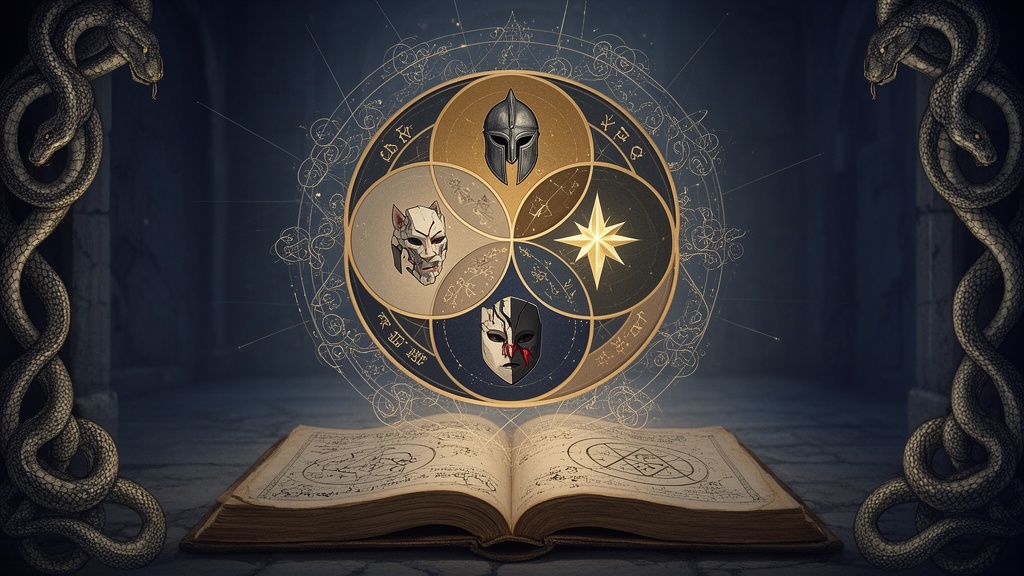
If more than one “you” is sitting at the table, whose future is your spread actually binding?
That is not a metaphorical question. It is a structural one. Most divinatory methods—from three-card “past–present–future” spreads to elaborate Kabbalistic mandalas—are built on the assumption that there is one subject of the reading. One agent who asks, one life-line that unfolds, one bundle of will and consequence the cards are “about”.
Once you stop treating that as a given, the whole architecture creaks.
This piece is not about whether plurality is “real”, or whether DID is overdiagnosed, or whether IFS parts are just fancy subpersonalities. It takes a narrower, more awkward question: if we take seriously that some querents experience themselves as more than one centre of agency, what does that do to our spreads, our consent logic, and the way we speak as readers?
And perhaps more uncomfortably: how often have we already used oracles to bully weaker inner voices, and called it guidance?
What “plural” are we even talking about?
“More than one you” covers a messy territory. If we do not carve it up, any recommendation becomes either meaningless or dangerous.
At minimum, there are four different things in play:
-
Clinically formalised plurality
Dissociative Identity Disorder, OSDD, structural dissociation. Multiple parts or alters with discontinuities in memory, sense of self, and control of behaviour. This is trauma territory, and there are standards of care for it. -
Therapeutic / experiential parts models
IFS, ego-state work, transactional analysis, Jungian complexes. Here “parts” are semi-autonomous bundles of affect, belief, and history. They may feel like distinct people at times, but the frame is explicitly intrapsychic. -
Subcultural and spiritual framings
Tulpamancy, soulbonds, headmates, spirit companions. People who experience stable inner others and may or may not link that to trauma. Some are explicit that their system is spiritual, not psychological. -
Metaphorical inner characters
The inner critic, the muse, the saboteur. Writers talking about “the character that lives in my head.” No diagnosis, no formal practice—just the recognition that we are not psychologically flat.
This article is primarily concerned with people who experience multiple inner agents with their own agendas, regardless of which box they tick. It does not treat DID as interchangeable with tulpamancy, or IFS as a synonym for spirit work. The ethical pressure point is simpler: if the querent in front of you is not a single, unified decision-maker, your usual way of addressing “you” is no longer neutral.
It is also not a diagnostic text. Nothing here should be used to identify DID, “detect” structural dissociation, or substitute for therapy. The tools and spreads I will sketch are symbolic devices for self-reflection and ethical containment, not instruments that reveal clinical truth.
The monadic querent baked into divination
Look at how spreads talk.
“Where you are now.”
“Outcome if you follow this path.”
Tarot books, rune guides, geomantic manuals—almost all speak in the singular. Even when they nod to “inner conflict”, they still assume one subject who is conflicted, not several subjects in disagreement.
The structure is monological: one questioner, one oracular field, one answer. Even multi-position spreads like the Celtic Cross treat the positions as facets of one psyche, one timeline.
That monadic subject is not a neutral default. It is a model of mind. Once you overlay plural-psyche frameworks on top of it, several things become obvious:
-
If different inner agents have different stakes in the question, there is no single “you” whose consent can authorise the reading.
-
If one part is driving the question whilst another will bear most of the consequences, a reading that speaks to “you” as a unified will risks siding, by default, with the part that can reach the table.
-
If a system has internal hierarchy—hosts, protectors, exiles—then any oracle that returns “You must integrate / let go / move on” can easily be weaponised by the powerful against the marginalised.
None of this requires exotic metaphysics. It follows directly from the plural models themselves. IFS explicitly describes protectors who override exiles “for their own good”. Structural dissociation describes ANPs (apparently normal parts) who are motivated to keep trauma material dissociated. DID case material is full of systems where one alter seeks therapy and another sabotages it.
If those dynamics exist in the therapy room, they exist at the reading table. Oracles, with their aura of authority, are perfect tools for internal coercion.
I have seen versions of this play out:
-
A self-identified plural system comes for a reading about a relationship. The presenting host wants to leave. A protector part is terrified of abandonment. The spread is framed as “Should you stay or go?” The cards fall heavily towards “go”. The host leaves, quoting “the cards” as justification. The protector responds with weeks of self-harm ideation, and the system later describes the reading as “being ganged up on”.
-
A client doing parts work pulls daily cards “for guidance”. Whenever a fearful, trauma-linked part surfaces, they ask the deck, “Do I really need to listen to this?” and interpret any “negative” card as confirmation that the part is “toxic” or “a demon”. The oracle becomes an exorcism tool against their own exiles.
-
A reader, uncomfortable with plurality, reframes alters as “attachments” and uses a spread specifically designed for spirit banishing. The system reports feeling “psychically assaulted” and stops divination entirely.
These are anecdotal, not controlled studies. But they are not rare. And they are not surprising once you see that standard practice assumes one agent who can legitimately speak for “the self”.
The claim, then, is not that we must redesign divination or we are committing malpractice. It is that if we take plural-psyche models seriously, we have strong reasons to reconsider how our methods operate when the querent is not singular.
The oracle as mediating object, not judge
Psychologically, what changes when you read for a plural system is not just the content of the spread. It is the mechanism.
With a unitary ego, the oracle is often a mirror: projection, amplification, gentle contradiction. One subject meets a symbolic field and negotiates meaning.
With a plural psyche, the oracle becomes a third space in a dialogue. Multiple inner agents are projecting onto the same symbolic field, sometimes in competition. The cards, runes, or hexagrams become an externalised surface where parts can see their differences reflected.
That is not hypothetical. In practice, you will see things like:
-
The same card eliciting radically different responses from different parts. One alter sees Death and panics; another sees liberation.
-
A protector part refusing to let the querent even look at certain positions in the spread, or insisting on re-shuffling until “the right” card appears.
-
A young exile latching onto an image (say, the Star) as proof that “someone finally understands”, whilst the managerial host dismisses it as “false hope”.
In that context, the most useful stance is not “I, reader, will determine what the oracle objectively says about you.” It is closer to: “Let us see how your internal family responds to these symbols, and whether the spread can mediate a conversation.”
This is where the archetypal layer becomes interesting rather than merely decorative. Parts are often already living archetypes: the Wounded Child, the Warrior Protector, the Witch, the Martyr. A spread can serve as a stage where those figures appear, interact, and are recognised.
But only if we stop collapsing them back into a single “you” every time we open our mouths.
Consent when there is no single decider
Ethics in divination has finally caught up with the idea that you should not read for someone without their consent. Plurality asks a harder version: what counts as consent when there is no single subject who can grant it?
In therapy, the pragmatic answer is: you work with the part who shows up, and you do not assume that consent generalises to the whole system. You also do not try to “treat” parts who have not consented, and you are careful not to ally with one part against another.
We can adapt that logic without pretending to do therapy.
At minimum, for any reading that might significantly affect a plural querent’s life, it is worth:
-
Naming who is asking.
“Who is fronting right now?” or, in less clinical language, “Which part of you is most present with this question?” This is not diagnostic; it is situational awareness. -
Asking about other stakeholders.
“Are there other parts / inner voices who have strong feelings about this topic?” If so, “Would they want to be included, or would they prefer not to engage?” -
Clarifying scope.
“This reading will speak to the part of you that is asking, and to whatever else chooses to respond through the cards. It cannot bind your whole system unless all of you agree.”
That last sentence matters. In plural communities, one recurring harm is external authorities—therapists, priests, partners—treating the host or a dominant alter as “the real one” and everyone else as noise. Oracles can easily replicate that: “The cards say you must integrate”, addressed to the host, becomes a weapon used against reluctant alters.
A divinatory ethic that recognises plurality would instead treat non-consensus as data. If different parts do not agree, the reading is not “unclear”; it is accurately reflecting a multi-agent system.
You can build that into spreads without pretending you can guarantee safety.
Spreads for more than one voice
The temptation here is to invent a “Plurality Spread” and declare the problem solved. That would be dishonest. No layout can prevent a determined host from using the oracle to override an exile.
What we can do is design structures that invite multiple perspectives and make it harder to ignore them.
For example, a simple three-card frame for a decision:
-
Fronting part’s perspective
“What does the part who is asking want from this situation?” -
Protector / cautious part’s concerns
“What does the part of you that is trying to keep you safe fear here?” -
Hidden / marginalised part’s needs
“What does a less-heard part of you need us to know about this?”
You do not need the querent to have formal IFS language. You can translate: “the part that is pushing forward”, “the part that slams the brakes”, “the quiet part that never gets the mic”.
Before pulling, you might say: “If any part does not want to be spoken for in position 3, that is fine; we will treat that card as ‘what is currently out of view’ rather than ‘what you must expose’.”
After the spread, you resist the urge to synthesise into a single directive. If position 1 shows the Chariot, position 2 the Nine of Swords, and position 3 the Four of Cups, you might say:
“There is a strong drive to move, a strong fear of catastrophe, and a quieter sense of numbness or depletion. Rather than deciding which is ‘true’, this spread is showing how your internal family is not yet aligned. Any choice you make will go better if you acknowledge all three.”
Notice what this is not doing. It is not diagnosing DID. It is not claiming that card 3 has literally contacted a specific alter. It is using the symbolic positions to make room for more than one inner stance.
You can extend this logic:
-
Consensus-check positions
A final card: “What happens if you proceed without full internal agreement?” Another: “What supports would help your internal system handle this choice?” This is not a clinical consent form. It is a way of surfacing the cost of railroading. -
Non-coherence flags
A position explicitly named: “Where is the spread refusing to give a single answer?” If wildly contradictory cards land there, you do not blame the oracle; you name the multiplicity. -
Part-specific readings
Occasionally, with systems who work explicitly with alters or parts, you may be invited to read for a specific part. In that case, you anchor the question: “This reading is for [name/description of part]. Other parts are welcome to observe, but the guidance is not automatically for them.” The ethical move is to keep that boundary clear, not to universalise.
None of this prevents misuse. A host who wants to ignore their protectors can still say, “Well, the Chariot is clearly the real me; the Nine of Swords is just my anxiety.” But at least the structure has made the anxiety visible as a legitimate voice, not a glitch.
Spirits, parts, and the risk of bad analogies
The esoteric world has its own plurality: spirits, daemons, guides, ancestors, egregores. It is tempting to draw a neat line: “Your IFS parts are just like your spirit allies; all are inner figures we can talk to through the cards.”
That analogy is useful at one level and dangerous at another.
On the useful side: both spirits and parts are experienced as semi-autonomous agents. Both can be in conflict. Both can be engaged with, negotiated with, even bound by oaths in some traditions. From a phenomenological standpoint, reading for “my war ancestor” and reading for “my angry protector” can feel structurally similar.
On the dangerous side: clinical models of dissociation are explicitly not describing literal others. They are describing how one human nervous system copes with trauma by compartmentalising experience. Treating alters as spirits to be exorcised, banished, or bargained with as if they were external entities is contraindicated in every modern standard of care.
Conversely, reducing spirits to “just parts” is equally sloppy. It collapses an entire esoteric ontology into a psychologising gesture that helps nobody.
The cleanest way through is to hold two parallel statements:
-
When we talk about IFS parts, structural dissociation, or DID alters here, we are using models of intrapsychic organisation. We are not making ontological claims about whether they are “really” just you.
-
When we talk about spirits, daemons, and guides, we are in the territory of esoteric ontology. In that frame, they are not you, even if your psyche is the instrument through which you meet them.
In practice, the question for divination is not “Is this voice a part or a spirit?” It is “Given that the querent experiences multiple agents, how do we avoid trampling any of them with oracular authority?”
If a system says, “This alter is a demon attached to me,” a trauma-informed stance would be cautious about literalising that. You can still design a spread that asks, “What does this presence want? What does the vulnerable part it is attached to need? What boundaries support your safety?” without endorsing an exorcism frame.
Similarly, if a spirit-worker says, “My guide disagrees with my human self about this move,” the plural logic still applies: you are dealing with more than one agent with different priorities. A multi-voice spread can make that explicit.
The point is not to adjudicate what is “really” happening. It is to design oracular practice that does not carelessly re-enact the worst of either psychology or occultism.
Shadow, hierarchy, and the oracle as weapon
Shadow work has long been part of serious divination. But in plural systems, shadow is not just repressed content; it is often repressed agents.
The system’s dominant configuration—host plus favoured protectors—will have its own shadow: exiles locked away, inconvenient alters minimised, entire affective worlds declared “not me”. Divination that aims for tidiness—clear answers, coherent narratives, “integration” as the only acceptable arc—will naturally align with that dominant coalition.
Some familiar moves take on a different colour in this light:
-
“Your fear is just resistance to growth”
Said to a protector whose job is to keep the system alive, this is not encouragement; it is gaslighting. -
“The cards show you need to let go of the past”
Directed at exiles who have never had their story heard, this is erasure. -
“You keep pulling Swords because you are in your head, not your heart”
To a highly cognitive host who has been forced to manage chaos for years, this may be the only safe place they have.
The issue is not that these interpretations are always wrong. It is that, in plural contexts, they can easily become tools of internal oppression. The oracle’s symbolic authority—”this is what the cards / runes / spirits say”—gives cover to whichever inner faction wants to win.
A plural-aware reader will resist becoming an enforcer. They will:
-
Treat distressing cards not as proof that a part is “toxic” or “demonic”, but as signals of unmet need or unprocessed pain.
-
Notice when one part is trying to use the reading to pathologise another (“see, the cards say you’re the problem”) and name that dynamic.
-
Be willing to leave a reading incoherent rather than forcing a narrative that sacrifices minority voices.
This is where the sceptical instinct is actually protective. If you do not believe that your spread gives you infallible access to the capital-T Truth about the querent, you are less likely to wield it as a cudgel.
The reader’s projections and limits
Plurality does not just complicate the querent side. It also exposes the reader’s own shadow and projections.
If you have unresolved fear of “madness”, DID case studies you half remember, or a background in deliverance ministry, a plural system will light that up. Without noticing, you may:
-
Collapse plurality into pathology and subtly steer the reading towards “integration” as cure.
-
Reframe alters as spirits because that is a more familiar category, and reach for banishing tools.
-
Over-identify with a particular part (often the host or a protector who reminds you of yourself) and ally with them against others.
Designing plural-aware spreads will not save you from that. The only thing that helps is ongoing self-examination and a willingness to say, “This is beyond my competence.”
There are situations where the most ethical move is to decline or radically narrow the scope of a reading:
-
If the querent is actively destabilised, switching rapidly, with parts arguing through you.
-
If the system is in crisis around self-harm, suicidality, or acute trauma response, and you are not a clinician equipped to hold that space — refer out, decline, or radically narrow the scope of what you are doing.
-
If you find yourself wanting to “fix” the system, or feeling responsible for their internal coherence.
In those moments, the best divination is often no divination. Refer to a trauma-informed therapist if the querent is open to that. If they are not, you can still name your limits: “I can offer symbolic reflection, but what you are describing needs more support than a reading can provide.”
This work—reading for plural systems, designing spreads that do not collapse multiplicity, resisting the urge to enforce coherence—is still experimental. We do not have outcome studies. We do not have consensus protocols. What we have is a growing recognition that the monadic querent was never the only kind of person at the table, and that our methods have been quietly erasing everyone else.
The task now is to build oracular practice that can hold more than one voice without pretending it is easy, safe, or solved.