
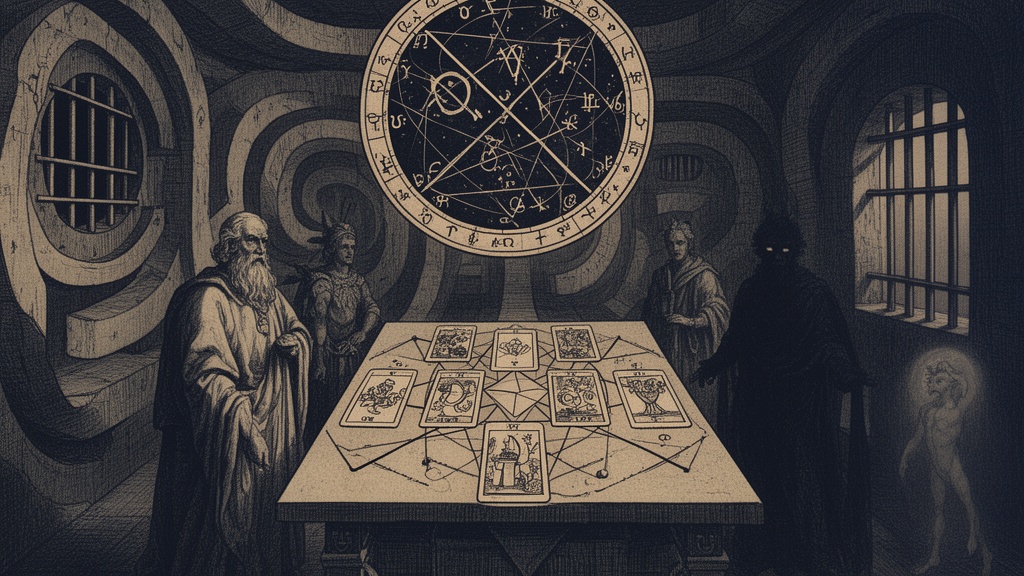
Inside a self-sealing belief system, every card you pull is already scripted—unless you deliberately build an escape hatch into the spread.
That is not a metaphysical claim about the cards. It is a claim about what happens when ambiguous symbols meet a group that has outlawed surprise. The behaviour that changes is not the oracle’s “output” but the way minds and groups metabolise it.
The question is whether spread design and question structure can do anything about that—or whether, once the epistemic doors have been bolted, all we are really doing is decorating the walls of the cell.
What counts as a “closed world”?
We need a harder edge than “intense group” or “strong beliefs”. There is a difference between a devotional coven with a clear mythos and a system that has turned its back on reality testing.
For our purposes, an epistemically closed environment has at least three features:
- Non-falsifiability: Core claims are insulated from refutation. Any possible event can be explained as confirmation.
- Active sanctioning of disconfirmation: Doubt or contradiction is not just frowned upon; it carries social, spiritual, or material penalties.
- Insulation from external feedback: Outsiders’ perspectives are discounted in principle—”asleep”, “mundane”, “agents of the Archons”, “MK-Ultra victims”, and so on.
Closure is a gradient, but once those three line up, the oracle is in trouble.
Contrast three quick vignettes:
- Tarot study group: Strong preferences (“We read the Devil as shadow work, not addiction”), but if a reading points to a mundane explanation, no one is excommunicated. Members still cross-check against jobs, relationships, bank balances.
- Initiatory magical order: Doctrinal frame is tight. Certain cards “mean” specific Sephirot or grades. But if someone’s ritual result does not match the expected vision, the group may actually use that as data: “Where did the banishing slip?” Disconfirmation is uncomfortable but not structurally impossible.
- Conspiracy enclave / cultic order: Every event is proof of the narrative. Failed prophecy? “Spiritual fulfilment.” Legal charges? “Persecution by the Deep State.” A Tower card drawn for the leader’s health proves the “attack” is intensifying. Any interpretation that does not bend back to the myth is suspect, possibly demonic.
In the first two, a Celtic Cross is still capable of ambush. In the third, the same spread behaves differently—not because the positions changed, but because the interpretive regime forbids certain moves.
This is what “divination behaves differently in closed systems” really means: not that the oracle loses its powers, but that the human feedback loop around it has been engineered to exclude certain classes of meaning.
From projective exercise to projective assimilation
Divination in open contexts is structurally risky. You and the querent invite something other than your conscious narrative to speak: the unconscious, the spirits, the patterning of synchronicity, however you language it. Even if you are a strict materialist, you at least allow the cards to destabilise the story you walked in with.
In a closed world, that risk is removed.
Psychologically, the mechanism is straightforward:
- Motivated reasoning: The querent (and often the reader) has a preferred conclusion. Interpretations are steered, often unconsciously, towards that outcome.
- Confirmation bias: Symbols that support the group myth are highlighted. Discordant cards are minimised, reinterpreted, or pathologised.
- Social enforcement: The group’s reaction to “off-script” readings trains everyone in what is sayable. You learn quickly which interpretations get you praised for “discernment” and which get you labelled “under attack”.
The result is not just projection but what we might call projective assimilation. Whatever the oracle throws up, the system’s mythic immune system wraps around it and digests it.
The archetypal configuration is familiar. The Senex dominates: law, order, the already-known. The Hero in shadow mode defends the narrative at all costs. The Trickster—the disruptive ambiguity that makes real oracles dangerous—is exiled. The Oracle archetype itself is captured; it no longer mediates between worlds, it parrots the group ego.
This is why so many readings in these environments feel curiously bloodless, no matter how dramatic the language. The cards are not allowed to be other.
When the spread itself becomes a weapon
The sceptical objection here is valid: the root problem is not the geometry of the spread but the interpretive norms and power structure around it. A Celtic Cross can be used to enforce doctrine or to dismantle it.
Still, spread design is not neutral. In a closed system, certain question types and layouts act as risk multipliers for closure. They align structurally with the group’s need to avoid disconfirmation.
Three recurrent pathologies:
- Outcome fetishism under punishment
Any spread that culminates in a single, definitive “Will X happen?” card is dangerous in a context where the answer is not allowed to be “No”.
Example: A doomsday group asks, “Will the prophecy be fulfilled this year?” Outcome card: 4 of Cups. In an open context, you might talk about disappointment, delay, re-evaluation. In a closed context, the card is immediately retranslated as “The world will ignore the fulfilment” or “God is testing our faith”.
The geometry funnels all ambivalence into a binary, then hands that binary to a group that cannot afford one of the two options. The only tolerable move is to reinterpret.
- Service-to-mission framing
Spreads built entirely around “How can I better serve the Work / Leader / Mission?” collapse the field of possible concerns. There is no position for “At what cost?” or “To whom am I lying?”
Inside a high-control order, a classic “Path of Service” spread becomes structurally aligned with exploitation. Every card, however grim, is read as “what you must sacrifice”. The 10 of Swords is “ego death for the Great Work”, not burnout or abuse.
- Doctrine-locked position titles
Positions like “Karmic Lesson”, “Attack from the Dark Lodge”, “Blockage in the Throat Chakra” pre-encode the explanation. The card is no longer allowed to say “There is no attack” or “This is not about karma at all”.
In a conspiracy frame, a “Hidden Enemies” slot will always be filled—from the deck if not from the reader’s imagination.
None of these layouts is inherently evil. In an exploratory group, they can be used creatively. But in a system where disconfirmation is punished, they become structural accomplices. They pre-select the kinds of answers the oracle is allowed to give.
When the oracle refuses to stay on script
If you have read long enough, you have seen the oracle misbehave even in the tightest of temples. The leader draws cards about the glorious success of the coming operation and gets the 7 of Swords, the Tower, the 8 of Cups. The official interpretation is “spiritual warfare”, but you can feel the current running the other way.
Psychology has a lot to say about this—unconscious doubts surfacing, micro-rebellions sneaking through symbol selection. But those accounts do not exhaust the phenomenon. There are readings that land like an intrusion, a foreign body in the group mind, and refuse to be fully digested. They nag. They return in dreams. They become the seed of someone’s eventual exit.
Even if you take a strictly Jungian view, the objective psyche has its own agenda. If you allow for spirits or acausal patterning, the argument is stronger: whatever is on the other end of the line is not necessarily loyal to the cult.
The practical problem is that closed systems are extremely good at patching leaks. A disruptive card can be labelled “attack”, “test”, “deception”. A spread that momentarily opens an outside perspective can be rebranded as “what the enemy thinks of us”. The immune system learns.
So the question becomes: can we design for this resistance to capture in a way that is more than cosmetic? Or are we flattering ourselves?
Escape-hatch spreads: what they can and cannot do
Let us be blunt: no clever layout is going to “fix” an environment that meets the three criteria of closure. If disconfirmation is punished, if external reality is pre-emptively discounted, if the group has had years to develop interpretive antibodies, your spread is not a crowbar. At best, it is a hairline crack.
That said, spread and question design can create micro-conditions where the oracle’s resistance to capture has a better chance of doing its work—especially for individuals who are already ambivalent.
Three design principles are worth exploring, with their failure modes kept firmly in view.
1. Explicit outside perspectives
Design positions that are anchored, in their very wording, to an external point of view:
- “What would an outsider see here?”
- “How does this look from outside the group’s story?”
- “How might someone unaffected by our doctrine read this situation?”
In the conspiracy scenario from earlier—”What will confirm that our group’s prophecy is correct in the coming month?”—you might propose:
- Group’s expectation of fulfilment
- What an outsider would see happening
- Unseen contradiction or cost
Card 1 can do the usual work of mirroring the myth. Card 2 is the wedge: you insist, up front, that it must be narrated in terms that a non-believer could recognise. Card 3 is not allowed to be spun as “support”; it is explicitly “contradiction or cost”.
Failure modes are obvious. Card 2 can be reinterpreted as “how the sheep see it, the fools”, and Card 3 as “persecution that proves we are right”. In a fully closed group, that is exactly what will happen.
Where this sometimes does real work is with a querent already half-in, half-out. Giving them permission to imagine an outsider’s view—with the cards as a transitional object—can legitimise the doubts they already have. The spread is not creating scepticism; it is giving it a safe mask.
2. Forced contradiction slots
Most spreads are structurally conciliatory. Even the “challenge” position is usually folded back into a “how to overcome it” narrative. To resist closure, you can build in positions that are required to stand as contradictions:
- “What am I refusing to see?”
- “What in this situation does not fit the story?”
- “What would prove us wrong if we took it seriously?”
The rule of the spread is that these positions may not be harmonised away. If the group myth is “We are persecuted innocents”, and the “does not fit” card is the Devil, you sit with addiction, complicity, or obsession, not “the Devil is attacking us”.
Again, the failure mode is retranslation: “What we are refusing to see is how powerful the enemy is.” The card is turned into more of the same.
The leverage here is not on the group but on the individual psyche. You are giving the unconscious a formally sanctioned space to object. If there is nothing there, nothing will happen. If there is, the symbol can constellate it.
3. Randomised blind elements
Closed systems thrive on pre-formatted questions: “How can I better serve?”, “What is blocking the mission?”, “How is the Dark Lodge attacking us?” One way to loosen that grip is to insert question elements that neither reader nor querent fully control.
For example:
- You and the querent each secretly write a possible question—one doctrinal, one not—and shuffle them. You draw one face-down and read without knowing which is which until after the interpretation.
- An external party (not from the group) supplies a list of possible question frames in advance. The querent randomly selects one to use.
Or within a spread:
- Include a “wild card” position whose interpretive rule is “must not be read through group jargon; use only mundane language, as if explaining to a stranger on a train.”
These protocols are fragile. A sufficiently trained group mind can absorb them in a week. But again, they are not aimed at overthrowing the system; they are aimed at making it slightly harder for the querent to keep everything inside the same groove.
In some cases, the very experience of not knowing which question has been drawn, or of being forced to describe a card without sacred vocabulary, produces a momentary vertigo. That vertigo is the crack.
When technique is not enough: ethics at the table
The strongest ethical objection to “escape-hatch” design is that it may encourage practitioners to stay inside systems that are, frankly, abusive, on the fantasy that they are doing subversive work. “I’m helping from within” is a story cults specialise in feeding to their more intelligent members.
We need to be honest about the limits.
- In a fully closed, heavily sanctioned environment, any spread you design will be used as another tool of enforcement unless you are willing to openly defy the interpretive regime. That defiance has costs—for you and for the querent.
- In mildly to moderately closed groups—intense but not yet cultic—spread design can be part of a broader strategy of reality-testing and boundary-setting. But it is not a substitute for those other moves.
- There are situations where the only non-collusive act is refusal: declining to read on certain questions (“Will the prophecy be fulfilled?”), or at all, and naming why.
Practically, you will feel the line in your body. When you notice yourself smoothing over contradictions to avoid trouble, or coaching the cards into orthodoxy to keep your place in the order, the oracle has already been captured—and you with it.
The skills required here are not primarily technical. They are:
- The capacity to hold contradiction without resolving it prematurely.
- The willingness to disappoint, unsettle, or lose clients.
- The clarity to recognise when you are being recruited as liturgical staff for someone else’s closed world.
Spread geometry matters, but the spine behind it matters more.
The devouring container
One of the more disturbing archetypal patterns in closed systems is the shift from Mother as container to Devouring Mother: the group as an engulfing matrix that punishes differentiation. Divination is often framed as “nurturing guidance”, “loving correction”, “Mother’s voice”.
In that frame, any card that points to exit—8 of Cups, Fool, 6 of Swords—is re-coded as “temptation to abandon your true family” or “test of loyalty”. The labyrinth is declared already mapped. There is nothing outside the walls but chaos.
Designing spreads that name the possibility of outside is one way to push back:
- “What lies beyond the current path?”
- “What would it mean to step out, even briefly?”
- “What does my life look like if I stop doing this work for six months?”
You may never be allowed to ask these questions overtly in a temple setting. But you can offer them quietly to individual querents who are already peering over the edge. Sometimes you do not need the cards to answer; the very act of articulating the position is the heresy.
Leaky oracles, leaky selves
There is a temptation, especially for those of us who love structure, to treat all this as an engineering problem. If we can just get the right combination of cross-checking positions, blind draws, and outsider perspectives, the oracle will outwit the cult.
That is not how it works. Oracles are not measuring devices. They are sites of encounter—between conscious and unconscious, individual and group, human and whatever-else. In closed worlds, that encounter is policed. Spread design can shift the angles of incidence, but it cannot remove the guards.
The more interesting question, perhaps, is what happens to us as readers when we work in these environments. Do we become harder, more sceptical, more cunning? Do we start building escape hatches into every spread, even for ordinary clients, unable to trust any narrative that closes too neatly? Or do we, slowly, let the group’s certainty colonise our own interpretive instincts?
“Inside a self-sealing belief system, every card you pull is already scripted.” The real test is whether you notice when that scripting begins to sound like your own voice—and whether, at that point, you are still willing to let a single, badly behaved card ruin the story.