
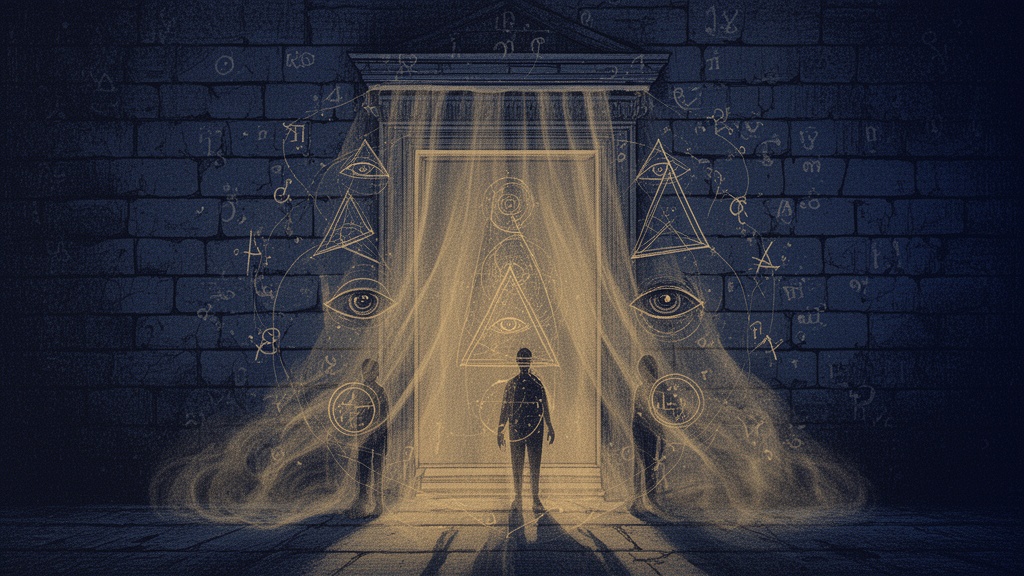
If some of the psyche you’re reading for literally has no words and no pictures, what exactly do you think your cards are talking to?
That isn’t a rhetorical flourish. It’s a technical question. Because if you answer it lazily—”the unconscious”, “the inner child”, “my guides”—your practice will quietly default to colonising whatever cannot answer back with a story.
The alternative is harder: to admit that some of what we read for is genuinely non-symbolic, or at least non-reportable, and to design oracles that respect that fact by not pretending to understand.
Three kinds of “no words”
We need sharper categories than “deep stuff”. Otherwise this whole topic dissolves into vibes.
There are at least three distinct layers in play:
-
Sub-symbolic processes
Neural and bodily configurations that never appear as images or words in principle: autonomic states, error signals in predictive processing, procedural patterns. You infer them indirectly—from heart rate, flinch response, the way a hand hovers over one pile of cards rather than another. They are “hidden states” in the technical sense. -
Pre-verbal experience
Early attachment states, infant terror or delight, the feel of a room before you had language. These can later acquire images and words, but they weren’t structured that way when laid down. Any later narrative is an after-the-fact mapping. -
Non-reportable / dissociated material
Experiences that could be symbolised, but are currently sealed off. Structural dissociation, frozen trauma scenes, self-states that go blank when approached. Here the block is defensive or architectural, not inherent.
All three are “beyond words” in different senses. Lumping them together is sloppy; treating them the same in practice is dangerous.
What you can do is constrain how much symbol you allow yourself to squeeze out of a given operation: binary rather than narrative, index rather than story, presence rather than content.
Once you accept that, “divination under anaesthesia” stops being a romantic metaphor and becomes a design problem.
Hidden states and noisy channels
Modern cognitive science is useful here—not as proof of how tarot works, but as a structural analogue.
In predictive-coding style models, you never see the system’s internal configuration directly. You see reaction times, choices, micro-movements, autonomic shifts. From those coarse, noisy outputs you infer a “hidden state”: threat level, expected reward, implicit bias. The link is causal and testable, but always indirect.
Pure-lot oracles—geomancy, coin throws, yarrow stalks, dice—have the same shape:
- There is some unseen configuration: “the figure”, “the line”, “the lot”, “the pattern of the moment”.
- The querent’s micro-behaviour (when they stop shaking, which page they open to) couples that configuration to a discrete output.
- You never access the hidden thing itself; you get coarse-grained symbols and work within that limit.
The analogy is formal, not mechanistic. We do not know how psyche, spirits, field, or anything else couples to the fall of cards. We do not have an fMRI of the Hanged Man. If you try to sell “tarot as a diagnostic sampler of your predictive hierarchy”, you are doing pseudoscience.
The point of the analogy is discipline. If you treat the draw as a noisy, low-bandwidth channel from an inaccessible configuration, you stop pretending your ten-card Celtic Cross is a transparent biography of someone’s preverbal terror. You are sampling boundary conditions, not downloading a trauma narrative.
That shift alone will clean up an astonishing amount of overreach.
Not everything wants to be a story
Most of our training—occult and psychological—biases us towards narrative. Archetypes, myths, life-paths, “what happened and what it means”. Even trauma-informed tarot tends to assume that if you go gently enough, the unspeakable will eventually sit down and give an interview.
Sometimes that’s true. Sometimes it isn’t.
From a trauma perspective, dissociation is not just damage; it is also architecture. The system has built sealed rooms so it can go on living. Parts work recognises that some self-states are meant to be out of contact most of the time. Forcing access can destabilise the whole structure.
Esoteric systems have their own language for this: veils, inner temples, sealed teachings, names that must not be spoken. The point is not mystique; it’s containment. The outer court protects both the initiate and the current.
You do not prove your devotion to a current by tearing down its veils. You prove it by guarding them.
The same applies at the table. There are parts of psyche that may never be safely narrativised. There are others that could be, but not today. If you treat every silence, every blank, every “I don’t know” as a challenge to your interpretive prowess, you have already taken the coloniser’s stance: everything must be brought under story.
Divination for non-symbolic layers has to be willing to fail at story on purpose.
Valence oracles for pre-verbal fields
Let’s start with the least contentious layer: sub-symbolic and pre-verbal affect.
A large class of traditional divination is already in the business of pure valence:
- Auspicious / inauspicious.
- Proceed / delay / stop.
- Open / closed.
This is exactly the granularity at which core affect operates: pleasant/unpleasant, activated/quiet, approach/avoid. No plot, no characters, no backstory—just orientation.
When you’re working with material that never had words, or only acquired them later, this is often the only honest question set you can ask.
Protocols here look almost insultingly simple:
-
One-card draw, question restricted to valence:
“Is it safe to touch this at all today?”
Interpretation is forced into a binary or ternary: green / amber / red. You do not ask “what is it about?” You do not go hunting for childhood scenes. You stay at the level of state. -
Three-way orientation spreads:
Positions as “Approach”, “Hold”, “Withdraw”. Draw one card only, place it on one of the three by lot or by rule (e.g. suit or dignity). You’re reading the direction of movement, not the content. -
Repeated micro-sampling:
Same binary question, same single-card protocol, once a week for three months. You’re tracking trend: is the field more open, less threatened, more regulated? You still don’t know why, and you don’t pretend to.
This is divination as affective triage. You are not operating as a storyteller; you are acting as a very crude instrument panel for a system that cannot yet report its own readings.
It sounds minimal because it is. That’s the point.
Dissociated parts and sealed rooms
Dissociated material is different. Here, the issue is not that experience was never symbolic; it’s that the system has locked the symbols away.
The temptation—especially for magicians—is to reach for spirit language. The part becomes “a spirit in a triangle”, the trauma a “bound demon”. There is some structural usefulness in that: grimoires are manuals in how to contact without collapse. Circles, triangles, vessels: all containment architectures.
But if you start talking about someone’s dissociated eight-year-old as if it were a goetic parasite, you have crossed an ethical line. Parts are you, organised by necessity. They are not intruders.
So borrow only the architecture, not the demonology.
Think in terms of rooms:
- Some rooms are open plan: you can walk in, look around, move furniture.
- Some rooms are lit but locked: you can see through a window, but not enter.
- Some rooms are sealed: no windows, no door handle on this side.
Traditional esoteric systems have the same structure: exoteric court, inner court, sanctum. Clinical dissociation theory is describing the same thing in different language.
A trauma-informed reading can mirror that architecture:
- Open positions: cards you interpret normally, with the client, in full narrative.
- Window positions: cards you draw and look at, but interpret only minimally—valence, stance, boundary.
- Sealed positions: cards which mark that “there is something here” and nothing more.
The sealed positions are where most readers overstep. They pull a card for “what you’re not seeing” and then proceed to tell the querent exactly what they’re “not seeing”, in lurid detail. That is not unveiling; it is burglary.
Reading under anaesthesia: an example
When working with dissociated or pre-verbal material, these architectural principles translate directly into protocol design.
Take a concrete scenario.
A querent with severe early trauma says: “Every time I go near this, I go blank. Therapy makes it worse. Guided visualisations make me disappear. I want to make some kind of contact with that part, but I can’t handle stories or images about it.”
You decide you’re working with pre-verbal and dissociated layers. So you design a three-card protocol with explicit limits:
-
“Is it safe to touch this part today?”
One card, drawn and revealed. You read it only for valence and activation: open/closed, green/amber/red. If it’s a red, you stop there. The reading has done its job: it has said “not today” and you respect that. -
“What is the needed stance toward this part?”
One card, drawn but not turned over. You both acknowledge: “There is a stance here, but we are not naming it today.” The card functions as an index, not as information. -
“What must remain veiled?”
One card, drawn and immediately placed under a cloth or into an envelope. It will not be revealed or interpreted. It may be burned later, or simply returned to the deck unseen.
The only narrative work happens around card one, and even there you discipline yourself: no backstory, no “this must be your mother”, no speculative trauma reconstruction. Card two and three are ritual containment devices, not prompts for cleverness.
Notice what you have not done:
- You have not tried to “channel the blank part”.
- You have not used the cards as a covert projective test to tell the client what their dissociation “really” is.
- You have not equated their structural blankness with some glamorous underworld goddess.
You have acknowledged presence, checked for safety, and left the sealed room sealed.
For many systems, that is more than enough for one sitting.
When the cards stand vigil
This is where the practice starts to blur the line between divination and ritual.
If no one ever looks at card three, is it still divination?
Depends how narrowly you define the term. If divination is “decoding a message”, then no. If divination is “structured encounter with the unknown using randomised symbolic tokens”, then yes. You have still cast the lot; you have still oriented yourself to an unknown configuration and acknowledged its existence.
Personally, I find it more honest to say: these are divinatory-derived containment rites. They use the same tools, the same randomisation, but their aim is not information acquisition. Their aim is to mark, seal, and stand vigil.
There is precedent for this in magical practice:
- Sigils that are written, charged, and then wrapped so they cannot be seen again.
- Names of power inscribed and submerged, never spoken aloud.
- Talismans whose exact configuration is known only at consecration and then deliberately forgotten.
In all cases, not-looking is part of the operation. The symbol is allowed to work without the ego colonising it.
Why should divination be any different when it meets material that cannot safely be seen?
We are used to the idea that if you draw a card you must flip it, and if you flip it you must interpret it. That is not a law; it is a habit. You can design protocols where drawing without seeing is the technique.
What matters is that you are explicit—with yourself and, if present, with the querent—about what you are doing. You are not pretending to receive content. You are marking presence and boundary.
The shadow of interpretation
This kind of work exposes a particular shadow in divinatory culture: the refusal to tolerate not-knowing.
The oracle falls silent, the pattern is muddy, the querent dissociates—and instead of naming that as the result, we improvise. We tighten the spread. We “pull a clarifier”. We reach for a myth that will make it all hang together.
That move is not neutral. It is an act of control.
With non-symbolic or non-reportable material, that drive to impose sense becomes actively violent. The system is saying “no entry”, and we respond by picking the lock with archetypes. On the other side, there’s a different shadow: retreating into mystical vagueness where nothing ever means anything because “it’s all ineffable”—which avoids the responsibility to say, “Yes, something is here, and we are choosing not to look at it.”
Constrained protocols—binary questions, sealed cards, valence-only readings—are a way of holding the tension between those extremes. They force you to:
- Name what you are not doing.
- Accept that some results are genuinely inconclusive.
- Sit with the anxiety of silence without filling it.
If you find yourself itching to “just peek” at the veiled card, that’s useful information. It tells you about your own relationship to the unknown, not about the client’s trauma. That, too, is part of the work.
Practical complications and limits
None of this is automatically safer or more ethical. It just shifts the risks.
Some querents will find “there is a card here we will never see” intolerable. They may feel cheated, infantilised, or convinced you’re hiding something from them. Others will spin elaborate fantasies into the vacuum you’ve created, which can be just as colonising as any story you might have told.
Minimal symbol isn’t a universal good. Some people regulate through clear narrative; others destabilise if you leave things too open. Working with dissociation, derealisation, and early trauma is clinical territory. If you are not a clinician, you need to know when to stop and when to refer.
There is also the basic philosophical limit: we do not know what, if anything, is “on the other side” of the randomisation device. Self, spirits, field, chance, some emergent property of ritual attention—pick your ontology. The “hidden state” analogy is a heuristic, not a mechanism. You can behave as if you are sampling a configuration; you cannot claim to be reading neural states, karmic records, or daimonic blueprints in any testable way.
If you want to work at this edge, you need three capacities more than any others:
- A taste for ambiguity and silence.
- A robust sense of your own limits.
- The discipline to let the cards not speak, and to count that as a completed operation.
What are your cards talking to?
So we circle back to the opening question.
If some of the psyche you’re reading for has no words and no pictures, what exactly do you think your cards are talking to?
One honest answer is: they’re not talking to it at all. They’re talking around it. They’re sampling the margins of a hidden state, checking whether the field is open or closed, marking the door of a sealed room without walking through.
Another answer is: they are not talking, they are standing vigil. The draw is not a message but a gesture—a way of saying, “We know you are here,” without demanding that the unspeakable become speakable.
Both answers require you to give up something: the fantasy that every spread can be turned into a coherent myth; the comfort of believing that if you shuffle hard enough, the cards will tell you everything.
What you get in exchange is a different kind of relationship with the oracle: less like a gossip, more like a guardian at the threshold.
The next time you hit that wall of blankness—the querent goes foggy, the cards flatten into static—you could reach for another clarifier, another story, another metaphor.
Or you could ask whether, in that moment, the most skilful move is to let the cards fall silent and simply mark that there is a room here whose contents are none of your business.
What kind of reader you are may depend on which option you can bear.