If you are going to splice two oracles together, you need to know whether their underlying grammars can even speak the same language.
Most hybrid systems never get that far. They are aesthetic marriages: tarot plus zodiac glyphs on the borders, Lenormand with archangel names, Ifá‑coloured majors with no change in how the deck is actually read. The result is often pleasant, sometimes numinous, but structurally it is still “tarot with stickers on”.
The interesting question is different: what happens when you try to make two divinatory grammars actually interoperate? Not as a collage, but as a cross‑compiled system where each oracle’s way of thinking is preserved and made to talk to the other.
That is where things either become powerful or fall apart.
What “grammar” actually means here
Before we can talk about cross‑compiling, we have to be precise about what we are compiling.
“Grammar” here is not a mystical essence. It sits on a spectrum:
- At the formal end, you have systems like geomancy, where the generative rules, combinatorics, and chart structures are explicit.
- In the middle, you have semi‑formal frameworks like planetary hours or classical dignity schemes: the rules are defined, but practice varies.
- At the tacit end, you have how a given tarot lineage actually reads a Celtic Cross, or what “reversals” do in that lineage. The grammar is real, but mostly embodied and unspoken.
For our purposes, a system’s grammar is:
- its state space (what configurations are possible),
- its operations (how those configurations are generated and transformed),
- its implicit model of time and causality, and
- its constraints on interpretation (what counts as a stretch versus an abuse).
That is as close to formal as we need to get. We are trying to make explicit the rules that already govern how an oracle thinks, so that when we hybridise, we are not just piling symbol sets on top of each other and calling it depth.
Three grammars on the table
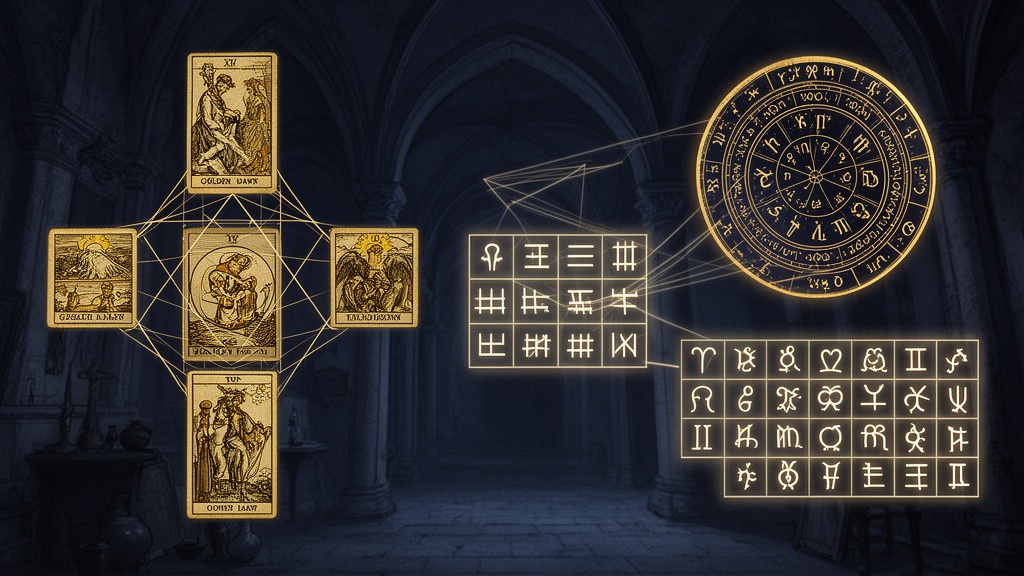
To avoid hand‑waving, let us work with three concrete grammars: Golden Dawn‑style tarot, traditional geomancy, and planetary hours. You can substitute your own lineages, but then you have to be equally explicit about their commitments.
Golden Dawn tarot (as actually used)
- State space: 78 cards; in a spread, positions plus adjacency relations. Reversals may double states if you use them as distinct.
- Operations: random draw; positional assignment; sometimes elemental dignities or counting techniques. The spread imposes a narrative skeleton (crossing, foundation, outcome, etc.).
- Time and causality: quasi‑narrative, often non‑linear. Cards can indicate past, present, possible futures, advice, underlying factors. Time is elastic; the same card can represent an event, a process, or a psychological stance.
- Constraints: cards are polyvalent but not infinitely so. A Ten of Swords is not “mild confusion”. Major trumps carry archetypal weight; courts often encode agency and role.
Traditional geomancy
- State space: 16 figures, each a 4‑bit pattern of active/passive (or odd/even) lines. In a shield chart, 15 positions; in a house chart, 12. The combinatorics of mothers → daughters → nieces → witnesses → judge are fixed.
- Operations: binary addition (XOR‑like) of figures; fixed rules for populating charts; methods for deriving answers (house focus, aspects, company of figures).
- Time and causality: more determinate and fate‑coloured. Charts are often specific to a question and a bounded time frame. There is movement (via mutations, moving charts, perfection), but it is constrained.
- Constraints: figures have core meanings and planetary rulerships; dignity and house placement sharply limit plausible readings. A Caput Draconis in the 10th is not “total collapse”.
Planetary hours (classical, Chaldean order)
- State space: 7 planets cycling through 24 hours, starting from the day’s ruler. Each hour is a single planetary “mood”.
- Operations: simple modular arithmetic to determine the hour; sometimes combined with rising signs, lunar mansions, or elections.
- Time and causality: explicitly temporal and environmental. The hour colours the quality of actions initiated under it, or the “weather” through which the question moves.
- Constraints: the hour does not dictate specific events; it modulates them. Mars hour is not “you will be stabbed”, but it is unlikely to favour delicate peace‑making.
Each of these grammars is already hybrid in its history. Golden Dawn tarot is a Kabbalistic‑astrological‑Christian fusion; geomancy is Islamic‑Latin scholastic; planetary hours are Mesopotamian‑Hellenistic. The point is not purity. The point is that within a given lineage, the rules hang together. The grammar is internally coherent enough that if you wildly misread a figure or card, another practitioner from the same lineage would call you on it.
When we talk about a hybrid being “structurally coherent”, we mean: coherent relative to the internal commitments of the specific lineages we are using.
What cross‑compilation is not
It is tempting to take “cross‑compilation” literally and start talking as if tarot were Python and Ifá were Rust. That metaphor is useful so long as we keep its limits in view.
The metaphor buys us:
- Attention to state spaces: are we doubling up on the same information, or adding genuinely new axes?
- Attention to operations: does one system’s way of updating states contradict the other’s?
- Attention to constraints: does the hybrid increase or decrease the oracle’s resistance to our projections?
What it does not buy us is a guarantee that neat mappings on paper will work in practice. Divination is embodied, dialogical, and often improvisational. Many successful hybrids have stabilised “from below”, through repeated use and shared tacit norms. Treat it as a thinking tool, not a design specification.
Discriminative power without pretending to be a lab
There is another potential trap: talking as if we can measure “discriminative power” in a quasi‑scientific way. If we are honest, we cannot, not within the scope of an article.
We can, however, talk about something more modest and more practical:
- Constraint: does the hybrid add structure that narrows plausible interpretations, or does it simply multiply options?
- Friction: does the hybrid create points where the systems can disagree in a way that forces you to think, or does it allow you to cherry‑pick the nicest line every time?
- Differentiation: does the hybrid help you distinguish between genuinely different outcome paths or psychological stances?
At the table, these show up as:
- Fewer mutually incompatible storylines from the same spread.
- Greater convergence between different readers using the same protocol.
- Querents reporting that the reading drew clear distinctions rather than a fog of “could be this, could be that”.
That is as far as we will claim. Anything more would require long‑term empirical work most of us are not doing.
When grammars really do talk: a worked hybrid
Let us build a hybrid tarot + geomancy + planetary hour protocol and watch where it holds and where it strains.
Scenario: “Is this new job offer aligned with my long‑term purpose?”
You decide:
- Tarot (Golden Dawn lineage) will provide the narrative structure.
- Geomancy will encode fate‑pattern and emphasis on key positions.
- Planetary hour will act as a contextual filter.
You lay a 10‑card Celtic Cross during the hour of Jupiter. For positions 1–6 (the cross proper), you cast one geomantic figure each, using a standard 4‑line toss. You do not build a full shield chart; each figure is local to its position.
Your explicit protocol:
- Tarot defines the storyline: what is happening, what is at stake, advice, likely trajectory.
- Geomancy modulates each key node: how fixed or negotiable is this point? where is fortune or blockage?
- Jupiter hour is a global constraint: any interpretation that runs directly counter to Jupiterian themes (growth, expansion, legitimacy, wisdom) is treated with suspicion or framed as “off‑weather”.
Already you can see a few things:
- Tarot and geomancy both have planetary layers (trumps, courts, and minors via decans on one side; figures with rulers on the other). There is a natural bridge.
- Tarot’s time is elastic; geomancy’s is more determinate. You have to decide whether the geomantic figure in, say, the “near future” position is about inevitability or about the tendency of the current pattern.
- The planetary hour has no internal spread structure; it sits above as a single global mood.
Now imagine position 4 (“what is behind you”): tarot gives you the Eight of Pentacles; geomancy gives you Carcer.
- Tarot alone: a history of diligent skill‑building, apprenticeship, focus on craft.
- Carcer: Saturnian containment, restriction, sometimes prison, sometimes discipline and structure.
The grammars agree on constraint and hard work. Here, the hybrid increases clarity: this is not just “you have been working hard”, it is “you have been working under Saturnian conditions—narrow scope, limited freedom, high discipline”. Under Jupiter hour, that becomes: the question is partly about moving from Carcer to something more Jovial.
Now imagine position 6 (“near future”): tarot gives you the Three of Wands; geomancy gives you Via.
- Three of Wands: expansion, looking to the horizon, initial results, trade, exploration.
- Via: the road, movement, changeability, lunar.
Again, the grammars resonate: movement, outward expansion. Jupiter hour amplifies this. The hybrid has not added contradiction; it has added a second witness pointing in the same direction, and a planetary weather that makes that direction more likely to be auspicious.
This is a coherent cross‑compilation:
- State spaces overlap but are not redundant.
- Operations do not contradict: both systems accept that “given current conditions, this is the likely unfolding”.
- Constraints increase: it is harder to spin a narrative of total stagnation from these positions without doing violence to either grammar.
Now let us stress it.
Suppose in position 10 (“probable outcome if nothing changes”), tarot gives you The Sun; geomancy gives you Tristitia.
- The Sun: success, visibility, clarity, joy, integration.
- Tristitia: sadness, instability, Mercury‑Aquarius, falling.
Here the grammars clash. Under a naïve hybrid, you might average them out: “mixed outcome”. Under a rigorous one, you do not.
You have at least three structurally different ways to handle this, which you should decide before you read:
- Hierarchy of grammars: you declare tarot primary for outcome, geomancy secondary. The Sun stands; Tristitia comments, perhaps as “success tinged with anxiety or instability”.
- Domain split: you assign domains. Tarot speaks to psychological and vocational fulfilment; geomancy to external conditions. The Sun: you feel aligned and visible; Tristitia: the market or organisation is unstable.
- Conflict as diagnostic: you treat such contradictions as flags: something in the querent’s situation is split. The Sun may be the persona, Tristitia the underlying pattern. Jupiter hour may then arbitrate: which is more in line with legitimate expansion?
The point is not which option you choose; it is that you have a rule. Without it, the hybrid becomes a buffet: you pick whichever symbol suits your mood and call that “depth”.
From a psychological angle, this is where the ego–Self axis lights up. You are literally holding the tension of opposites—success versus instability—in search of a third thing that honours both grammars. If you are honest, that tension can produce real insight. If you are evasive, it becomes sophistry.
When hybrids self‑cancel
Not every combination is salvageable. Some hybrids undermine their own oracles at the level of grammar, not just taste.
A few recurrent failure modes:
1. Conflicting agency models
Tarot, as actually read, often encodes agency: courts as people, majors as archetypal forces, minors as choices and consequences. Traditional geomancy, in many lineages, leans more towards fate patterns and environmental conditions.
If you bolt them together without thinking, you can end up with readings where:
- Tarot says: “You can choose to walk away.”
- Geomancy says: “This pattern is fixed for now.”
If you have not decided which model of agency is primary in which domain, you will either:
- Soften the geomancy into “vibes” so it does not contradict tarot’s voluntarism, or
- Treat tarot as mere colour on top of a fixed geomantic verdict.
In both cases, one grammar is being hollowed out. The hybrid is self‑cancelling: you have invoked two different ontologies of how change happens, then quietly thrown one away.
2. Incompatible temporal logics
Consider Lenormand (in the French‑German cartomantic lineage) and planetary hours.
- Lenormand spreads are often read in a quasi‑sentence fashion, with positions determined by proximity, not fixed temporal slots. Time is implicit and fluid.
- Planetary hours are literal clock time segments with clear boundaries.
If you say “I will lay a 9‑card Lenormand and assign each card to a planetary hour across the next day”, you have forced a sequential, discrete temporal model onto a system that normally operates in a more fluid, overlapping way.
That can be done, but if you are not explicit that you are overriding Lenormand’s usual temporal logic, you end up with two incompatible clocks ticking at once. Again, one will quietly dominate, usually the more formal one (planetary hours), and the other becomes decoration.
3. Redundant state spaces masquerading as depth
A common modern move is to take a tarot deck, assign a geomantic figure to each card, and then read both. If the mapping is one‑to‑one and you always pull them together, you have not increased state space; you have relabelled the same draw.
If the Four of Wands always comes with Laetitia, you have not added information. You have created a private correspondence system. That is fine as a devotional or mnemonic practice, but structurally it is not a hybrid oracle; it is a reskinned tarot.
The danger is thinking you have more “signal” when you really have more labels. The oracle’s resistance to projection has not increased; you have just given yourself more nouns to project onto.
Shadow motives behind eclectic splicing
None of this happens in a vacuum. The urge to hybridise is rarely purely structural. There are shadow dynamics at play.
- Eclectic evasion: you hit the sharp edges of a system—say, the bluntness of geomantic “no”—and instead of working with that, you reach for tarot to soften it. The hybrid becomes a defence against constraint.
- Authority anxiety: you cannot tolerate committing to one oracle, so you assemble three and hope their combined authority will make the decision for you. The hybrid becomes a way of avoiding responsibility.
- Colonial shadow: when drawing on Ifá, cowries, or Afro‑diasporic cartomancy, the power imbalance is not just theoretical. Mapping orishas onto tarot trumps without regard for how agency, hierarchy, and personhood are understood in that lineage is not just structurally sloppy; it repeats patterns of appropriation and erasure.
On the last point, grammar is not neutral. In many Ifá lineages, for instance, odu are not just “signs”; they are living intelligences with specific protocols, taboos, and ritual economies. Treating them as a set of archetypes to paste onto the majors ignores a great deal of what those systems insist on as non‑optional.
A structurally honest hybrid with such systems would:
- Be anchored in actual lineage‑based practice, not outsider projection.
- Make clear which commitments are being honoured and which are being bracketed.
- Accept that some grammars are incommensurable: there are places you cannot cross‑compile without breaking something fundamental.
The trickster is always in the room here. Hybridisation is trickster work: boundary‑crossing, rule‑bending. Sometimes that is precisely what is needed. Sometimes it is just mischief. The line is drawn where you refuse to look at what you are breaking.
Designing hybrids as protocols, not vibes
If you want to build or use hybrids that do more than decorate, you need to think in terms of protocols: explicit rules about who does what, when, and how conflicts are resolved.
At minimum, a workable protocol answers:
- Role assignment: which system is responsible for what? Narrative? Timing? Agency? Environmental conditions?
- Order of operations: do you cast both in parallel, or does one feed into the other (e.g. geomancy first, tarot as commentary on the judge)?
- Conflict resolution: when the grammars disagree, what happens? Is there a hierarchy, a domain split, or a diagnostic use of conflict?
- Scope of projection: where are you likely to project your own stuff? Can you build in checks—fixed significators, pre‑declared meanings—to keep yourself honest?
For example:
- “In this hybrid, tarot handles psychological process and advice; geomancy handles external outcomes and timing; planetary hour sets the overall mood. If tarot and geomancy contradict on outcome, geomancy takes precedence for events, tarot for inner stance. We do not fudge contradictions; we name them.”
That is not especially mystical, but it is operational. It also has a psychological function: it constrains your projective freedom. You cannot always pick the nicer symbol and ignore the harsher one. The hybrid has teeth.
It is cognitively demanding to hold multiple grammars and a protocol in mind. There is no way round that. If you do not have deep fluency in each system separately, hybridisation just multiplies your confusion.
Where the metaphor breaks, and why that matters
It is worth underlining where the cross‑compilation metaphor stops being helpful.
- In code, you can fully specify a language’s grammar. In oracles, much of the grammar is tacit, embodied, and historically contested. There is no single “true” tarot grammar; there is Golden Dawn, Marseille, Thoth, and your own hard‑won idiolect.
- In code, a compiled program either runs or does not. Hybrid divination can be formally messy and still work, because “work” here includes numinous resonance, spirit contact, and shifts in consciousness that are not reducible to structural neatness.
- In code, adding layers usually increases constraint. In divination, adding layers can increase degrees of freedom in interpretation to the point where the oracle stops resisting you.
That last point is crucial. An oracle that never says “no”, never corners you, never confronts you with an unwelcome pattern, is not an oracle; it is a mirror. Many hybrids drift towards that. Every contradiction can be smoothed by appealing to the other system. Every sharp message can be blurred by another layer.
So the design question is not “how do I make this hybrid as rich as possible?” It is “where does this hybrid still push back?”
Beyond psychology
You can tell this whole story psychologically: hybridisation as individuation, holding symbolic opposites to constellate a third; or as defence, multiplying symbols to avoid the trauma of clear messages. That lens is real and useful.
But if you have worked with these systems long enough, you also know it is not exhaustive. There are times when a clumsy, theoretically incoherent hybrid lights up with uncanny accuracy, and times when a beautifully designed cross‑compiled oracle feels dead in the hands.
At that point, grammar is necessary but not sufficient. Traditions speak of spirits, intelligences, lineages, egregores. Call it what you like: some hybrids attract presence, others do not. Structural coherence is one way of making a vessel that can hold such presence without leaking. It is not a guarantee that anything will pour in.
The more you attend to grammar, the more sharply you can see that difference.
The next time you are tempted to add another system to your readings, you might pause and ask: in this conversation, what language is each oracle actually speaking—and am I inviting them to talk to each other, or to drown each other out?
The answer may not stop you from hybridising. It may, however, change whether you are building a bridge between worlds, or just a louder echo chamber.