
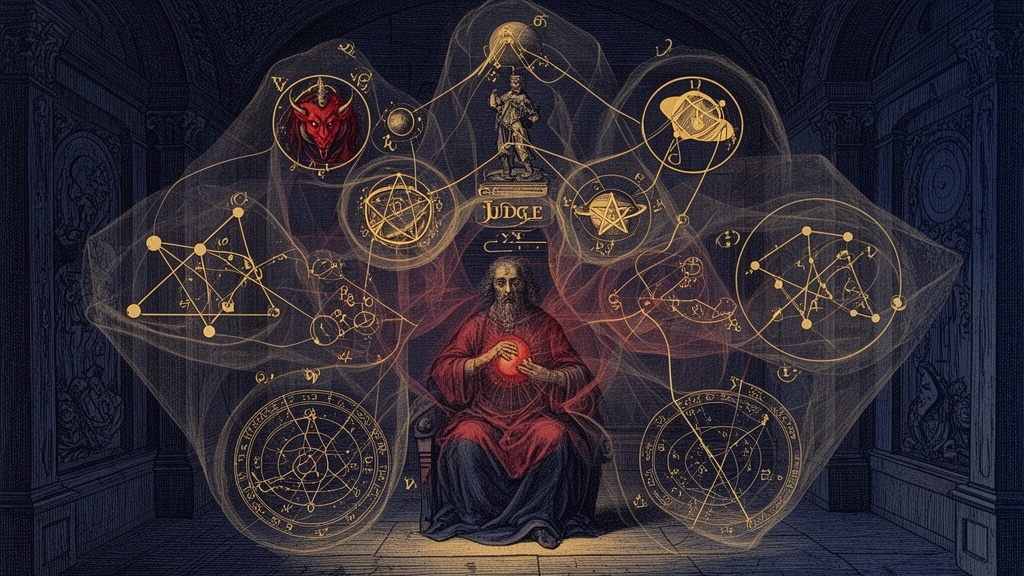
If you keep pulling the same archetypes no matter what you ask, the fault is not in your shuffling. It is more likely that the oracle has stopped humouring your questions and started modelling the thing that generates them.
Most of us notice this first as irritation. New topic, fresh spread, same Devil–8 of Swords–4 of Pentacles triad. Or in horary: different questions, same afflicted lord of the Ascendant, same Saturn sitting on the 10th. Or in geomancy: Carcer again, in precisely the house you were hoping would break pattern.
You can explain this away as “themes” or “the unconscious insisting”. You can blame confirmation bias. Or you can take seriously the possibility that the oracle is behaving like a system that has recognised that your queries are not independent, and that it gets more leverage by tracking the small set of hidden constraints that shape all of them.
That is the latent-variable view of divination. It is not the only possible view.
General vs particular: the old language for latent structure
We do not need to import Jung or psychometrics to articulate this. The bones are already in the older doctrines.
Ptolemy opens the Tetrabiblos by splitting the astrological object into the general (katholou) and the particular (idion). The stars, he says, incline according to general natures and dispositions; from these, specifics follow. Book III’s preface makes the point more bluntly: configurations signify temper, character, and propensities more than discrete fated events. In modern terms: astrology is calibrated to parameters, not one-off incident reports.
Valens is even less coy. His treatment of the Lot of Fortune and Daimon is not “this is a nice extra point if you remember to use it.” These lots describe the governing spirit and the basis of life. They are there when you ask about money; they are there when you ask about travel; they are there when you ask about illness. The topic changes, the basis does not. Later, when he shows how profections, time lords, directions all circle back to the same few themes, he is describing what we would call convergence on a small set of stable factors.
Abu Maʿshar’s annual revolutions repeat that logic: every year chart, every profection, is an unfolding of a single radix template. You can read as many “what about this year?” charts as you please; you never get away from the natal parameters.
Shift traditions and the pattern persists. Sefer Yetzirah gives you thirty-two paths—three mothers, seven doubles, twelve simples—from which multiplication proceeds. The palette is fixed, the paintings are infinite. Kabbalistic language of shoresh ha‑neshamah, the soul’s root in a specific Sefirah or partzuf, is explicit: you can act in many domains, but a soul rooted in Gevurah will colour all of them.
Ifá practitioners will recognise this immediately. The client presents with many issues; the babalawo keeps meeting the same handful of Odu. Life unfolds, but the oracular pattern-space is heavily skewed toward the person’s “own” configurations. The corpus is large (256 Odu), yet in practice there is strong recurrence. Fate is not a list of events; it is an enduring pattern through which events pass.
None of these authors had factor analysis. The ancients were not doing statistics, but they were already working with the intuition that a few stable structures sit underneath the apparent variety of concern.
Significators, judges, and roots: when the system ignores the question
Traditional divination gives us very literal machinery for “the system is tracking something other than what you asked”.
Horary does it in your face. Māshāʾallāh insists that the lord of the Ascendant signifies the querent regardless of topic. You may be asking about lost property or missing ships; the Ascendant still says “this is the person and their constitution”. Bonatti’s Considerations before Judgment turn that into procedure. You do not rush to the house relevant to the question. You begin with radicality, with the condition of the querent, with the Moon’s state. If those are wrong—void of course, late degrees rising, malefic in the 1st—you may be instructed not to judge at all, or to tell the querent that the chart is about their confusion or frivolity, not their ostensible problem.
Lilly follows suit. He will simply refuse judgment when the chart’s “parameters” are wrong. The system, in that logic, has veto. It can decline the manifest question and instead report on the querent’s general state: not fortune-telling, but diagnostic.
Geomancy makes this structural. The Judge is literally an aggregate latent variable—a figure computed from all the mothers, daughters, nieces. It is “the root verdict of the whole operation”. Some Latin manuals go further and introduce a Reconciler or super-judge when contradictory stories arise. Here, the oracle itself manufactures a variable whose only job is to summarise the rest.
Cattan singles out the First Mother—the very first figure—as la racine, the root of the matter. Even when later house figures seem to speak clearly to the topic, he will listen first to that root. In some cases he privileges it over subsequent house-specific detail. The message is unambiguous: beneath the positional content you have an underlying state.
Cartomantic traditions build the querent in by hand. Etteilla chooses a significator by age and sex, lays it down before dealing, and reads the spread as modulation around this anchor. The Golden Dawn codifies the Significator as the “central figure of the Querent” in Book T. It is not replaced by other cards, only modified. Lenormand and Kipper go further: Man/Woman or Hauptperson I/II are fixed presences in the tableau. Every card’s meaning is relational: how does it fall relative to the main person? Repetition in those systems is transparently about the way the latent “my life as configured now” engages a rotating cast of topics.
There is a token (significator, judge, root, Ascendant lord) whose semantic scope is explicitly broader than the present question. You cannot make sense of the reading by ignoring it.
Oracles that change the subject
The other half of the picture is oracles that quite openly ignore, redirect, or correct the querent’s stated concern.
The Yijing is explicit about this. The Ten Wings—especially the Dazhuan—tell you that the Changes disclose the way (Dao) of Heaven and Earth, the configuration of time (shi), and the position of the person in that configuration. Wang Bi’s commentary reads hexagrams primarily as situations, not answers to specific yes/no queries. You ask, “Will this business succeed?” Hexagram and lines respond, “This is the structure of the current situation and your stance within it.” Whether your little enterprise thrives is, from the oracle’s perspective, a secondary derivation from that structure.
Ifá does this in a more confrontational register. There are plenty of recorded cases where the client wants to know about love or commerce; the Odu and its verses speak instead about a neglected taboo, an offering not made, an ancestral misalignment. The diviner is obliged to say, in effect, “You asked about X; the oracle is talking about Y.” The manifest question is treated as symptom; the Odu maps the underlying misconfiguration.
Horary’s strictures against judgment, again, play the same role. So do the stories in Plutarch where Delphi responds not to the literal query but to the questioner’s character and the city’s moral climate. In ritual magic, dead air or perverse answers often signal not demonic whimsy but a problem of license, purity, or authority; the Goetia is blunt that unresponsive spirits should lead the magician to examine their own standing.
It is the default assumption in much of the older material: the system has its own vantage. It may deem your question trivial or mis-framed, and revert to reporting on what it regards as the root condition.
If you then see the same cards, lots, or figures recur whenever the oracle takes that prerogative, you have at least the outline of a latent-variable model. The oracle is less like a FAQ bot and more like a diagnostic engine with its own priorities.
Latent variables as a formal analogy, not a secret ontology
It is tempting at this point to say: oracles are secretly running Bayesian updates, estimating parameters for an internal model of the querent.
That is not the claim. A tarot deck is not doing factor analysis. A horary chart is not an optimisation routine. What is true is that the structure of what practitioners report from experience—the “same archetypes no matter what I ask” phenomenon—lines up surprisingly well with how latent-variable models behave.
In psychometrics you have:
- Observed items: individual survey questions, test problems, behaviours.
- Latent variables: unobserved traits (extraversion, verbal ability, depression).
- A mapping: many different surface items load on a smaller number of factors.
Give the model enough data and it starts to treat new items not as fresh, independent questions but as noisy measurements of traits it already knows how to track. It converges on the latent structure and pays less attention to idiosyncrasies.
Translate this into divinatory terms and you get:
- Observed outputs: card spreads, geomantic figures, hexagrams, charts.
- Manifest questions: “this job?”, “that lover?”, “move cities?”.
- Unseen structure: core commitments, constraints, systemic roles, long transits, daimons.
If over a sequence of readings you see the oracle keep homing in on the same few archetypes, houses, planets or figures, you can model this as if the system has decided that the efficient thing to do is to refine its picture of those underlying factors, rather than flatter the illusion that each question is a discrete island.
This is a structural analogy about information flow, not an ontological claim about what oracles “really are”. It can be wrong or inapplicable on a case-by-case basis. It lives alongside other framings—spirit insistence, repetition compulsion, simple cosmological fate—and sometimes those will explain the data better. But taking the analogy seriously changes how you work.
What exactly is latent here?
The analogy also clarifies what, precisely, might be latent.
You can distinguish at least three:
- External constraints.
These are the hard parameters: chronic illness, visa regime, caring responsibilities, war, a long Saturn transit through the 6th. The querent’s situation is genuinely shaped by a small number of structural facts, and every “different” question is a rephrasing of “How does this structure bite here?”
Repeating Saturn–Carcer–Tower signatures in that context are not primarily psychological, and not negotiable by affirmations. They are reflections of a shared, real constraint.
- Relational roles and commitments.
The family scapegoat, the golden child, the unofficial carer. The loyal retainer in a workplace dynasty. The devotee in a lineage whose internal rule is “we do not surpass the teacher”. These roles are not fully conscious but they are not just “inside” either: they live in relational expectation, in systemic dynamics.
Here, repetition in 4th/10th houses, Court cards in particular suits, authority archetypes (Emperor, Hierophant, 10 of Wands) may be tracking who you are socially allowed to be, and how you collude.
- Schemas and complexes.
Core beliefs and constellated complexes: abandonment, defectiveness, unrelenting standards; Puer/Senex tensions; martyr and saviour dramas. These operate very much like latent variables in cognitive psychology: invisible structures shaping which options you notice, how you weight risks, what you treat as “possible”.
The same Devil–8 of Swords–4 of Pentacles cluster across career, love, and spiritual vocation is the textbook signature of a binding schema: self‑protection turned self‑imprisonment.
The oracle does not care about your theoretical taxonomy. It just keeps lighting up the same symbolic co‑ordinates. Our language—“time lord”, “temperament”, “Lot of Daimon”, “shoresh”, “Odu”, “complex”—marks different metaphysical takes on that invariance.
What the latent-variable framing adds is a disciplined way of saying: “When you ask different things and get the same pattern, treat that pattern as the variable, and your questions as indicators of it.”
Question-space, not just world-space
There is another layer that is rarely named but is arguably where some of the strangest convergence shows itself: the shape of the querent’s question-space itself.
In psychometrics you can run factor analysis not only on people’s answers, but on the questions. You discover that certain items are effectively redundant—they ask the same thing in slightly different words. Clusters appear: a group of questions all really measure social anxiety; another all probe perfectionism.
Now think of the questions a long-term querent brings you over a couple of years. Written down, they look distinct:
- “Should I leave my partner?”
- “Should I switch careers?”
- “Should I move back home?”
- “Should I start a YouTube channel?”
From inside their life, each is experienced as a separate fork. From outside, you may notice they are all versions of “Am I allowed to choose autonomy over loyalty?” or “Am I permitted to expose myself to risk and visibility?”
If, for all of those, the oracle keeps producing Death + 8 of Cups + The Fool, or Saturn hammering the same house axis, it is not just that their situations are under the same constraint. It is that their framing of situations falls along a single latent dimension. Their question-space is essentially one-dimensional, however many syllables they add.
Seen that way, the oracle is not simply telling you about the world. It is revealing how the querent’s inner model of the world compresses diverse circumstances into a small set of permissible queries. Divination becomes, in part, analysis of how they ask—not in place of fate or spirits, but alongside them.
This is precisely where sceptical objections about “this is just a mirror” bite. If you stop here, you have psychologised divination into projective testing. The more interesting move is to admit that the oracle appears able to speak at all three levels at once:
- “Objectively, this job is precarious and your country’s labour market is hostile.”
- “Structurally, you keep re‑enacting a saviour–martyr script with bosses and partners.”
- “Phenomenologically, you are only able to ask about choices once they are already at breaking point.”
The same repeating cards can carry all three layers. A latent-variable frame does not demand you choose one.
When the pattern does not stabilise
Once you start seeing latent variables everywhere, it is easy to forget how often the pattern refuses to cohere. It is worth being explicit about the cases where the analogy fails or should be muted.
There are at least three common ways the latent-variable analogy frays:
- Volatility instead of convergence.
You have clients whose spreads are wildly different every time, despite a stable long-term crisis. No repeated majors, no persistent house axis, no Judge that refuses to budge. Sometimes the only constancy is the lack of constancy.
Under a strict factor-analytic lens, you would say “the latent factor is weak” or “the data do not support a low‑dimensional model”. In practice, these are often people in genuine liminal space: between systems, between identities, without a coherent schema. The oracle flickers because the life does.
- Same life issue, different deck vocabularies.
You change decks or divinatory systems and the phenomenology of repetition evaporates. Tarot repeats evaporate when you move into horary; the geomantic figures tell a completely different story than last month’s runes.
At minimum, that tells you the latent structure is not simply “out there” waiting to be measured; it is partly a function of the symbolic catalogue. Some systems have coarse measurement domains: they are good at lighting up, say, Saturnine role‑constraints, less fine‑grained about other axes. Others are the opposite. Expecting every method to exhibit the same convergence signatures is a category error.
- Clients with many genuinely independent domains.
There are people whose love life, work life, and spiritual life really are loosely coupled. Their career decisions are driven by market conditions and luck; their relations by a robust, reasonably secure style; their spiritual path by private, idiosyncratic curiosity. You can do dozens of readings over years and not find a single cross‑domain archetype that insists.
In those cases, forcing a latent-variable story is overfitting. Sometimes many questions really are many questions.
The scope condition is simple: the latent-variable framing is aimed at the non‑trivial subset of cases where practitioners actually see striking cross-topic recurrence. When that phenomenology is absent, the model should go quiet.
How to read when the oracle is tracking a parameter, not your prompt
Suppose you are in that subset. You have the repeating majors, the planetary fixations, the Odu that will not go away. How do you work with that without vanishing into abstractions?
A few concrete moves.
1. Name the variable. Carefully.
When you see convergence, do not immediately announce a grand theory of the querent’s life. Treat it as a hypothesis and co‑formulate it.
“If I looked at these readings as if they were surveying the same trait, what would that trait be?” Then test candidates out loud:
- “Fear of being visible?”
- “Unwillingness to disappoint the family?”
- “Commitment to carrying other people’s burdens?”
You are trying to state what seems invariant in the oracular responses across domains, in language that the querent can recognise. You are not diagnosing them; you are modelling what the oracle appears to be interested in.
2. Shift from answering to assessing.
Once named, you stop pretending that each new question is fresh. The YouTube‑channel example is a clean illustration.
The querent asks: “Should I start a YouTube channel about my spiritual work?”
You know from prior sessions that the Devil, 4 of Pentacles, and 8 of Swords have been stalking them across topics: jobs, relationships, magical practice. You lay a spread explicitly to test whether the oracle is still tracking the same parameter:
- Centre: “What latent variable is being tracked right now?” → The Devil.
- Work: “How it shows in career.” → 4 of Pentacles.
- Relationships: “How it shows with others.” → 8 of Swords.
- Family/system: “How it shows in the origin system.” → 10 of Pentacles reversed.
- Current question: “How it colours the YouTube decision.” → 2 of Pentacles.
- Maintainer: “What keeps this variable in place.” → 9 of Swords.
- Modifier: “What can actually shift it.” → Temperance.
You could contort that into a forecast about subscriber counts. But if you are honest about the recurrence, the spread is not talking about algorithms.
The Devil in the centre is the latent variable: bondage by consent, the internalised contract that says “I stay in the role, even if the chain is loose.” The 4 of Pentacles shows how that plays out in work: clinging to safe, known positions, hoarding credentials and job security, refusing visible risk. The 8 of Swords shows the interpersonal correlate: self‑censorship, paralysis, letting other people’s imagined reactions fence you in. 10 of Pentacles reversed points straight at the ancestral and familial script: the dynasty pattern that says “we do not rock the boat; we preserve the family image; we do not go public with our oddities.”
The 2 of Pentacles, in the position of the actual question, is almost mocking: juggling, side‑hustling, keeping things light and reversible. “Can I do this in a way that does not really count? Can I add a channel as another spinning plate, so that if it fails it will not have been a real attempt?” The querent’s ostensible question is about a platform; the oracular answer is about yet another half‑measure.
The 9 of Swords as maintainer is the catastrophising loop that locks the parameter: rehearsing humiliation, imagining exile from the family, pre‑living every possible embarrassment. That mental theatre is precisely what keeps the Devil’s chains in place; it makes the voluntary bondage feel compulsory. Temperance as modifier is not “think positive”; it is measured edge‑work. Neither a grandiose leap into instant full‑time content creation, nor another year of hiding. It is titration: deliberate, proportionate experiments at the boundary of visibility, calibrated so that the system can actually integrate them.
The reframe you offer is not: “Yes, start the channel, you will be successful.” It is:
“The oracle is not particularly interested in YouTube metrics. It is asking whether you are going to use this project as another way to stay half‑in, half‑out of the binding pattern we have seen for a year. If you start the channel as a reversible side‑act, nothing fundamental changes. If you use it as a field for Temperance—small, steady exposures beyond the family script—that is where the Devil starts to loosen.”
What the querent leaves with is not a binary prediction but a map: this is the parameter being tracked, this is how you habitually maintain it, this is the kind of move that would actually constitute a different answer.
3. Build spreads that assume a factor structure.
If the phenomenon is real, you can design for it.
A simple architecture for a client you read often:
- Root: “The main latent variable the oracle is tracking in your life this quarter.”
- Work: “How it shows in your work situation.”
- Love: “How it shows in intimacy.”
- Family/system: “How it shows in your origin system.”
- Body/health.
- Exception: “Where this pattern does not hold.”
- Leverage: “What most effectively shifts this variable in the next 6–12 months.”
You are effectively specifying positions as different “items” that probe the same latent dimension. Position 6 is your model‑misfit check: if it brings in a completely different symbolic regime, you know your single‑factor story is incomplete or overextended.
In astrology you can do something similar with repeated activation of one axis: fix that axis as the root, and then read derived houses or time-lords as “how this parameter expresses” in domains, rather than treating each horary as sealed. In geomancy, treat the Judge as your latent variable and read house figures as item responses to it, rather than twelve unrelated mini‑stories.
4. Run model‑misfit checks explicitly.
Do not fall in love with your latent variable. Test it.
You can do that within a spread: deliberately include positions that ask “What is not explained by the main pattern?” or “What is currently orthogonal to this?” If those positions stubbornly echo the same archetypes, your confidence in the parameter grows. If those positions bring in genuinely different material, you have evidence that the life is not as one‑dimensional as your model would like. Adjust.
You can also do this over time. When a client who has been under a clear Saturn‑Devil‑Carcer regime for three years suddenly starts pulling expansive, Jupiterian, Knight‑of‑Wands stories across domains, treat that as a structural change, not just “a good week”. Ask explicitly: “Is the old parameter still in force, or has the system moved to a different one?” Then read with that question in mind.
5. Use “oracle changed the question” as a professional move, not an embarrassment.
If Bonatti and Lilly could refuse judgment on a badly rooted question, you can certainly say to a client:
“The cards have not really answered ‘Will I get the job?’ They have answered, ‘This is how you relate to authority and security right now.’ I am willing to stay on the surface if you prefer. But the system is clearly more interested in this root pattern.”
The difference between that and evasion is that you can point to the repeated structures across sessions as evidence. You are not hiding; you are showing your working.
Psychology is a useful language, but not the only one
At this point the psychologist in the room reasonably says: you are describing schemas, attachment styles, constraint satisfaction, repetition compulsion. Why dress that in planetary or arcanum drag?
From a purely internalist vantage, the latent variable is indeed the schema: “people leave”, “I must carry everything”, “if I succeed I will be punished”. The oracle externalises that; the deck functions as a projective test with exquisite control over which parts of the symbolic library keep lighting up. The repeated figures are the psyche’s attractors.
That language is often familiar and clinically useful. It can also be a flattening.
The older sources are not talking about schemas. They are talking about daimones, lots, fate, the constitution of the soul. The Hermetica insist that a person’s mixture of powers determines the fate they undergo; the Zohar roots souls in particular Sefirot; Ifá treats the Odu not simply as patterns in the head but as deep cosmological structures you are born under and must negotiate with.
For many working practitioners, those are not just metaphors. Repetition is not “your schema talking again”; it is your time‑lord, your Odu, your tutelary spirit refusing to be sidelined. It is an external intelligence saying, “No, we are not done with this.”
The latent-variable framing can sit inside that cosmology quite happily, so long as you remember what the analogy is doing: it describes the behaviour of the oracle–querent system at the level of information, not the ontology of who or what is behind it. To say “The Judge acts like a latent variable” is not to say “God is a factor model”. It is to say: when the same symbolic cluster recurs no matter what stimulus you feed in, you should read that as invariance and give it structural priority.
The danger: loving the model more than the person
There is one shadow here of which it is worth being consciously wary.
Hidden‑parameter talk is intoxicating for the practitioner. It flatters our wish to be the one who “sees through” surface plurality to the single structural truth. It lends itself to pronouncements: “Your real issue is X.” It easily slides into treating the querent as data, their life as a dataset for our favourite theory.
But people are not factor models. They are not required to have one dominant latent variable. They are allowed to be inconsistent, to contradict themselves, to have domains that really are independent. They are allowed to change.
The oracle, too, is not obliged to behave like our analogy. Sometimes it will indulge the small question even when you are clearly in the grip of a larger pattern. Sometimes it will answer the trivial thing because the trivial thing is kind, or because timing matters, or because the spirit you are dealing with is in a mood.
If you insist on a latent-variable frame when the phenomenology does not support it, you are no longer reading; you are imposing. If you use it to collapse everything into one story when the spread is clearly multi‑polar, you are not being profound; you are being deaf.
The discipline is to notice when the oracle behaves as if it were tracking a parameter—and to work skilfully with that—without forgetting that this is a way of organising experience, not a final description of what divination “really is”.
If the system keeps dragging you back to the same cluster of symbols, you can either resent it for not answering your clever, narrow questions, or you can concede that something in the configuration knows more about priority than you do. The interesting work begins when you stop arguing with that insistence and start asking, with the querent, what kind of life becomes possible if you treat the recurring pattern as the main variable, and let the individual questions fall out as its side‑effects.