
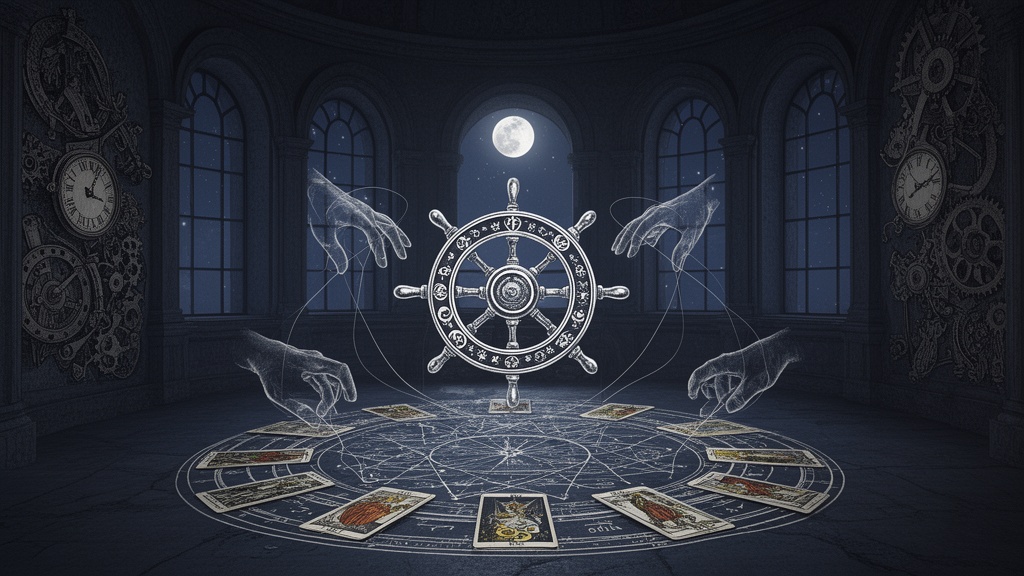
Once you start pulling cards every fifteen minutes while the situation is still moving, you are no longer doing guidance — you are hard‑wiring the oracle into your decision process. At that point the question is not “What will happen?” but “How are we steering this, right now, and what is the oracle actually controlling?”
Most divinatory literature quietly dodges that question. It is much less comfortable with the reader texting photos from a courtroom corridor every half hour, or laying down a three‑card check mid‑evocation to decide whether to push the working further. Those are the cases where divination stops being episodic consultation and becomes a live component in a control loop.
The point of this piece is not to romanticise that move. It is to ask what changes — structurally, psychologically, magically — when you wire an oracle into the steering wheel, and how to do it without spinning the car.
What “control” actually means here
In engineering, a feedback controller does not control “the world”; it regulates the behaviour of a specific system by measuring its state and adjusting inputs. A thermostat does not command the weather; it adjusts the boiler.
In crisis‑speed divination the only thing you can reliably put under that kind of control is yourself (or your group): your actions, your pacing, your attentional focus, your choice of when to commit and when to hold. Whether you also believe that magic, spirits, and synchronicity allow that control to reach beyond your own behaviour is doctrinal business we will not settle here. For the purposes of design, the tight loop is:
situation → your perception → the oracle → your interpretation → your next move.
Once you are reading at crisis cadence, divination is no longer just a mirror. It is a steering input into that loop. The real question is whether you design that loop consciously or let it run on raw anxiety.
The historical baseline: punctuated, not continuous
If you look to the sources for precedent, what stands out is how rare our modern “every fifteen minutes” regime actually is.
Ancient kings did not march with a haruspex pulling fresh livers every quarter hour. At Delphi, Croesus tests multiple oracles before his war with Persia, and Greek cities return to Apollo with follow‑up questions when the first answer is ambiguous. But these are clustered around decisive junctures: declare war, sue for peace, abandon the city, stand and fight. Herodotus does not show anyone re‑querying in the middle of a charge; when he shows iterative consultation it is between phases of a campaign, not between sword‑strokes.
Chinese rulers cast hexagrams in war and politics. The Xici portrays the Changes as constant companion to a ruler, a way of aligning governance with the Way. Han histories have generals consulting before campaigns and at key turning points: attack now or later, cross this river or not. Again, those are decision gates, not twenty‑minute updates from the front.
Geomancy, in both Arabic and Latin forms, is extremely fast to cast. You could, in principle, throw charts all day. Yet the traditional rule is stark: one chart per situation or question. Try again too soon and you are told you will only get confusion or lies. Horary astrology is similar. Lilly is blunt: repeat the same question in short order and the heavens will not speak; the new chart is either void or malicious.
There are, of course, strands nudging toward higher frequency. Sortes and bibliomancy could be casual enough that ecclesiastical authors felt the need to distinguish legitimate reading from superstitious lot‑casting; Augustine, for instance, explicitly condemns Christians who open Scripture at random for answers in De Doctrina Christiana II.21, even whilst narrating his own “tolle, lege” moment in the Confessions as providential rather than a method. Etteilla’s manuals normalise repeated consultation about health, love, and business, with spreads explicitly scaled to weeks and months. Nineteenth‑century cartomancy pamphlets begin to talk about daily cards for housewives and shopkeepers. In the twentieth century, daily draws and journalling become standard process tools in tarot books.
But even in traditions that talk about continuous alignment — the Yijing as daily practice, Golden Dawn Tarot as a “book of wisdom” you live with — the practical instructions overwhelmingly assume episodic work. The Golden Dawn’s Opening of the Key is a multi‑stage feedback structure, but entirely within one divinatory session. Crowley’s real‑time feedback channels in serious work are visions, spirit voices, and the body of the rite, not an hourly three‑card.
If you want something closer to actual continuous feedback in pre‑modern practice, you do not find it in repeated card draws. You find it in omen watching and spirit interaction: Babylonian astrologer‑priests tracking eclipse series and strange births as ongoing commentary on royal conduct; Roman augurs reading bird flights throughout a campaign; Solomonic operators watching the crystal for signs of consent or deception whilst a spirit is in the triangle. There the system talks back on its own clock; you do not keep pushing the button.
So: the move to ultra‑high‑frequency, on‑demand divination in live operations is a late, largely modern innovation. It arises from cheap, personal tools, digital time pressure, and therapeutic or self‑tracking models. That does not make it illegitimate, but you should not pretend ‘Tarot as live dashboard’ is a perennial teaching. It is an experiment; treat it as such.
From big answers to small corrections
The way most spreads are still designed assumes a punctuated model. You lay ten cards, sweep across past‑present‑future, take a view, maybe refine with a clarifier, and then go away and live with it. You are asking the oracle to deliver a compressed narrative about a chunk of time.
The moment you go to crisis cadence, that is the wrong shape.
If you are in the corridor outside a courtroom, or keeping a group safe in a protest, or midway through a risky evocation, you do not need — and cannot use — a grand overview every quarter hour. What you need is:
- a compact read on the current state of play,
- a sense of deviation from your intended line,
- and the minimal viable correction.
That is a different job specification. You are no longer asking for the movie; you are asking for a bearing check and a nudge.
Control theory is useful here not because you can or should turn your working into a thermostat, but because it forces you to be explicit:
- What are you actually trying to regulate? (Pacing? Risk exposure? Ethical red lines? The magical “heat” in the room?)
- How often does the real situation actually change in ways you can act on?
- Given that cadence, what counts as “off course”?
- How much is any given reading allowed to move the wheel?
As soon as you answer those in concrete terms, your spread design changes.
You stop asking “What will happen with this trial?” every time the judge adjourns. You start asking “Relative to the strategy we already committed to, what has shifted in the last half‑day that matters for our next move?” You stop telling a story about who the querent is as a soul and start mapping, for the next interval only, where their attention and energy most need to lean.
Designing a loop instead of a one‑off
Historical practice does offer one strong analogy: electional astrology and talismanic magic. There the magician does not keep re‑divining during the hour of Mars. They design a temporal control structure in advance: these hours, these days, these planetary configurations are usable; within that window we act. You could call that open‑loop control with a pre‑computed schedule.
Continuous divination in crisis is what happens when you close the loop: instead of choosing a good window and then trusting it, you keep sampling and adjusting.
That can be done with rigour, or it can be done with panic. The difference is protocol.
Consider a simple example from direct action, stripped of romance.
An affinity group go into a protest with Plan A (hold this intersection peacefully for two hours) and Plan B (withdraw to a secondary site when police posture passes a certain threshold). They know they will be subject to hysterical contagion from the crowd and their own nerves. They have a deck and a designated reader.
If they use the cards in the usual way, they will improvise spreads on the pavement when things “feel weird”. Someone will say “this looks bad, pull something”. Cards get flung down, interpretive authority concentrates in whoever is loudest. The oracle becomes a free‑floating anxiety amplifier.
If they treat divination as part of a designed loop, the work happens beforehand.
They run a larger, slow spread at home to map constraints: where are we likely to get hubris? What are hard lines we must not cross? They articulate clear prohibitions: no physical engagement; if the cards show collapse and treachery and the real‑world indicators match, we leave.
Then they define a micro‑spread for the field. For instance:
- Card 1: Situation trend in the next 30 minutes.
- Card 2: Our group’s specific vulnerability in that window.
- Card 3: Minimal viable correction.
And they write down, in plain language, what certain outputs mean. For example:
- If Card 1 is a catastrophist Major (Tower, Death, Judgement) and Card 2 is a high‑risk Swords (7–10), we immediately go to Plan B without debate.
- If Card 1 is a Minor of Cups or Pentacles and there are no Majors, we hold course; only micro‑adjustments are allowed.
- If Card 3 is a Court, the correction is about who acts, not about whether we stay or go.
They also decide a sampling rate: we pull at T–60, T–15, then every 30 minutes unless something dramatic changes. And they decide shutoff conditions: after N spreads or once we leave the area, the oracle is off.
Now, when they step into a side street and see 5 of Wands, 9 of Swords, Page of Pentacles, they do not get lost telling a story about “petty conflict, anxiety, a studious youth.” They apply the rule: tension will rise without full collapse; the main risk is mental overload; the correction is to assign one grounded person to logistics and emotional monitoring. Nothing in that reading is allowed to rewrite the strategy; it can only shape how they inhabit it.
When, an hour later, they see Tower + 7 of Swords + 4 of Swords as lines form around them, they do not debate whether Tower here is “ego death” or “awakening”. They have already agreed what that pattern means at this cadence. They leave.
Under that regime, Tarot is no longer an open‑ended storyteller. It is a named component in a protocol. It regulates the group’s behaviour — timing, escalation, attention — according to pre‑committed rules.
This is very close, in structure, to what happens in emergency medicine or aviation: checklist plus decision gates. The difference is that the content of the checks is symbolic. That does not make it soft. It does mean you have to be honest about what is being controlled.
Feedback, noise, and overshoot
The control‑theory analogy is tempting to push too far. It is worth being clear about what survives translation.
There is obvious structural parallel at the level of pattern:
- Feedback. Action changes the situation; the next reading reflects that; you act again. You are in a loop, not a one‑shot.
- Lag. In many crises, the outer system updates more slowly than your nervous system. A legal manoeuvre may take weeks to show consequences; a talismanic operation may “take” over days. If you read every hour in that context, you are mostly sampling your own anxieties.
- Noise. At high sampling rates, almost everything you see is dominated by noise. Three contradictory three‑card pulls in an afternoon are not “the universe messing with you”; they are a sign you are over‑asking.
- Overshoot. If you give each spread too much power to alter your plan, you get oscillation: today we are suing, tomorrow we are settling, the next day we sack the lawyer. In magical work the analogue is the operation that is endlessly “tuned” and never allowed to complete.
Engineers handle these patterns by tuning “gain” — how aggressively the controller reacts to perceived error — and choosing a sampling rate that respects the system’s dynamics. You cannot calculate those numbers for a political campaign or a Goetic working, but you can steal the conceptual discipline.
You can, for instance, explicitly decide that in this situation a single reading is only allowed to adjust timing and tactics, not strategic aims. You can require that major reversals demand confirmation: “Abort the operation” is only authorised if we see a pre‑specified pattern twice in a row and the mundane signs are in line. You can hard‑code no‑action readings: ambiguous outputs trigger only observation and a longer gap before the next pull.
You also need to recognise instability. A run of wildly divergent answers is not an invitation to keep asking until you get the one you wanted. It is a meta‑signal. Something in the human‑oracle loop is now dominated by internal turbulence — panic, projection, group conflict — rather than the external situation. The correct move is to widen the interval, reduce the scope of questions, or stop.
Historically, this is exactly what rules against over‑consultation were trying to encode. The I Ching warns the noble person against “play” with the oracle. Horary texts say the heavens fall silent or deceive when you badger them. Islamic authors like al‑Ghazālī complain about people abandoning intellect and law in favour of istikhāra at every trivial crossroads. Modern chaos magicians warn about “divination addiction” long before they start talking about feedback.
None of those voices are allergic to guidance. They are pointing at a destabilising regime change: once you plug the oracle into a fast loop without boundaries, you stop harmonising with fate and start trying to day‑trade it.
The psychological engine under the hood
If you stay at the level of structure, you can pretend this is all mildly detached systems design. It is not. In crisis, the oracle is handling hot material: fear, hope, grief, fascination with catastrophe, the seduction of power.
Under acute stress, the nervous system wants two things that fight each other: speed and safety. Time feels compressed; decisions present as now‑or‑never. At the same time, the cost of a mistake feels catastrophic. Each pull buys you a tiny pause in that vice. Shuffling, laying cards, naming positions — these are ritualised time‑outs. They recruit the orienting response, widen the aperture just enough for pattern‑seeking to resume. Calling it “checking with the cards” is more acceptable, to most magicians and activists, than calling it “self‑soothing” or “trying not to panic”.
Done well, this is adaptive. Question design and fixed positional meanings are crucial here because they limit free association. “Card 2 is always vulnerability in the next hour” gives your unconscious a channel; it cannot just sprawl.
Done badly, the same mechanism is simple avoidance. As long as there is one more spread to throw, one more pattern to decode, you do not have to feel helpless or grieve what is already lost. You can stay inside the bubble of “there is still something to be optimised”. That is one reason people keep asking after the situation is effectively over. The operation is dead; the magic is spent; the legal die is cast; the relationship has been ended — but the loop is addictive. There is always some sliver of detail left they could, in fantasy, have got “right”.
And of course, not every compulsive loop is a calibration problem. Trauma, coercive group dynamics, economic desperation — these can drive over‑consultation in ways no clever cadence rule will touch. When the deck has become a way to survive someone else’s control, or to mask the fact that you have none, the real intervention is not another protocol but a therapist, a union, a shelter, a lawyer.
There is also the question of identity. In high‑velocity situations your usual stable roles are undercut. The reader who keeps pulling every fifteen minutes gets to inhabit a particular archetype: Magician at the console, Strategist in the war room, Priestess with the live feed from the hidden layer. It can call up discipline and service. It can also feed grandiosity and the refusal to admit “I do not know” or “nothing more can be done”.
On the client side, rapid‑fire consultation tends to intensify parent–child dynamics toward the oracle. If every micro‑choice is ratified by the cards, who owns the outcome? When things go badly, it is very tempting for both sides to dump responsibility onto “what the deck said”. Historically, sophisticated critics from Cicero to al‑Ghazālī have worried less about the metaphysics of divination than about exactly this abdication of judgement.
Putting the oracle into the loop makes its ethical liabilities more acute, not less. Once you know your three‑card check can trigger a group to stay in a situation that turns violent, or nudge a client to hold an investment another day, you are not just giving “insight”. You are actuating behaviour.
Fate, Dao, and the fantasy of micromanagement
The deeper objection is doctrinal: not just “can you control anything?” but “were these tools ever meant to be used this way?”
The Stoic and Neoplatonic answer is mostly “no”. Oracles reveal the Logos so you can align, accept, or gracefully decline where you cannot win. Confucian readings of the Changes are similar. You are not supposed to interrogate Heaven about every move; you cultivate virtue and right timing and leave the rest.
Hermetic, Renaissance, and modern magical lineages are more interventionist. They are happy with the idea that oracles help you meet the right spirit at the right hour, pick the right battle, optimise the phase of your ritual. But even there the ideal is rarely micromanagement. A Picatrix election is about choosing a day and hour to cast the talisman, then letting the thing work. Golden Dawn texts are clear that once a ritual is launched under the appropriate names and signs, you do not keep ripping it open to fiddle with it.
The same confusion runs through secular domains: glued to markets that tick every microsecond and social feeds that update in real time, we are trained to believe that more frequent information implies better steering. Technically, that is false even in finance. Above certain frequencies your readings are dominated by noise. The same is true in magic and crisis.
The uncomfortable truth is that many situations practitioners are tempted to steer with high‑speed divination are non‑stationary, adversarial, and poorly modelled. Court cases, online pile‑ons, street politics: by the time you notice a pattern it may already be invalid. That does not mean divination is useless there. It does mean that its most reliable target of regulation is you and your immediate circle: when you speak and when you shut up; when you escalate and when you leave; which values you will not trade away.
If you name that honestly, the practice becomes saner. You do not have to pretend your deck is a high‑frequency trading oracle for destiny. You can admit that what it mostly does in crisis is modulate your posture to fate (or Dao, or Providence) in a fine‑grained way: less “change the outcome” than “change how we ride it, and which parts of ourselves we refuse to lose”.
Practical design: some parameters worth fixing
If you are going to experiment with crisis‑speed divination, three parameters are worth fixing consciously.
Cadence. How often are you allowed to ask? Match this to the real update rate of the system. Political negotiations that shift day‑to‑day do not justify hourly pulls. Spirit operations that metabolise over weeks do not need daily micro‑tweaks. In genuinely fast scenes — time‑bounded protests, live negotiations, medical emergencies where you are not the clinician but the relative — you might very well set a 15–30 minute interval.
Scope. What is each reading about? “The whole operation” is too vague for a three‑card. In a loop regime, questions should be narrow and temporal: “In the next hour, where is the greatest risk?” or “How are we sitting relative to Plan A right now?” It also helps to cleanly separate macro‑spreads (slow, big‑picture, setting constraints) from micro‑spreads (fast, inside those constraints).
Authority. What can one spread actually change? Does any alarming card have the right to abort the whole working, or only to slow it? Does any “good” card let you override agreed safety rules? Pre‑commit this. It is very easy, under pressure, to let a convenient reading rubber‑stamp what you wanted to do anyway.
Alongside those, design explicit “off switches”. For example:
- A maximum number of crisis‑reads per day.
- Patterns that automatically suspend divination (e.g. a run of contradictions).
- Situations where mundane protocol trumps cards (health decisions based on clinicians, not the 8 of Cups).
Those cut against the grain of magical control fantasy. They are precisely why they are sane.
Where this leaves the oracle
One way to hear all this is as a psychologising shrink‑wrap: the oracle reduced to anxiety management and decision support. From the outside that is a perfectly adequate story. Continuous readings absolutely do function that way.
From the inside, things are more ambiguous. Practitioners who have sat inside live workings with a deck on the table, or who have read through a rolling political mess, often report a sense that the card stream and the event stream co‑evolve. A pattern of pulls will feel “out ahead” of the situation in a way that cannot be reduced to mood‑ring sampling. A hexagram or triad that appears at the right time, four times running, has a different feel than an anxious hand taking its own pulse.
Or you can say that the symbolic conversation is itself part of how the field moves — that when you wire the oracle into the steering wheel, something on the other side of the wheel takes that seriously.
Nothing in a feedback‑loop framing forces you to choose. What it does do is strip away the laziness of thinking of divination as an isolated, solemn act whose consequences are purely internal. Once you push it into crisis speed, you are building a live interface between symbol and action. You are giving the cards, or shells, or signs the right to reach into your timing, your courage, your threshold for walking away.
Ancient rules against over‑asking, and modern discomfort with “reading for every little decision”, start to look less like prudishness and more like clear perception of that fact. If you are going to wire the oracle into the wheel, you still have to ask — not only what you are steering, but who, or what, is permitted to take your hands when the crash is actually happening.