
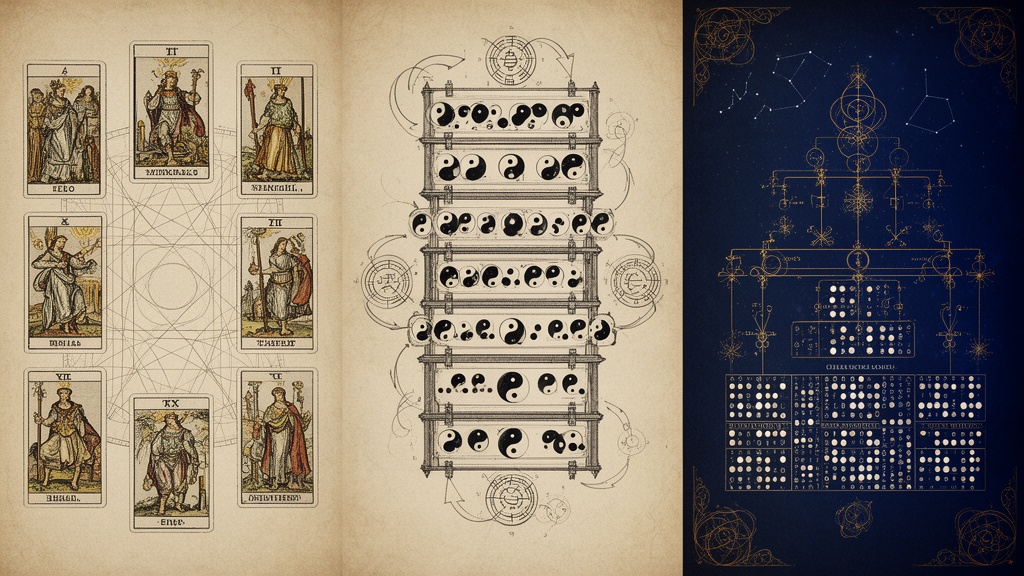
If you strip out every image from tarot, geomancy, and the I Ching and only keep the rules that generate results, you don’t just get three different oracles. You get three different ways reality is allowed to unfold.
That is the claim, anyway. To make it more than a clever metaphor, we have to get painfully explicit about what we mean by “structure”, “time”, and “causality” in a divinatory context.
I will start with definitions, then walk through each system as if it were just a machine producing tokens. Only then will I risk the heresy: that these machines quietly push us towards different intuitions of what time is like.
Not what time means symbolically. What it is like to inhabit.
What we are actually comparing
If we are going to talk about “generative grammar” without lapsing into hand‑waving, we need some operational terms.
-
State space: the set of distinct outputs the oracle can produce in a single consultation, abstracted from interpretation. A hexagram is a state; so is a 10‑card Celtic Cross; so is a full geomantic shield chart.
-
Generative steps: the sequence of rule‑governed operations that take you from indeterminacy (coins in hand, cards face‑down) to a completed state.
-
Branching factor: at a given step, how many distinct next‑states are available, given the rules. (Not “what they mean”, just “how many different structural outcomes”.)
-
Recursion: any rule where a previously generated state is fed back into the system to generate further structure. Changing lines in the I Ching are an obvious example; so are derived figures in geomancy.
-
Information density: roughly, how many bits of specification are locked in by one complete operation of the oracle. How finely discriminated is one answer from another at the structural level?
Those are the formal pieces. On the experiential side, I’ll use three equally blunt categories:
-
Narrative time: time as a sequence of discrete scenes or beats. Tarot spreads are the canonical example.
-
Processual time: time as ongoing transformation, phases of a single unfolding process. The I Ching lives here.
-
Branching/constraint time: time as a decision tree, where certain branches become inaccessible once choices are made. Geomancy leans in this direction.
The crucial move is this: I am not claiming that the formal properties determine the phenomenology. I am asking whether, once you model the mechanics cleanly, you can see why practitioners so often report particular “time feels” from each system — and where those reports are misleading.
Tarot as randomised library, not binary grammar
The hardest case for “bracketing symbolism” is tarot, so we should face that upfront.
With the I Ching and geomancy, there is a clean separation: first you generate a bare combinatorial object (a pattern of lines or dots), then you attach meaning. Tarot does not have that separation. The “tokens” are already symbolically saturated: 78 distinct, historically layered images, plus the suit/number/trump schema.
So what can we legitimately treat as tarot’s “generative grammar” if we are not going to cheat by smuggling meaning back in?
At minimum:
- A finite deck of 78 unique tokens.
- A method of randomisation (shuffling, cutting).
- A rule for drawing without replacement.
- A positional grammar: spreads that assign relational roles (past/present/future; self/other; inner/outer) to each drawn card.
- Optional: reversals as a binary modifier on each token.
You can ignore whether the card is the Two of Cups or the Tower and still talk about the structure: “10 unique tokens, each assigned to a distinct position in a fixed template, possibly each with a binary flag (upright/reversed).”
Structurally, then, a tarot reading is:
-
One sample from a very large state space:
– A single‑card draw: 78 possible states (or 156 with reversals).
– A 10‑card Celtic Cross without reversals: 78P10 ≈ 1.7×10¹⁸ distinct arrangements.
– With reversals: multiply by 2¹⁰. -
Generated in one pass: shuffle, lay out cards. There is no internal derivation rule that transforms card A into card B. Clarifiers and additional draws are meta‑moves by the reader, not mandated by the deck.
-
No intrinsic recursion: the system does not, of itself, tell you to modify an already drawn card to produce a new state. Any recursion is interpretive (“let’s draw a card on this card”).
The branching factor here is enormous at the level of final layouts, but trivial at each step: when you draw the third card in a spread, the only structural fact is “it is one of the remaining 76 tokens”. The richness comes from the size of the library and the positional relations, not from generative depth.
Information density per fully specified spread is extremely high: a 10‑card layout with positions is a very finely individuated state. But that density is “flat”: each card is an atomic unit, not built from simpler binary components.
This matters for time because tarot’s structure is spatial before it is temporal. The spread is a tableau. Time is implied by position labels (“future”, “outcome”), but the underlying machinery knows nothing about sequence or process. It simply places distinct tokens into a relational grid.
If you insist on a time metaphor here, tarot’s bare structure suggests narrative time: a set of discrete scenes laid out at once. You move through them in reading order, but they are all given simultaneously. There is no internal notion of feedback from one scene to the next; the causality is something you, as reader, impose.
The I Ching as binary process engine
With the I Ching, abstraction is much cleaner. At the structural level, you have:
- A binary line: yin/yang, broken/solid. Call it 0/1.
- A rule to generate six such lines in sequence, usually from the bottom up, by coin tosses or yarrow stalk counts.
- Optionally, a rule to mark some lines as changing (old yin/old yang), introducing a second binary flag on each line.
- A mapping from the ordered 6‑bit string to a hexagram index (1–64).
- A deterministic rule: if there are changing lines, flip them (0↔1) to produce a second hexagram.
Structurally, a basic, non‑changing hexagram is just a 6‑bit word. There are 2⁶ = 64 possible states. If you include changing lines, each line carries two bits of information (yin/yang, changing/static), so a full cast is a 12‑bit object. The number of distinct “primary + relating” pairs is 64 × 64 = 4096, but they are not equally likely because changing line patterns are not uniform. We can leave that aside; the point is that the state space is modest and fully generated from binary components.
Generative steps:
- Each line: branch factor 2 (yin or yang) at the simplest level.
- If you include change: effectively a 4‑way branch per line (young yin, young yang, old yin, old yang), but this collapses back to two structural line types (present/future) plus a change flag.
Crucially, the system has built‑in recursion:
- The relating hexagram is a deterministic transformation of the primary: same six positions, some flipped.
- Traditional practice then reads the changing lines themselves as loci of transformation, often line‑by‑line.
- There is also the notion of nuclear trigrams: lines 2–4 and 3–5 form an inner hexagram. That is another explicit re‑use of the same generated data to produce a further state.
So the oracle’s grammar is not “draw 1 out of 64 pre‑authored entries”. It is “build a 6‑line binary process; then, under specified conditions, transform it into another 6‑line process; then, optionally, extract inner patterns”. It is a small, recursive engine.
Information density per cast is lower than a large tarot spread — 6–12 bits of structural data instead of something like 60–100 bits if you treat each tarot card as a 6–7‑bit choice — but that information is explicitly organised as process: each line has an ordinal position and a potential future state.
You can see why the I Ching so often feels like processual time even before you read a single text:
- The oracle is literally about lines that change.
- The second hexagram is not another random draw; it is the future state of the same pattern.
- The nuclear hexagram is an “inner” process latent within the outer one.
Even if you stripped the Book of Changes of all Confucian and Taoist commentary and replaced it with neutral labels (“state A”, “state B”), the grammar would still model time as an unfolding pattern with internal feedback. You do not get a tableau of scenes; you get a diagram of a process at a particular phase, with explicit indications of where it is tending.
Geomancy as branching under constraint
Geomancy sits somewhere between these two. Like the I Ching, its primitives are binary; like tarot, its final presentation is a spatial array (the shield chart, or house chart). But the way you get from random marks to a chart is distinctive.
Abstract the traditional method:
-
You generate four Mothers, each a stack of four binary bits (odd/even, dot pair/single). So each Mother is a 4‑bit figure; there are 2⁴ = 16 possible figures.
-
From these four Mothers, you derive four Daughters by reading across the Mothers’ lines: – Daughter I: first line of Mothers I–IV becomes its four bits. – Daughter II: second line of Mothers I–IV, etc.
Already you have recursion: the Daughters are deterministic functions of the Mothers.
-
From the eight figures (4 Mothers + 4 Daughters), you generate four Nieces (sometimes called Nephews) by pairwise addition modulo 2 (or odd/even parity rules), then two Witnesses, then the Judge. Every step uses the same binary combination rule.
-
You then assign the 12 figures (or 16, in expanded methods) to houses in a fixed layout.
Structurally:
- Primitive state: a 4‑bit figure. 16 possible.
- Initial randomness: the four Mothers. If each Mother is truly random, that’s 4 × 4 = 16 bits of raw input.
- All subsequent figures are derived. No new randomness enters.
The state space of complete charts is not simply 16¹², because the figures are not independent. The Judge is heavily constrained by the Mothers. Many combinations are impossible under classical rules.
Branching factor:
- At the level of primitive input: each line of each Mother is a 2‑way branch (odd/even).
- Once the Mothers are fixed, the rest of the chart is deterministic. There is no further branching.
So geomancy’s grammar is:
- A burst of binary randomness at the beginning.
- Then a cascade of deterministic derivations, all using the same combining rule, until the chart is filled.
Information density per chart is high, but not maximal: the derived figures contain no independent randomness. They are compressed functions of the initial 16 bits. In that sense, a geomantic chart is more like a decision tree from a fixed seed than a random tableau.
This is where time sneaks in. Practitioners often experience geomancy as brutally fated, or at least heavily constrained: “these are the routes open from where you stand; others are simply not in play”. That is not just cultural fatalism. It is baked into the mechanics:
- Once the Mothers are set, certain Judges are impossible.
- The distribution of figures across houses is not arbitrary; patterns cluster.
- You cannot “re‑roll” a particular house without altering the entire seed.
Compared to tarot, where you can always draw another clarifier and the combinatorial space is so large that almost any story can be told, geomancy feels like branching under constraint: a decision tree where many branches have already been pruned by the initial throw.
Compared to the I Ching, geomancy has less internal recursion. There is no analogue of changing lines. The recursion is front‑loaded: repeated application of the same combining rule generates a static chart. Time here is not phases of a single process; it is the unfolding of implications from an initial condition.
Three grammars, three temporal intuitions
With these sketches in place, we can risk the interpretive leap. Not as metaphysical fact, but as a proposal: given these mechanics, what kinds of temporal intuition do they naturally afford?
- Tarot — simultaneity and narrative stitching
- All cards are drawn into position before interpretation.
- There is no internal rule that says position 1 causes position 2.
- The spread is a simultaneous configuration that the reader traverses in a chosen order.
The reader, not the system, supplies narrative linkage: “this led to that”, “this will likely follow”. The grammar affords narrative time because it presents distinct, richly differentiated “moments” that invite sequencing, but the sequencing is editorial.
The shadow here is obvious: the temptation to impose a coherent story on a situation that may actually be processual, cyclical, or radically contingent. The spread’s spatial grammar rewards pattern completion and narrative closure. It resists genuine open‑endedness unless the reader actively honours it.
- I Ching — phase, feedback, and return
- The oracle is literally a binary process: six bits, some of which may flip.
- The relating hexagram is a future or alternative state generated from the present one.
- Nuclear and constituent trigrams give “inner” and “outer” patterns.
The grammar enacts processual time: not “scene A, then scene B”, but “state A undergoing specified transformations”. Change is not an optional interpretive overlay; it is the organising principle.
The shadow here tends towards subtle fatalism or over‑processualisation: the sense that everything is part of a smooth transformation, that ruptures and discontinuities are always already contained in the pattern. Anyone who has lived through genuine catastrophe knows that some events do not feel like “the next phase”; they feel like the destruction of the phase model itself.
- Geomancy — initial condition and constrained unfolding
- A burst of randomness (the Mothers) is followed by deterministic derivation.
- The chart is a closure: a full implication space from a fixed seed.
- Houses give spatial/narrative positions, but the figures themselves are tightly correlated.
The grammar models branching/constraint time: an initial act (the casting) locks in a set of structural possibilities and impossibilities. Reading becomes the art of tracing which paths through this constrained space are live.
The shadow here is reductionism: the temptation to treat current constraints as absolute, to underplay emergent complexity or the possibility of genuine novelty. There is also the emotional defence of hiding behind the mechanics: “this is just what the chart allows” can become a way of not engaging.
You can already hear the sceptic clearing their throat: aren’t these just poetic overlays on neutral combinatorics? Why not say “tarot could be used processually”, “the I Ching can be read as static states”, “geomancy can tell stories”?
They are right to push. The mapping from structure to temporal intuition is not logically necessary. It is affordance, not entailment.
So the more interesting question is not “what does the oracle mean?” but “what kinds of moves does the oracle make easy or hard?”
-
It is technically possible to design a tarot spread that tracks process in six phases. But you are fighting the deck’s library‑like nature: 78 wildly differentiated tokens want to become dramatis personae in a story.
-
It is technically possible to use the I Ching as a glorified 64‑entry fortune cookie, ignoring changing lines and relating hexagrams. Many modern apps do exactly that. But in doing so you are discarding the very recursion that defines its structural elegance.
-
It is technically possible to treat a geomantic chart as a set of static symbolic assignments and riff narratively. But you will keep stumbling over the way certain figures recur and constrain others. The system keeps reminding you that the Judge is not arbitrary.
The psyche inside the machine
Once you pay attention at this level, the oracles become laboratories for watching how your own mind handles time.
Generating a tarot spread is an exercise in narrative projection. The tableau invites you to:
- Select which positions “really matter”.
- Implicitly choose a beginning and end.
- Smooth over contradictions to produce something like a plot.
You can watch yourself doing it. The structure is a Rorschach for your appetite for coherence.
Working with the I Ching is different. The binary recursion forces you to confront:
- The tension between present state (primary hexagram) and tendency (relating).
- The discomfort of lines that are “in transition”, neither fully one nor the other.
- The question of where you locate agency in a process that seems to have its own momentum.
Here the structure mirrors the psyche’s habit of revisiting the same conflict at deeper turns of the spiral. The hexagram is a snapshot of that spiral, with explicit indications of where the twist is tightest.
Geomancy, at the structural level, invites you to think like a systems modeller:
- Given these initial conditions, what cannot happen?
- Where are the bottlenecks in the chart?
- How do local changes (in one house) propagate through the fixed relationships?
The chart is a cognitive map of constraints. Reading it well asks you to distinguish between hard limits and soft potentials — a distinction many querents are painfully bad at making in their own lives.
In all three cases, the oracle is not just “answering questions”. It is training you in a particular grammar of expectation. Over years, that grammar seeps into your intuitions about fate, agency, and time.
Choosing a system as choosing a time
If you accept that the mechanics afford different temporal intuitions, there is an obvious practical implication: choice of system is already a theoretical move.
Most practitioners feel this before they articulate it. When a querent brings you a question about an ongoing, cyclical pattern — addiction, family dynamics, a business cycle — you reach for the I Ching or for process‑heavy tarot spreads. When they are at a hard fork (“this job or that one?”), geomancy’s branching logic can cut more cleanly. When they are lost in story, you lay out cards to see the cast and the stage.
Seen structurally:
-
For process questions (“How is this likely to unfold?”), a binary recursive system like the I Ching mirrors the very notion of unfolding. The grammar foregrounds phase, feedback, and return.
-
For constraint questions (“Is this even possible from where I stand?”), geomancy’s derivational cascade from a fixed seed makes visible the shape of the decision tree.
-
For narrative questions (“What is going on here?”), tarot’s spatial tableau lets you constellate roles, scenes, and arcs in one glance.
You can, of course, hybridise. One useful pattern:
- Start with tarot to map the situation as a story.
- Use geomancy to test the structural constraints implicit in that story.
- Consult the I Ching to situate the whole thing in a process: where in the cycle are we?
But hybridising demands discipline. If you pull a tarot card to “clarify” a geomantic Judge, you are crossing grammars: you risk letting tarot’s narrative looseness erode geomancy’s hard constraints. Conversely, if you insist on reading a tarot spread as if it were a process diagram, you are ignoring the way its randomness and library‑like nature privilege multiplicity over phase.
The advanced move is not to mash systems together into a symbolic soup, but to keep their logics distinct enough that their disagreements become diagnostic. When tarot tells a redemptive story, geomancy shows a blocked chart, and the I Ching speaks in images of revolution or standstill, the clash is where the work is.
Beyond projection, without denying it
A purely psychological account would rest here: these different grammars shape how we project time, causality, and agency; the oracle is a mirror; synchronicity is a fancy name for pattern recognition.
That account is not wrong, but it is incomplete. Anyone who has worked long enough with any of these systems knows the feel of the cast that lands too precisely, the chart whose constraints match external circumstances you could not have known, the hexagram that names the unspoken.
The structural analysis does not dissolve that mystery. If anything, it sharpens it.
Because once you see how little raw information is actually in play — 6 bits of line data, 16 bits of Mothers, a handful of cards from a finite deck — the specificity of the match becomes harder to write off as sheer data volume. The oracles are not giant databases crunching terabytes. They are small, elegant machines whose outputs, in practice, often exceed their formal degrees of freedom.
You can say: the extra comes from the reader’s intuition and the querent’s projection. Or you can say: the small machine is an interface to a larger order, an acausal connective tissue that uses these grammars the way language uses grammar — as a skeleton for meaning that is not reducible to its rules.
Both readings are coherent. Neither is provable. What the structural comparison does is make one thing very clear: whichever stance you take, you are not dealing with interchangeable toys. You are dealing with three distinct ways of cutting the flow of experience into form.
The next time you reach for cards, coins, or dots, you might pause for a moment and ask a less comfortable question than “Which works best for this client?”:
Which model of time am I about to invite into the room — and how long has it been quietly shaping the way I believe my own life can, or cannot, change?