
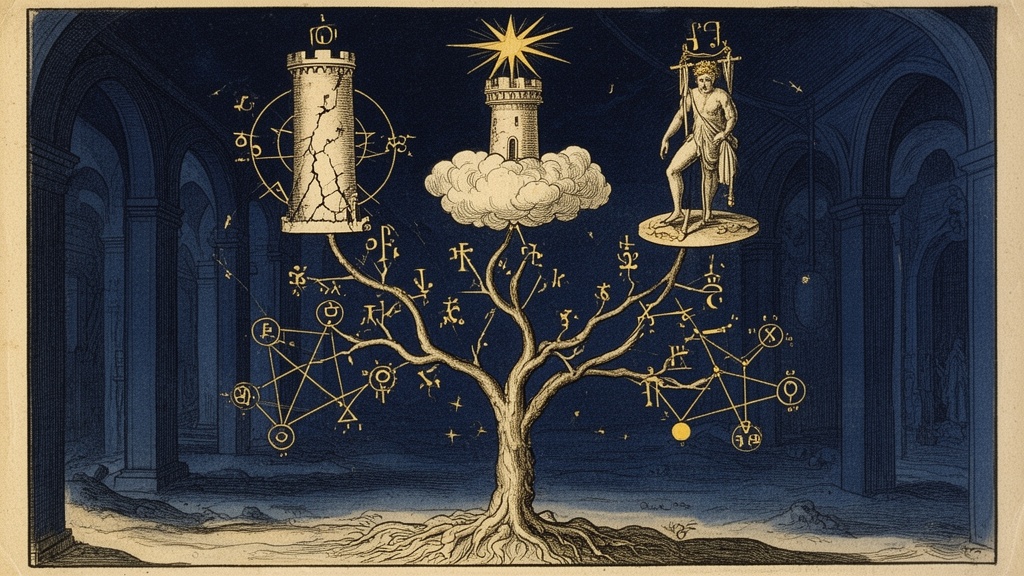
Some of your most embarrassing “misses” are not mistakes. They’re fossils from futures you refused to live.
If that sounds like a face-saving story, good. It should. Because if we’re going to keep using oracles in the twenty-first century without lying to ourselves, we need a better account of what they’re actually doing than “prediction that sometimes works”.
The claim here is simple and sharp:
Divination, at its best, is not a camera pointed at “the” future. It is a machine for generating counterfactuals: structured visions of futures that might unfold, most of which never will. Skilled practice is the art of reading and working with those unrealised branches—especially the ones you choose against.
To make that claim do real work, we have to be precise about what we mean by “counterfactual”, by “model”, and by “future”.
Three levels of “what if”
Let’s separate three layers that usually get blurred.
-
Psychological counterfactuals.
This is the basic human skill of “what if?”: imagining alternative outcomes, rehearsing different choices, running internal simulations. Cognitive science has a thick literature on this: counterfactual thinking as the engine of regret, learning, planning. -
Formal counterfactual models.
In philosophy of science and decision theory this becomes explicit structure: branching time diagrams, decision trees, possible-world semantics. You specify conditions, you map branches, you track what follows if you flip one variable. -
Ontological possibility space.
The strong claim: there really is a structured field of unrealised possibilities—call it branching timelines, the astral, the daimonic order—and oracles give you access to it, not just as metaphor but as contact.
Most writing on divination quietly conflates these. Either everything collapses into psychology (“it’s just projection”), or everything is smuggled into ontology (“the cards showed The Future”). Neither is good enough.
What I’m defending here:
- At minimum: oracles are disciplined technologies for doing (1) using structures reminiscent of (2). They are counterfactual engines in the modest but non-trivial sense that they systematically generate and constrain “what if” space.
- Possibly: there is also some version of (3) in play—synchronicity, daimonic patterning, however you name it—but that layer is not required for the counterfactual account to hold. It complicates it; it doesn’t replace it.
That distinction matters, because otherwise “counterfactual engine” is just a poetic way of saying “prompt for daydreaming”. We’re aiming at something tighter.
From snapshot fetish to branching structure
Most querents arrive addicted to snapshots: “Will I get the job?”, “Is this relationship going to last?”, “Where will I be in five years?” You know the drill.
We indulge that framing at our peril. Once a reading is treated as a single outcome report, every “wrong” prediction becomes a crisis for the whole practice. The usual escape hatches are familiar: blame timing, blame free will, blame the querent’s “energy”. None of that helps you become a better diviner.
Reframing divination as counterfactual work shifts the target:
- The spread is not “what will happen”.
- The spread is “a map of how things could happen, conditional on choices and constraints you are entangled with now”.
The question ceases to be “Did the reading come true?” and becomes “Did the reading correctly model the branching structure and its pressure points?”
That is a much harder standard. It is also much more interesting.
How oracles actually constrain “what if”
If you strip away the imagery and look at procedure, tarot, geomancy, and their cousins do at least three specific things that ordinary rumination does not.
-
Randomisation under symbolic constraint.
You don’t pick your cards or figures. You randomise, then interpret inside a fixed symbolic grammar. That combination is crucial. Pure randomness is noise; pure introspection is echo chamber. Randomness plus a shared symbol system forces you into patterns you would not have chosen, but must still render coherent. -
Positional structure.
Spreads and charts are not piles. A Celtic Cross, a shield chart, a three-path layout: each position is a query about a role in a process—past condition, emerging influence, outcome under X constraint. You are not just asking “What else?”; you are asking “What else in this slot?” -
Ritual bracketing and intersubjectivity.
The reading is a bounded event with stakes. There is a witness. Cards are turned in a particular order. Things are said aloud and remembered. This is not a private fantasy; it is a negotiated model between at least two psyches, anchored in a physical configuration.
Taken together, that makes oracles more than glorified journalling. They are symbolically constrained random generators feeding into a shared interpretive act. That is enough to warrant talking about “models” and “state spaces” in a disciplined analogical sense.
Analogical, not literal. A ten-card spread is not a formally complete decision tree. But it is a partial, structured cross-section through the space of “what ifs” around a question.
A worked example: three paths, one ghost
Take a simple but explicit counterfactual layout for the classic career question:
“What happens if I leave my job?”
You put down three columns:
- Column A: leave immediately.
- Column B: wait for a concrete opportunity, then leave.
- Column C: stay put.
For each column, you throw three cards or figures: near-term consequence, medium-term trajectory, deeper lesson/long-term pattern. Nine positions, three labelled paths.
Suppose you get:
-
Path A (leave now)
1. Near-term: The Tower
2. Medium: Five of Pentacles
3. Long-term: Nine of Wands -
Path B (wait, then leave)
1. Near-term: Two of Wands
2. Medium: Three of Wands
3. Long-term: The Star -
Path C (stay)
1. Near-term: Eight of Cups
2. Medium: Four of Cups
3. Long-term: The Hanged Man
You don’t need me to gloss these. What matters is how you frame them.
The snapshot reader says: “If you leave now, it will go badly. You’ll be broke and exhausted. Better to wait for a proper opportunity; that’s where the hope and expansion are. Staying is stagnation and sacrifice.”
The counterfactual reader says something more precise:
- “These are three branching futures available from where you stand. Path A is a high-disruption branch with heavy cost and hardening. Path B is a slower, more strategic branch that opens into genuine renewal. Path C is a holding pattern with emotional drift and a long-term theme of suspension and reframing.”
- “By seeing Path A as Tower/Five/Nine, you are already less likely to choose it. The reading is not just describing a possible disaster; it is helping you not walk into it.”
Here, and only here, it is legitimate to say: if the querent would have impulsively quit without the reading, and if they now choose Path B, then the “Tower future” is averted—not because we invented a face-saving story, but because we explicitly mapped it as a branch and used that map to choose differently.
Two constraints make this more than post hoc rationalisation:
-
The branches were explicit at the time.
You did not retroactively declare a ghost branch. The reading was designed as a branching model, not as a single prophecy. -
The querent’s decision changed in response to the model.
There is a before/after in their stated intention. “I was going to do A; seeing this, I’m choosing B.”
Without those, “it was a killed future” is just an alibi for being wrong.
Ghost branches and the discipline of error
So what about the reading that really is just off? You call a relationship dead in three months; three years later they’re married with a child. No obvious course correction, no explicit branching spread, just a miss.
Under a sloppy counterfactual narrative, you can always say: “Ah, that was a ghost branch you killed unconsciously.” That move is epistemically empty. If every possible outcome is compatible with your model, your model explains nothing.
A counterfactual approach worth having does something else: it uses the miss to refine how you specify branches and conditions.
Questions you can ask yourself after a failure:
-
Did I implicitly treat a conditional future as fixed?
“If you continue to ignore X, this blows up” is not the same as “This will blow up.” Did I collapse the if? -
Did I misidentify the branching point?
Perhaps the real fork was not “break up vs stay”, but “do the therapy vs don’t”. The reading may have correctly sensed volatility but pinned it to the wrong decision. -
Did I under-model constraints?
Health, law, immigration, systemic economic pressures: there are domains where individual agency is sharply bounded. Did I read as though the querent had more manoeuvre than they did?
In other words: counterfactual practice does not excuse error. It gives you a vocabulary for where your modelling went wrong.
Sometimes the answer is mundane: you projected, you over-identified, you read the cards through your own unresolved material. Sometimes the answer is stranger: the oracle was speaking to a different layer of the system than the one you thought you were asking about. Either way, “ghost branch” is not a universal solvent. It is a specific category: futures genuinely live in the reading but not in the world.
Psychological engine, daimonic wildness
You can, if you wish, stop at the psychological level: the cards externalise your implicit possibility models; you manipulate them in active imagination; you feel into each path; you come away with a clearer sense of what you do and do not want to instantiate.
On that account, the “oracle” is a ritualised interface for your own counterfactual cognition. It is powerful precisely because it is not transparent. The symbols carry affect, the randomness surprises you, the shared language with a reader lets you see your own material from an angle.
This is enough to explain a lot of what happens at the table:
-
The spread as projection screen for unlived lives.
Each branch is an image of a self you could become. Envy, grief, relief, dread: you get to feel those in vitro rather than in the wreckage. -
The reading as mentalisation training.
Holding multiple futures in mind, with their different emotional tones, strengthens the ego’s capacity to think modally: not “this is how it is” but “this is one way it could be”. -
The work as shadow confrontation around choice and regret.
Seeing the branch where you leave the marriage and flourish may hurt more than any “stay and stagnate” card. The temptation is to pathologise the branch (“that’s just fantasy”). The harder move is to admit: “I am choosing something else, and that choice kills this version of me.”
But if you have spent any time seriously with oracles, you also know this description is incomplete. There are readings that land with an alien rightness, that cut across both your and the querent’s expectations, that map not just your psyche but the world’s timing. Jung’s word for that was synchronicity; others call it daimonic intelligence, field patterning, sheer weirdness.
On that ontological edge, the counterfactual frame does something interesting. It suggests that what the oracle is “seeing” is not a single line but a modal structure: a pattern of affordances and constraints in the near future of a life, something like a local topology of possibility. The symbols then hook into that structure at points you can feel.
Is that true, metaphysically? I don’t know. But it is an honest way to talk about the irreducible strangeness without collapsing back into flat prediction.
Why not just use decision trees?
A fair sceptical question: if what you want is branching futures, why not do scenario planning on paper? Draw a tree, label the branches, assign probabilities. Why bother with cards at all?
Three specific differences make divination worth keeping in the toolkit.
- Non-obvious branches via randomness.
A decision tree only contains branches you are conscious enough to name. The oracle, by forcing you to interpret whatever falls, can surface options you would not have written down.
Geomancy is particularly good at this: a figure like Cauda Draconis in an “outcome if you stay” house can force you to consider catastrophic collapse where your rational model saw only mild boredom. Tarot’s archetypal density does similar work: The Lovers in the “consequences of taking the promotion” position might suddenly make visible a choice about value-alignment you had been politely ignoring.
-
Shared symbolic field.
In a reading, the model is co-constructed. You and the querent both know what The Tower tends to mean, but you negotiate its local instantiation. That intersubjective process is not just therapy-speak. It is a way of checking and stretching each other’s blind spots inside a grammar neither of you owns. -
Ritual commitment and temporal charge.
A reading is marked in time: “This is the moment we looked.” People remember it. They act differently after it. The cards are not just diagrams; they are omens. That aura of the oracular—however you explain it—gives counterfactuals teeth. They feel less like idle fantasy and more like actual forks in the road.
You can reproduce some of this in coaching or CBT, but the oracle’s blend of randomness, symbol, and ritual remains distinctive. You are not just thinking about possibilities; you are entering a drama with them.
Practising with ghost branches on purpose
If you buy any of this, it has consequences for how you design and deliver readings.
-
Make branches explicit.
Stop pretending every question is a yes/no. Even when the querent asks “Will X happen?”, reframe: “Let’s look at what happens if you pursue X actively, if you do nothing, and if you take an alternative route.” Build spreads that force at least two conditional futures into view. -
Name dead paths as dead.
When a branch is clearly being chosen against, say so: “This spread shows a path of burnout and collapse that you are already stepping away from.” That honours the reality of the ghost future without dangling it as a threat or secret destiny. -
Work the emotional residue of the unchosen.
Don’t rush to the “good path” and ignore the others. Ask: “How does it feel to see the version of you who leaves everything and starts over?” or “What part of you still wants the sacrifice in Path C?” This is where the shadow work lives. -
Set constraints on killed-future talk.
Be strict with yourself: only invoke “averted futures” when the reading was explicitly branching and the querent’s choice demonstrably shifted. Otherwise, own the miss. Your credibility, with yourself as much as with others, depends on that discipline. -
Adjust to domains of limited agency.
In health, legal, or collective-scale questions, branches may be narrower. The work there is often not “change the outcome” but “change your stance toward an outcome range”. Counterfactuals still matter—different ways of meeting the same diagnosis, for instance—but you are not selling omnipotence.
Behind all this is a shift in what you think you’re doing when you read. You are not a weather forecaster. You are a cartographer of might-be.
Crossroads, Trickster, Oracle
Underneath the technique, certain archetypes are quietly running the show.
The Crossroads holds the felt sense that more than one road lies open, even if they all lead into fog. The Trickster scrambles linear expectation, throwing the card you didn’t want in the position you thought you understood, keeping “prediction” from hardening into fate. The Oracle itself speaks in modalities rather than certainties, holding ambiguity without collapsing it.
When you treat divination as a counterfactual engine, you align your practice with those archetypes instead of fighting them. You stop apologising for ambiguity and start using it.
You also take on a harder responsibility. Mapping ghost branches means you are present not just at the birth of choices but at the funeral of possible lives. Every “no” your querent makes at the table is a small death. The cards are there for that, too.
The next time a reading turns out “wrong”, resist the reflex to either defend it as secretly right or discard it as useless. Instead, ask a stranger question:
If this spread is the fossil of a life that did not happen, what does that unrealised life still want from the one that did?