
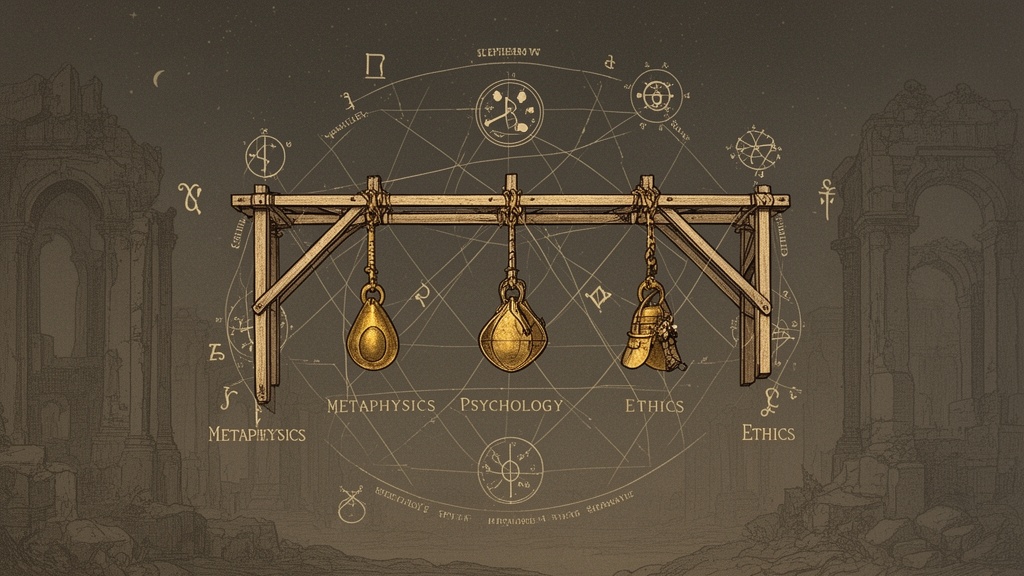
If you’re hanging an entire cosmology on a three‑card pull, where exactly do you expect it to attach?
That’s not a rhetorical sneer. It’s a structural question. Every divinatory layout you use already answers it, whether you’ve articulated that answer or not.
A spread is not just “some cards in a pattern”; it is a piece of oracular architecture with a finite number of beams, joints, and load paths. It can only carry so much metaphysical, psychological, and ethical weight before something gives. Most of the time, the failure is not dramatic; no tower collapses. The reading simply blurs, contradicts itself, or quietly becomes a projection screen for the reader’s favourite frameworks.
Call this oracular load‑bearing: the combined limit of what the spread’s structure can encode and what you and your querent can actually hold in mind without the whole thing dissolving into noise.
Once you start looking for that limit, you see how often we trample it.
Architecture before aesthetics
Historically, serious diviners have been more honest about structure than many of us are now.
Etteilla does not fling the same tableau at every problem. In Manière de se récréer… he is almost pedantic about matching operation to scope. You want a broad view of life and character? You use the full, fussy “Grand Jeu” with its articulated positions, elemental overlays, and moral diagnoses. You want a quick view on a specific matter? You use a smaller, stripped‑down layout, and you do not pretend it carries the same cosmological freight.
Papus, for all his breathless Qabalistic enthusiasm, does something similar. His “method of reading the Tarot” is not one single universal spread. He distinguishes operations for “general destiny” from those for a “determined question”. The heavy numerological and sephirothic scaffolding only properly attaches when the layout has enough articulation to map those distinctions.
Wirth goes further and warns explicitly against confusing “consultation” with “initiation”. A few cards on the table can answer a question; they do not automatically become a full mystical curriculum. He is, in modern terms, a load‑management advocate: don’t ask a fortune‑telling layout to carry your entire esoteric edifice.
Systematic esoteric and psychological use of the cards developed across the 19th and 20th centuries, beginning with French occultists and expanding through Jungian and humanistic movements — this is the tradition the current free-form eclecticism inherits, whether it acknowledges it or not.
Compare that to the contemporary habit of using a three‑card line as the default tool for everything from timing a job change to processing complex trauma to diagnosing “ancestral patterns” and “collective decolonial wounds”, all with a Rider–Waite–Smith deck whose day‑to‑day use, historically, was decidedly more mundane.
There is a mismatch here that is not about size alone. It is about structure.
What a spread actually is, structurally
Strip the imagery away for a moment. A spread is:
- A fixed number of slots (positions)
- A set of positional roles (“past”, “self”, “environment”, “unconscious”, etc.)
- A geometry that implies relations (lines, crosses, circles, houses)
- An implicit or explicit grammar for how those positions talk to each other
That is the architecture. The cards are the content. You cannot compensate for architectural limits by piling more content on each card.
Think of the Golden Dawn’s Opening of the Key. The cards are the same 78 bits of cardboard you use for your three‑card pull. What changes is the architecture: elemental piles, counting rules, dignities, decan attributions, path‑working overlays. Book T is very clear that you do not apply the full machinery to every throw. The operation itself gates the metaphysical load.
Geomancy offers an even starker example. Sixteen figures, no pictures at all. But once you cast them into the twelve houses, with fixed topical domains and a strict doctrine of witnesses, judges, and aspects, you have a chart that can legitimately bear a lot: character, timing, outcomes, even moral complexion. The load‑bearing is in the house structure and its relations, not in the figures as free‑floating symbols.
The I Ching is similar. A single hexagram is high‑density, but only because it sits in a rigid syntax: six fixed line positions, each with a doctrinal role; clear rules for changing lines; an established web of trigram and hexagram relationships. You are not improvising a new grammar every time.
Tarot spreads sit on the same continuum. A Celtic Cross is architecturally more articulated than a three‑card row. It has explicit axes (present vs crossing, conscious vs unconscious, self vs environment, hopes/fears vs outcome). You can legitimately talk about tensions and dynamics along those axes because the layout encodes them.
A three‑card line has a very simple base topology: three nodes in a row. Structurally, it supports a small handful of clean relations:
- A sequence (before–during–after)
- A central focus flanked by contextual modifiers
- A triad (thesis–antithesis–synthesis, or self–other–relationship, etc.)
You can decide that position one is “ancestral”, position two “personal psyche”, position three “collective field”, but you are now stretching a linear path to represent a nested system with feedback loops. The topology is not doing that work; you are importing it.
That is where load‑bearing becomes an issue.
Three kinds of load, one small frame
It helps to be precise about what we are loading onto the spread. Not every “layer” is the same kind of weight.
At minimum, you are juggling three dimensions:
-
Ontological / metaphysical load
Claims about what really exists and causally matters: spirits, karma, past lives, planetary intelligences, egregores, ancestral dead, tulpae, whatever your system admits. -
Explanatory load
Frameworks for why things happen in the way they do: trauma models, attachment theory, psychodynamic narratives, systems theory, decolonial analysis, economic constraints, etc. -
Ethical / relational load
What you take responsibility for in the reading: predicting vs exploring, giving advice vs witnessing, speaking about third parties, diagnosing vs reflecting, holding trauma vs referring out.
A simple spread can handle some of each. The problem is when we pretend it can hold all of each.
Take the very common modern move: three cards, read simultaneously as
- A karmic pattern (metaphysical)
- A trauma imprint (psychological)
- A colonial script (sociopolitical)
- With a side of transits and progressions (astrological metaphysics)
- All framed as a collaborative, consent‑based, trauma‑informed intervention (ethical)
Nothing in the geometry or positional labelling of a generic three‑card line distinguishes those levels. They collapse into one undifferentiated interpretive soup. You are effectively saying: “This card is your childhood attachment pattern, your ancestral curse, your Saturn square, your internalised white supremacy, and your current coping strategy.” That is not depth; it is conflation.
The metaphysical and explanatory frameworks you favour will quietly dominate. The others become garnish. The querent, unless unusually adept, cannot tell which claim belongs to which register, or which part of the reading is speculative cosmology vs clinically relevant vs politically actionable.
That is what an overloaded spread looks like from the outside.
How do you know you’ve exceeded capacity?
We cannot put a number on “how much” a layout can bear; this is not Shannon theory with bits per position. But we can name failure modes that show up reliably when structure and ambition are out of sync.
Some of them are interpretive:
-
Sprawl. The narrative keeps expanding to accommodate every card and every framework. By the end, the reading has touched on everything and committed to nothing. Ask the querent what the spread actually said; they cannot summarise it in under a paragraph.
-
Loss of discriminability. Positions blur. “Challenge” and “shadow” and “unconscious” all end up meaning “something difficult in you”. “Ancestral” and “past life” and “inner child” all point to the same vague elsewhere. Different metaphysical or psychological labels are applied to the same felt phenomenon because the layout gives you no way to separate them.
-
Retrofitting. Contradictory indications are smoothed over by adding more frameworks. A card that doesn’t fit the initial story becomes evidence of a “past life” or an “ancestral echo” or an “inner saboteur” without any structural anchor for that move. The spread becomes a Rorschach for whatever you need it to mean.
Some are cognitive and relational:
-
Working memory overload. You, as reader, find yourself mentally juggling too many axes at once: decans, elemental dignities, trauma language, political analysis, magical timing. You start dropping threads, or you lean on stock phrases. Depth is replaced by fluency.
-
Querent flooding. The querent looks dazed, not moved. They nod, but when you ask them to reflect back what they heard, they latch onto one or two fragments and ignore the rest. Or they latch onto the most deterministic or grandiose piece (“So this is karmic and I’m cursed”) because the architecture did not clearly distinguish “this is a metaphorical lens” from “this is how the cosmos is wired”.
-
Hidden contradictions. You oscillate between incompatible stances without noticing: “This is your fate” in one sentence, “You can always choose differently” in the next, without any structural cue (like distinct positions for fixed conditions vs agency) to hold that paradox consciously. Or you slide between “this is trauma” and “this is karma” as if those were interchangeable explanations.
These are the oracular equivalent of cracks in the plaster and doors that no longer close properly. The building is still standing, but you are asking more of it than its frame was designed to support.
Topology and what a shape can say
The geometry of a spread is not an aesthetic flourish; it encodes what kinds of relations can be made explicit.
- A line expresses sequence, direction, and simple triads.
- A cross expresses tension between axes: vertical (inner/outer, spiritual/material) and horizontal (self/other, past/future).
- A circle or wheel expresses cycles and distributed influence.
- A house layout (astrological or geomantic) expresses domains of life and their interrelations.
Astrology is instructive here. A natal chart can bear a lot of interpretive and ethical weight precisely because its topology is rich and fixed: twelve houses with defined scopes, aspects with defined angular relations, angles that anchor identity and life direction. Ptolemy and Lilly both spend real time delimiting what such a chart can and cannot responsibly claim. Lilly’s “Considerations before Judgement” are essentially a treatise on not overloading the chart: don’t pronounce when the figure is not radical; don’t promise what the configuration does not support.
Now compare that to a three‑card line. Yes, you can hack it. Readers routinely invent diagonals, echoes, and emergent patterns. A single card can be taken to stand for an entire subsystem (“this is your family system”). Narrative skill can imply cycles and feedback loops that the geometry does not show.
But that is exactly the point: the more you rely on imported grammars and readerly invention, the less the spread itself constrains your projections. In a circular, multi‑node spread designed for cycles, the return of a theme is anchored in distinct positions; you can point to the structure. In a three‑card line, “this feels cyclical” is a felt sense, not a structural fact.
When you are carrying a lot of metaphysical and psychological load, that difference matters. Without structural constraint, overfitting is easy. You can make three cards tell any story you like.
This topological looseness becomes especially visible when we try to make one simple layout serve multiple functions simultaneously.
Divination, initiation, therapy, politics – all at once?
The French occultists and the Golden Dawn were, whatever their flaws, reasonably disciplined about distinguishing functions.
- Fortune‑telling and “vulgar divination” were one thing.
- Initiatory use of the trumps as a path of spiritual development was another.
- Magical operations with the cards as talismans or sigils were a third.
You can see that separation in their layouts. Etteilla’s moral and “past life” analyses are not squeezed into the same mini‑spread as a quick look at next month’s money. The Golden Dawn reserves the full OOTK for serious work and has simpler operations for quick queries. Crowley, in The Book of Thoth, oscillates wildly in tone but still implies that some questions require ritual preparation and that “divination is a department of Magick”, not a casual parlour trick.
Modern practice often tries to do all of it at once, and often with the smallest possible container. A typical example:
- Layout: three cards, “Situation / Challenge / Advice”.
- Question: “Why do I keep ending up in abusive relationships, and how is that tied to my ancestral line and to patriarchy more broadly, and what magic can I do about it, and how does this fit my Saturn return?”
That is not a bad question. It is several questions at very different explanatory levels and with very different ethical stakes. A serious response would require:
- At least one position for structural context (social, economic, political)
- At least one for personal patterning (attachment, trauma, coping)
- At least one for ancestral or metaphysical framing (if you work that way)
- At least one for agency and possible interventions
- Possibly one for “what is out of scope / not to be touched here”
You can try to compress all of that into three cards. Many readers do. But notice what happens: some of those levels get reduced to colour commentary. “Patriarchy” becomes a word you mention in passing rather than a structural factor you genuinely track. “Ancestral” becomes an aura around the reading, not a distinct line of inquiry. The spread’s architecture does not allocate them their own beams; they hang off whatever nail is available.
That is how ethical load can exceed capacity. You find yourself, almost despite your intentions, speaking as if three pieces of cardboard can bear the same diagnostic weight as a therapy intake, a political analysis, and a magical consultation combined. Your role blurs. The querent’s expectations blur. The layout has given you no way to mark those boundaries.
The spread as container, not cure
There is a reason trauma therapists talk about a “window of tolerance” and “titration”. It is not only about content; it is about container. Session length, frequency, the therapist’s role, the room itself – all structure how much intensity can be safely invoked.
Ritual magicians think similarly in different language. You do not call down a godform in a casual, unbanished space. You construct a circle, mark the quarters, state the intent, and close properly. The container is part of the operation.
A tarot spread is a much looser container, but it is still a container. Number of positions, positional labels, and the way you open and close the reading all contribute to how much psychic and metaphysical charge the session can hold.
When you bring high‑intensity material into the room – trauma, ancestral burden, systemic oppression, death and illness, serious magical work – and your chosen layout has:
- No position for resourcing or support
- No position for limits or “what we will not touch”
- No differentiation between inner pattern, outer circumstance, and metaphysical narrative
then you are effectively inviting a lot of charge into a very small cup. You might manage it through your own skill and containment, but the spread is not helping you. It is not designed to.
This is not an argument for turning every reading into quasi‑therapy or full ceremonial magic. Tarot is not therapy, and a “resource card” is not a substitute for an actual support network. It is an argument for recognising that layout choice is part of ethical practice. If you are going to court that level of intensity, either expand the container or narrow the scope.
Sometimes the most ethical move is to say: “This question touches on things that are beyond what this spread – and this role – can hold. We can look at one slice of it today, and you may also want to bring the rest to your therapist / your coven / your organiser group.”
That is not cowardice. It is structural honesty.
What disciplined load‑bearing looks like in practice
This does not require abandoning small spreads. It requires being explicit about what they are for.
A three‑card line can be razor‑sharp if you limit its job. For example:
- “What is the immediate pattern I am enacting in this situation?”
Card 1: my stance
Card 2: the other party’s stance (as perceived)
Card 3: the dynamic between us
You can hold a lot of psychological depth there without dragging in karma, ancestors, or Saturn. You can name trauma patterns as they show up in this dynamic without pretending to resolve the whole trauma history.
If the querent then asks, “But what about the ancestral side?” you have a choice:
-
You can say, “That is beyond the scope of this spread; let’s schedule another session with a layout that has space for that,” and design, say, a six‑card spread with distinct positions for personal, familial, and collective layers, plus at least one for support.
-
Or you can expand the current container consciously: “Let’s draw two additional cards specifically for ancestral patterns and ancestral support. We’ll keep them separate from the three we’ve already interpreted, so we don’t collapse everything into one channel.”
Notice that in both cases you are tracking load. You are not silently repurposing existing positions to carry more weight than they were labelled for.
The same applies to metaphysical overlays. If you want to work with decans, planetary rulerships, and Qabalistic paths, a more articulated spread like OOTK or a decan wheel gives you actual anchor points. Doing full natal astrology through a three‑card daily draw is not “advanced”; it is structurally incoherent.
Similarly, if you want to bring in decolonial analysis, you can give it a place: a position explicitly labelled “structural / systemic factors” or “colonial scripts at play here”. That way, when you speak about those dynamics, you are not smuggling them in as an afterthought to a card that is also doing ten other jobs.
The discipline is not in which frameworks you allow; it is in matching frameworks to architecture.