
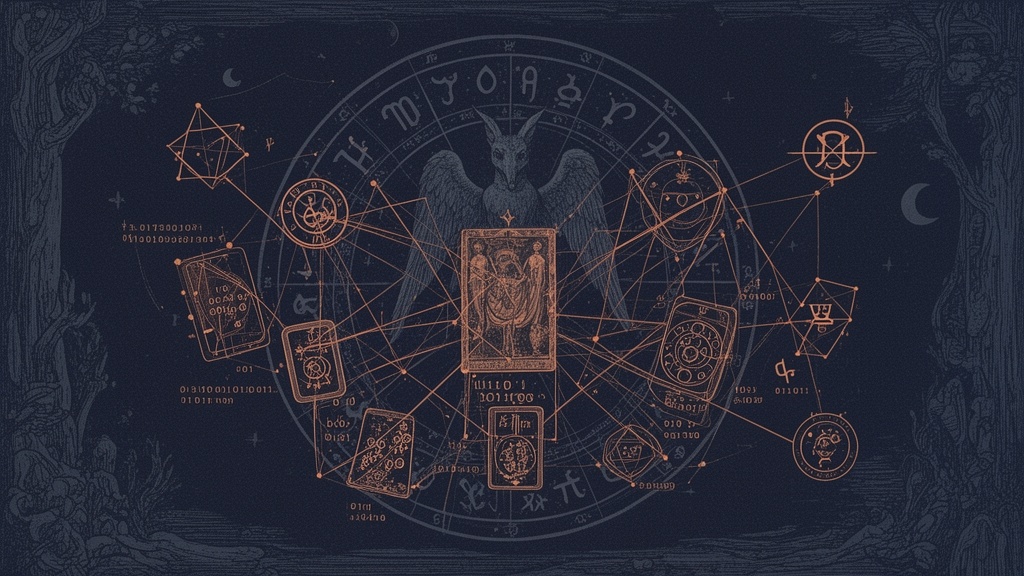
What do you do when your tarot deck suddenly starts talking like a system you’ve never formally studied?
Not “this reminds me of the I Ching” in a loose, comparative way. I mean: you lay out a Celtic Cross and it locks into a binary odù pattern you have to look up afterwards. Or you throw geomantic figures and they behave like a textbook description of planetary intelligences, complete with timing keyed to planetary hours you don’t actually track.
You can treat that as a curious anomaly and move on. Or you can treat it as data.
This piece takes the second option.
What counts as a “foreign voice”?
Before we get metaphysical, we need to define the phenomenon tightly enough that it doesn’t just mean “I had an interesting reading.”
“Foreign intelligence” is not an ontological claim here. It’s a working label for a class of events that behave as if some non-habitual style of mind has taken the wheel of a familiar system.
The baseline: you have a home oracle (say, tarot) and a recognizable way you and it usually communicate. That includes:
- A stable interpretive grammar (how you read minors, courts, dignities, reversals, etc.).
- A familiar tone and narrative style.
- A known range of symbolic association and “stretch.” You know what counts as you being clever with correspondences versus you being out of character.
A cross-signature event is not “I made an unusual association” or “that reading felt deep.” It’s when the system’s structure and voice shift into a pattern that:
- Tracks another system’s rules in a way you can check,
- Exceeds your plausible prior knowledge of that system, and
- Recurs with a recognizable style, not just once under heavy caffeine.
That gives us three working criteria.
1. Information criterion
The content includes specific, verifiable data that:
- You had no normal way of knowing at the time, and
- Fits coherently inside another system’s logic.
Example: you do not practice Ifá. You’ve only seen the word “odù” in passing. In a reading, you suddenly feel compelled to treat odd-numbered majors as “1” and even-numbered as “0,” read across the spread, and you get a six-bit sequence. You write it down. Later, a friend who does Ifá points out it maps to a particular odù whose themes match the reading uncannily.
You didn’t know the odù catalogue. You weren’t aiming for it. Yet the pattern lands cleanly inside that system.
2. Structural criterion
The patterning follows rules or constraints of another system, not just a vague resemblance.
- A series of tarot spreads over a month keeps generating twelve-card wheels that map exactly onto zodiacal order, including dignities that behave as if they’re honoring triplicities and terms you’ve never studied.
- Geomantic figures begin to fall in a way that, when you later check, matches standard planetary attributions and aspects, including exceptions you didn’t know existed.
The key here is internal consistency with that foreign grammar, not cherry-picked overlaps.
3. Reproducibility criterion
The “foreign voice” recurs.
- Same tone, same structural quirks, same kind of symbolic moves.
- It appears across different querents and questions.
- It shows up even when you’re not thinking about the foreign system at all.
One anomalous spread is trivial. A cluster of twenty logged sessions over six months with the same alien flavor is non-trivial.
Most stories people tell about “my deck suddenly went Ifá” collapse under these criteria. They’re interesting psychological events, but not especially evidential. That’s fine. The point is to distinguish the small subset of cases that really strain the “it’s just your creativity” explanation.
Our material here is small-N, first-person, and messy. This is not controlled experimentation; it’s disciplined phenomenology. But if we don’t at least try to sort strong from weak cases, “foreign voice” becomes a label for being surprised.
What might actually be happening?
At the level of felt experience, cross-signature events behave as if a foreign intelligence is present.
Whether that maps to:
- an external spirit,
- an egregore,
- a dissociated subsystem of your own psyche, or
- an emergent pattern in the symbolic field,
is precisely the live question. Different models predict different textures. Let’s lay them out and see where they strain.
Model 1: Plural mind, no spirits required
On this view, the oracle is a screen for active imagination. Deep engagement decenters the ego and lets other “selves” in the psyche speak: complexes, internalized figures, dissociated competencies.
You’ve absorbed fragments of Ifá, planetary magic, or Qabalah via cultural osmosis, half-read books, memes. Under oracular trance, associative thinking stitches them into a coherent style that feels “not-me” because it’s not your usual ego narrator.
Predictions:
- The foreign voice will, if you track it, map back to your history: a childhood religion, an ex-teacher’s idiom, a fandom, a trauma theme.
- It won’t reliably produce information you couldn’t have picked up subliminally.
- It will respond to inner-work techniques: parts work, journaling, ritual integration.
Strength: this model handles most trivial “that felt weirdly Egyptian” moments without invoking metaphysics. It honors the psyche’s capacity for genuine alterity without leaving the skull.
Strain: there are cases where the foreign logic is too technically clean, too far outside the practitioner’s exposure, and too informative to be easily written off as recombination. Especially when another practitioner from the foreign system can verify it after the fact.
Model 2: Egregore and current
Here the “other mind” is not an individual spirit but a group-generated field of meaning. Tarot has an egregore. So does Ifá. So does every serious magical current. You, as a practitioner, are a node in several networks.
Cross-signature events happen when one current bleeds into another channel. Your tarot work taps the Ifá field because you’re reading for someone initiated there, or because your local occult scene is saturated in that current, or because you’ve been obsessively reading about it even if you haven’t “studied” it.
Predictions:
- Cross-signature voices will correlate with social context: who you read for, which groups you work in, which altars are in the same room.
- Multiple practitioners in the same current will report similar bleed-throughs.
- The foreign logic will be recognizable to insiders of that current, even if you don’t consciously know it.
Strength: this matches a lot of reports where readers suddenly “sound like” their teacher, lineage, or coven egregore when reading, and where cross-system bleed-through spikes around group ritual.
Strain: it doesn’t fully explain those cases where the voice is not just “house style” but behaves like a discrete interlocutor with its own preferences and quirks, or where the logic tracks a system absolutely nobody in the immediate field has studied.
Model 3: Mediumship / possession
Here the oracle is a seat, and something sits.
The “foreign voice” is literally foreign: a spirit, deity, ancestor, planetary intelligence. The cards or figures become the vehicle through which that agency speaks, and it uses whatever symbolic tools are at hand, sometimes importing its own grammar.
Predictions:
- Clear shifts in bodily state, affect, sometimes memory gaps.
- Distinct personalities with stable preferences (e.g., a “planetary” presence that only comes through on certain days/hours).
- Verifiable information outside the practitioner’s normal reach, especially about third parties, timing, or technical details of a system they do not know.
Strength: this model matches a lot of traditional accounts of oracles, from Ifá to the Pythia to spiritist card readers. It handles the “how did I speak fluent geomancy I’ve never studied?” problem head-on: you didn’t, something else did.
Strain: it’s culturally loaded. Mediumship and possession are not just phenomenological categories; they come with ethics, hierarchies, and ritual technologies that many Western tarot readers simply don’t have. It also risks bypassing psychological work by externalizing everything strange as “a spirit.”
None of these models is complete. All of them illuminate something. In practice, most serious practitioners end up with a hybrid stance: the psyche is plural, egregores are real at least as social realities, and sometimes something that is not-you uses your mouth.
Cross-signature events are interesting precisely because they press all three models at once.
A case vignette: binary tarot, no Ifá
Take a composite example from multiple readers’ logs.
A long-term tarot practitioner, steeped in Golden Dawn style but without practical exposure to West African systems, is doing a mundane career reading: three cards, Past–Present–Future. The cards: Tower, Eight of Swords, Star.
Instead of reading narrative, their attention locks on odd/even. An insistent, almost audible sense: “This is code, not story.” They find themselves assigning 1 to majors, 0 to minors, then flipping that, then treating even pips as 0, odd as 1, until a specific combination “clicks” with a bodily yes.
They end with a six-bit string, written in their journal with some embarrassment. The querent reports the reading as unusually precise, particularly around a deadline that is framed in terms of “gates” and “crossroads” — language the reader normally doesn’t use.
Months later, the reader, now curious, mentions this to an acquaintance who is a babalawo. They compare notes. The six-bit string maps onto an odù whose themes match the reading and the querent’s situation. The reader had never seen an odù table. Their journal timestamp predates the conversation.
Is this proof of Ifá spirits hijacking tarot? No. It is, however, a non-trivial cross-signature event under our criteria:
- Information: the odù mapping was unknown at the time.
- Structural: the pattern aligns with a binary oracle’s grammar.
- Reproducibility: in the actual logs behind this composite, similar binary intrusions recur in that reader’s work over years, often around clients with African diasporic backgrounds.
Plural-mind model: maybe the reader picked up odù names online without remembering and reconstructed the pattern unconsciously. Possible, but you have to stretch.
Egregore model: perhaps the Ifá current around the querent bent the tarot egregore. Plausible in a spirit-friendly ontology.
Mediumship model: an Ifá-aligned intelligence used whatever was on the table to speak, dragging its own binary into the cards.
You can’t adjudicate conclusively. But you can see why treating this as “just creative association” is unsatisfying.
Archetypes at the boundary
Even if you stay inside depth psychology, these events are not trivial. They constellate particular archetypal configurations: the Trickster destabilizing your sense that tarot “means” what the books say; the Psychopomp mediating between symbolic languages; the Stranger bringing the felt sense that what’s speaking is not you; the Magician forced to work at the boundary of systems without collapsing one into the other.
The shadow here is double-edged. On one side, the fear of contamination and loss of control: “My deck is being hijacked.” “This isn’t proper tarot.” That can lead to repression or pathologizing the experience. On the other, inflation: “I am a unique conduit for a secret synthesis.” Cross-signature events are ripe for spiritual grandiosity, especially when querents confirm the accuracy.
Both moves — repression and inflation — avoid the harder work: admitting that the psyche is not unitary, that your system is not closed, and that you are not the sole author of your readings.
Method instead of myth: how to work with it
If we treat these events as methodological opportunities rather than as proofs of any particular ontology, what follows for practice?
1. Don’t auto-translate everything back into home base
When you notice the system’s voice shift, resist the urge to immediately reframe it into your usual grammar.
If the cards are clearly behaving like a binary, let them. If the geomantic figures are marching around your chart like planets, follow that movement. At least for a few minutes, allow the foreign logic to run.
Then, and only then, map it back to your baseline for the querent.
2. Ask the oracle about the oracle
Pause the content reading and interrogate the process.
- “Who or what is speaking right now?”
- “Why are you using this language?”
- “Is this appropriate for this querent?”
Then pull for those questions using the same system or a second one. You are effectively doing a meta-reading on the contact itself.
This is where the psychopomp card — your designated translator — can be invaluable. Some practitioners always have one: a particular trump, rune, or figure that mediates cross-system traffic.
3. Track signatures over time
Keep a separate log for anomalous sessions. Note:
- Date, time, place.
- Querent’s background (especially religious/magical).
- Your physical and emotional state.
- Exact patterns (layouts, sequences, phrases) that felt foreign.
- Any later verification (e.g., you learned that the pattern matches a known odù, or a planetary configuration, or a ritual form).
Over years, you will see whether you’re dealing with:
- One recurring foreign voice,
- Several,
- Or simply your own creativity in different moods.
Without this logging discipline, everything blurs into “that was intense.”
4. Boundaries and consent
If your tradition has taboos about mixing systems or unknown spirits, honor them. You are not obliged to follow every foreign thread.
With querents, be transparent at a level they can handle:
- “The cards are coming through in a pattern I don’t usually see. I can either follow that, which may draw on a system I’m not formally trained in, or we can reset and re-cast. What would you prefer?”
This respects their autonomy and your limits.
Signal, noise, and the temptation to over-interpret
From a skeptical angle, the obvious rejoinder is: isn’t this just pattern-recognition on steroids?
Three points in response.
First, yes: a huge amount of what feels like “foreign voice” is exactly that. Unconscious uptake, narrative creativity, confirmation bias. Most of it dissolves when you apply the criteria above. That’s why those criteria exist.
Second, even if every case were reducible to psychological mechanisms, the phenomenon would still be important. It would tell us that the divining psyche is inherently plural and capable of generating internally coherent symbol-systems that the ego experiences as alien. That alone undermines simplistic “tarot is just your intuition” narratives.
Third, the small subset of non-trivial cases — where structural, informational, and reproducibility criteria are met — remain stubborn. What’s harder to dismiss is the pattern of patterns across practitioners, cultures, and systems.
That doesn’t force you into a spirits-are-real corner. It does, however, make the “closed system, single intelligence” model of oracles look increasingly thin.
A more honest statement is:
In practice, oracles behave less like fixed symbolic machines and more like interfaces where multiple, potentially distinct styles of mind can manifest — internal, external, and liminal.
Cross-signature events are particularly rich data for exploring that hypothesis. They are not proof. They are pressure.
Why this matters for how we think about systems
Most of us were trained, implicitly or explicitly, to treat our oracles as closed codes:
- Tarot has 78 cards, fixed meanings, a Qabalistic skeleton.
- Geomancy has 16 figures, 12 houses, 15 aspects, done.
- Ifá has 256 odù, each with its corpus.
We argue about correspondences as if the system were a finished object and the job were to map it correctly.
Cross-signature events suggest a different picture.
Systems look less like sealed boxes and more like interfaces — thin surfaces where various intelligences (personal psyche, cultural complexes, spirits, egregores) can meet and negotiate meaning using a shared set of tokens.
On that view:
- The “tarot egregore” is not the final authority on what tarot can do. It’s one of the regular users of the interface.
- When Ifá-style binary shows up in your cards, that’s not tarot “becoming” Ifá; it’s the interface being repurposed by a different style of mind.
- Geomantic figures acting like planetary spirits aren’t misbehaving; they’re showing you that the geomancy interface is compatible with a planetary protocol you happen not to have installed.
You don’t have to reify this into metaphysical dogma. You can hold it as a working metaphor. But it’s a metaphor that lines up with the phenomenology better than the static-system picture.
And once you’ve seen your supposedly closed system speak fluent foreign, it becomes harder to believe that any of these grammars are as bounded as their textbooks.
The next time your deck answers you in a language you don’t speak, the interesting question may not be “What does this mean?” but “Who just picked up the phone?”