
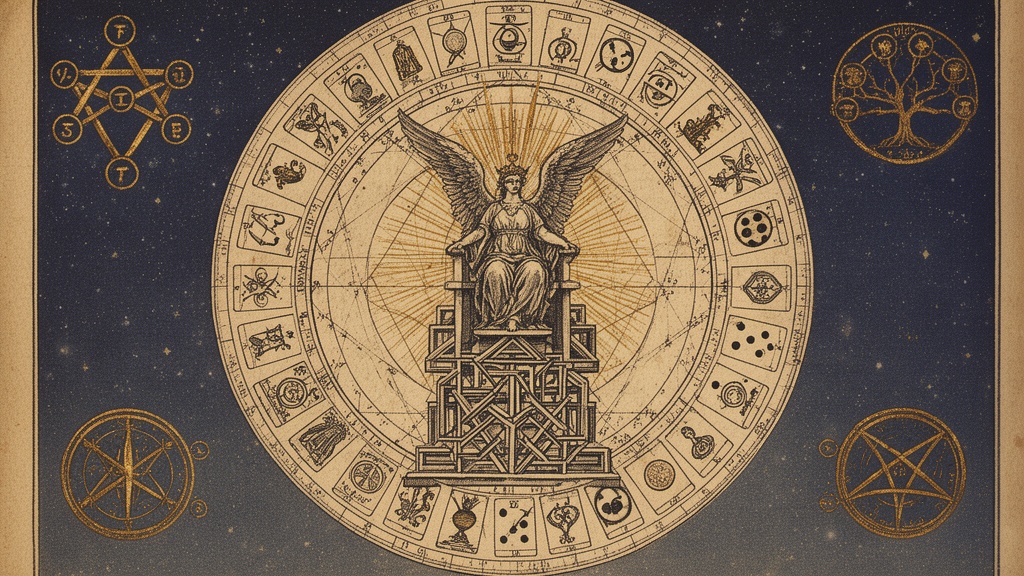
Most of what passes for “higher guidance” in tarot carries more grimoire logic than most readers would admit, or even recognize.
One of the clearest skeletons behind that logic is the Abramelin operation—not as a one‑to‑one source text for tarot, but as a template for how authority, ordeal, and relationship to powers can be structured. That template moves through Mathers, Crowley, and Thelemic culture into the Golden Dawn–style tarot ecosystem. Its logic still shapes how “higher self” and “True Will” readings are framed, even when the metaphysics have been thoroughly psychologized.
Once you start seeing that skeleton, a lot of apparently neutral tarot practice stops looking neutral.
This piece tries to make that structure visible—not to accuse you of “secretly doing Abramelin” when you lay a spread, but to ask what kind of operation you’re actually running when you invoke higher guidance with 78 printed spirits.
What We Can Actually Claim About Abramelin and Tarot
Before getting tangled in correspondences, it helps to keep three distinct layers on the table.
1. Documented historical influence
Some links are simply there in the record:
- Mathers publishes The Book of the Sacred Magic of Abramelin the Mage in 1898. That text is one of the key sources for the “Knowledge and Conversation of the Holy Guardian Angel” (K&C of the HGA) as a formal operation in the British occult revival.
- Crowley takes K&C of the HGA as the central task of the magician. In Liber Samekh and elsewhere he explicitly leans on Abramelin as both source and precedent.
- Golden Dawn and Thelemic angelology and doctrine around HGA and True Will feed directly into Crowley’s Book of Thoth and, more diffusely, into post‑GD esoteric tarot. The HGA/True Will complex becomes part of the conceptual furniture around how cards are supposed to “guide.”
That’s not speculative; it’s just the genealogy of a set of ideas.
2. Transmission by milieu
Once HGA and True Will are centered in ceremonial magic, they become part of the ambient air:
- Lodge work, magical diaries, and early 20th‑century occult publishing normalize the idea that there is a singular, authoritative inner (or supra‑personal) guide, and that the magician’s job is to contact it and align with it.
- Tarot is taken up inside that same milieu. Decks are redesigned and reread through that lens: as tools for contacting higher guidance, discerning Will, subordinating “lesser” drives and distractions.
Even when a given tarot author never cites Abramelin, they’re speaking a language whose grammar was partly set by that operation’s reception.
3. Structural analogy
Then there’s a different level, where we’re no longer talking about historical lineage but about pattern:
- Modern “higher self,” “soul path,” or “True Will” tarot work often behaves like a miniaturized, psychologized Abramelin: a central, privileged authority; a field of unruly, subordinate powers; and an attempt to reorder them under the right center.
- In that sense, Abramelin is a sharp model for something that might otherwise stay implicit in our reading habits.
If you keep these three layers distinct, you don’t have to pretend tarot is “just another grimoire” to see that its modern esoteric forms are not innocent of grimoric logic.
HGA vs. “Higher Self”: Same Architecture, Different Ontology
Equating the HGA with the “higher self” is common and lazy in exactly the way that matters here.
In the Abramelin text, the Angel is:
- An external, ontologically independent being;
- A specific emissary of God, not a metaphor for your better judgment;
- The legal source of your right to command spirits.
You don’t talk it out with the Angel. You obey, because that obedience hooks you into a vertical chain of command: God → Angel → magician → spirits.
Crowley doesn’t soften this as much as later readers sometimes assume. Even when he layers in “Genius” or “True Will,” the Angel remains a real intelligence with its own mind and voice. The structure is still monarchic.
By the time you get to late‑20th‑century tarot books, that verticality has been dramatically psychologized:
- “Higher self” is treated as an immanent stratum of the psyche—wiser, more integrative, but still “you.”
- Access is framed as intuitive, imaginal, or contemplative rather than as the outcome of a once‑in‑a‑lifetime ordeal.
- The relationship is collaborative: you “listen to,” “dialogue with,” or “align to” this stratum, not swear fealty to an angelic superior.
Ontologically, these are different universes. Structurally, the resemblance is hard to miss.
- A privileged center of guidance
- Abramelin: the HGA as singular, authoritative voice.
- Tarot: “higher self,” “soul,” “core guidance,” “True Will” positions that anchor the reading.
- A mediating technology
- Abramelin: the fixed, time‑bound operation with its rules and constraints.
- Tarot: consecration, question‑craft, spread design, invocation of guides, trance techniques.
- A field of subordinate or conflicting forces
- Abramelin: demons and sub‑lunar spirits to be bound and put to work.
- Tarot: drives, complexes, external pressures, ancestral patterns—mapped as cards in tension, to be integrated, redirected, or reframed.
When you ask, “What does my higher self want me to know about this?” and then treat one card as the answer and the rest as noise, resistance, or context, you’re not “doing Abramelin.” But you are operating inside a similar architecture of address: first, establish the privileged voice; then, read every other force relative to it.
The most striking difference is at the endpoint. Abramelin culminates in command: spirits are brought to heel and given tasks. Contemporary tarot ethics, especially with a therapeutic inflection, tends to reject coercion:
- Internal parts are to be listened to, not exorcised.
- “Blocks” are reframed as protectors or wounds, not enemies.
- External obstacles are handled with boundaries and negotiation, not domination.
The metaphysics has shifted from monarchic to pluralistic. The process skeleton—identify the right center, reorganize around it—has mostly stayed in place.
Ignoring that skeleton is how you end up talking like a Thelemite (“align with your path, ignore distractions”) while imagining you’re doing purely client‑centered, non‑hierarchical work.
Tarot as Spirit Catalogue
Abramelin doesn’t just give you an Angel and an ordeal. It gives you a fully enumerated bureaucracy of powers:
- Named spirits with seals and specific jurisdictions: finding treasure, stirring love, granting invisibility, teaching sciences, and so on.
- The sense that, taken together, they cover the operative field of the magician’s world.
- A bureaucratic model of magic: once you have the Angel’s backing, you can manage this staff.
Golden Dawn tarot work doesn’t replicate that, but it rhymes with it more than most readers notice.
By the time you have:
- 78 cards, each slotted into a lattice of sephiroth, elements, decans, and planets;
- Attributions of angelic and qabalistic names to each decan (and thus to the associated minors);
- Trumps keyed to specific paths on the Tree, with their own angelic and divine name chains;
you effectively have a catalogue of powers mapped onto the deck.
You can see this explicitly in GD material like the Book T papers and the decan/angel assignments that lie behind the minors, and in Crowley’s Book of Thoth, where cards are repeatedly treated as active forces with jurisdictions:
- The 5 of Disks is not a generic “hard times” symbol; it is “Lord of Material Trouble,” Mars in Taurus, with all the implied friction of martial force in a fixed earth sign.
- The 8 of Wands is “Swiftness,” Mercury in Sagittarius, a specific mode of rapid, expansive communication.
- The court cards are “Lords” of elements in elements, with angelic and geomantic ties, functioning like governors of particular domains of action.
Once you take those attributions seriously, each card starts to look less like a static signifier and more like a spirit‑form with a temperament and jurisdiction. A spread becomes a convened council or clash of these powers around a question.
Operationally, the difference from Abramelin is obvious:
- In Abramelin, you conjure Spirit X to do Y. The list is instrumental.
- In tarot, you draw Card Z to see a pattern. The list is diagnostic and contemplative.
But the underlying logic—“the world of operation can be mapped as a finite set of named powers, each with its own domain”—is the same.
If you lean into that analogy instead of shying away from it, a few things become available:
- Treating cards as powers to be related to (invited, negotiated with, constrained) rather than just as messages to be decoded.
- Reading spreads as temporary economies: which powers dominate, which are suppressed, which are missing but needed.
- Designing workings where you stabilize a given card’s power in your life over time, instead of just noting its appearance and moving on.
This isn’t a claim about what tarot “really is.” It’s a way of operationalizing the GD’s grimoire‑adjacent layering. If you’ve ever felt the deck as a living ecology, Abramelin’s bureaucratic angelology gives you a way to think about how that ecology might be governed—and by whom.
From Ordeal to Micro‑Operations
The Abramelin operation is a designed ordeal:
- Months of fixed prayer and abstinence.
- Daily repetition inside a circumscribed space and schedule.
- A climactic encounter with the Angel, followed by a series of confrontations and pacts with the demonic hierarchy.
- A promised reordering of your spiritual economy: before the operation and after it are not the same life.
Most tarot work is nowhere near that scale or intensity. But if you strip away the metaphysical claims and look at the process architecture, there’s an echo that’s hard to ignore.
Serious card work tends to involve:
- Repetition under constraint: daily draws, weekly check‑ins, lunar or solar cycles, year‑long pathworkings.
- Self‑imposed rules: dedicated decks for particular themes, ritual preps, bans on reading certain topics for oneself or others, oaths about honesty in interpretation.
- Structured confrontation: returning again and again to the same pattern—attachment dynamics, vocational ambivalence, addictive cycles—through the cards, allowing no easy escape from seeing it.
- Turning points: the reading that precipitates a breakup, resigning from a job, starting therapy, initiating into a lodge, shifting magical current.
Psychologically, both Abramelin and this kind of tarot practice function as ritualized individuation:
- Inner figures are externalized (Angel, demons; cards, ancestors, “energies,” parts).
- Interaction happens inside a bounded symbolic container with its own rules.
- Over time, self‑experience and agency reorganize around the repeated encounters.
The scale and claim differ:
- Abramelin asserts a categorical shift: you become a different kind of being, with a new standing in the cosmos.
- Tarot tends toward incremental shifts: new narratives, altered decisions, gradual integration.
But when you design tarot work as finite operations—with a defined beginning, middle, and end; explicit constraints; and a planned climax—you’re consciously miniaturizing the ordeal model.
A six‑month Major Arcana pathworking, with a set ritual, journaling protocol, and final integrative spread, is not Abramelin. It is, however, recognizably the same species of thing: a time‑bound, rule‑bound operation aimed at permanent reconfiguration.
If you take that seriously, a reading stops being “just some cards” and becomes a micro‑operation: a small, contained working that slightly alters your inner economy. A series of such micro‑operations, under a coherent intention, adds up to an ordeal.
The interesting question is not whether that’s “really magic,” but: into what are you being re‑made, and under whose authority?
Chains of Authority and the Ethics of “Higher Guidance”
Abramelin’s authority structure is not subtle:
- God is the source.
- The HGA is God’s personalized emissary to you.
- Your right to command spirits is derivative of your obedience to the Angel.
- Spirits are subordinate; their resistance is a problem to be overcome.
Crowley’s Thelema keeps the structure while changing the language:
- “True Will” is the deep law of your being, not a mood or preference.
- Once known, it justifies decisive action; internal or external resistance is, in effect, error.
- The magician’s task is to discover that Will and bring all other forces into its service.
When that complex hits tarot, you get:
- Spreads and texts about “discovering your life purpose,” “aligning with your True Will,” “hearing what your higher self wants.”
- Layouts where one card or position is explicitly directive (“core guidance,” “true path,” “soul’s desire”), and all other cards are read as support, challenge, or distraction relative to that center.
At the same time, contemporary tarot culture has been moving in a different ethical direction:
- Away from guru models, toward consent‑based, collaborative work with querents.
- Toward trauma‑informed practice, which treats internal “parts” as protectors or wounded aspects, not enemies to be bound.
- Toward pluralistic and decolonial critiques of rigid hierarchies, including in spiritual cosmologies.
So you end up with an interesting tension: polycentric ethics, monocentric metaphors.
A very ordinary example: a client asks, “How can I align with my life purpose this year?”
You have at least two distinct frames available.
Monocentric (Abramelin/Thelemic)
- You designate a central position: “Core directive / True Will in this period.”
- Other positions map “rebellious spirits”: fears, conflicting desires, social obligations, addictions.
- Additional positions show “binding/integration”: what must be constrained, what must be sacrificed, what is brought into service.
- The spread enacts a hierarchy: there is a right directive; everything else is evaluated as either serving or hindering it.
Polycentric (plural/parts‑based)
- You map multiple legitimate centers: vocational self, relational self, somatic self, spiritual self, each with its own card.
- You explore their negotiations and conflicts without assuming a single one should rule.
- The endpoint is not command but treaty: boundaries, compromises, sequencing (“this now, that later”).
The cards on the table could be identical in both versions. The operation you are running is not.
In the first, you are effectively acting as a priest of the querent’s Angel/True Will/higher self, helping them subordinate other powers. In the second, you are acting as a facilitator of a council, where no single power has automatic supremacy.
Both can be done responsibly. Both can be abused. The point is that the monocentric model most readers inherit has its roots in something like Abramelin, whether or not they’ve ever opened the grimoire.
The skeptic’s objection here is predictable: “You’re over‑reading. People just want clarity. ‘Higher self’ is a metaphor. There is no actual chain of authority; it’s all internal narrative.”
From a strictly psychological standpoint, that’s defensible. But even as narrative, how you narrate matters. A psyche organized around a singular, unquestionable center behaves differently than one organized around negotiated plurality.
If you present guidance as coming from a singular “higher” authority, you are implicitly licensing certain moves:
- Overriding ambivalence as mere resistance.
- Treating suffering parts as “demons” to be disciplined rather than wounded beings to be tended.
- Justifying drastic life changes as obedience to a calling that outranks all other claims.
Sometimes that is exactly what is needed. Sometimes it is not. Knowing that you are, in effect, borrowing Abramelin’s chain of command in miniature gives you a clearer sense of what you are doing when you lean into that language.
Working With the Skeleton Instead of Pretending It Isn’t There
None of this obliges you to become a Thelemite, or to retrofit your tarot practice into a half‑baked Abramelin cosplay.
What it does is offer a sharper vocabulary for choices you are already making.
You can:
- Treat the 78 as a loose symbolic toolkit, or as a catalogued spirit ecology. Either way, the GD scaffolding is there. If you choose to ignore it, that’s a choice.
- Frame “higher self” spreads as encounters with a singular directive center, or as facilitated dialogues among multiple centers. Both have precedents; both have consequences.
- Design your long‑term tarot work as open‑ended exploration, or as finite operations with constraints and ordeals. The latter will, whether you name it or not, push you toward Abramelin‑style architectures of transformation.
There is no neutral tarot. Every spread is an operation with an implicit metaphysics of authority, even if that metaphysics is “there is no authority; we’re just talking.”
The interesting question, once you’ve seen the Abramelin skeleton, is not whether to exorcise it. It’s whether you want to keep pretending your “higher guidance” work is innocent of grimoric logic—or whether you’d rather decide, consciously, which powers in your practice get to speak with command, and which are finally allowed to answer back.