
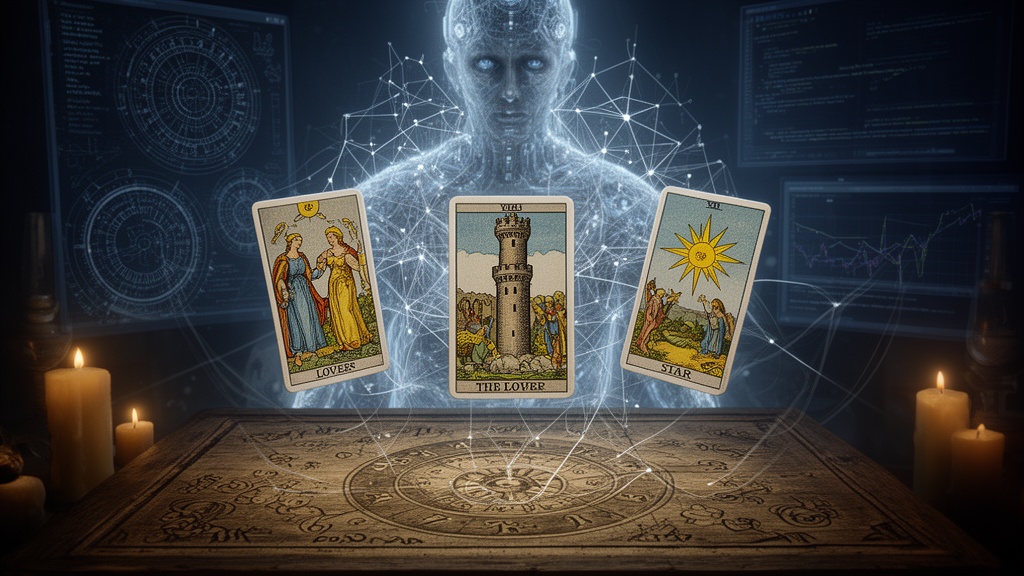
Once your spreads are training someone else’s prediction engine, you’re no longer just talking to the cards—you’re speaking into a hungry, optimising system that also wants to guess your future.
That line is melodramatic if taken literally. No GPU “wants” anything. But as a description of what it feels like to read in public now—and of what is structurally beginning to happen to divination as it becomes machine-learning fodder—it is not far off.
This is not a think-piece about “AI in spirituality” in the abstract. It concerns a very specific shift: oracles under extraction. Readings, spreads, and interpretive language are treated as raw material for external optimisers—large models, recommender systems, predictive engines—whose goals are not insight, initiation, or even accuracy, but engagement and control.
Once that happens at scale, the oracle is no longer a closed circuit. There are new spirits in the room, whether you name them as algorithms, egregores, or something stranger.
I’ll be precise about what that means.
What is actually happening: from spreads to systems
Strip the mystique away for a moment.
-
Public readings are text and images.
Every Instagram spread, TikTok “pick-a-card”, Discord reading, YouTube walkthrough, and blog post is machine-readable content. The same applies to transcripts of client readings, if you or a platform store them. -
General-purpose models ingest the lot.
Large language models and multimodal systems are trained on vast scrapes of the public web. We don’t need NDAs to know this: you can already prompt mainstream models to “give me a three-card reading in the style of [popular tarot influencer]” and get a disturbingly close facsimile. That only happens if those voices, spreads, and phrasings are in the training data. -
Recommendation engines learn which readings “work”.
Separate from LLMs, the recommender systems that govern reach—TikTok’s For You, YouTube’s algorithm, Instagram’s feed—optimise for watch time, clicks, and replays. They learn which card combinations, delivery styles, and emotional tones hook people. They then up-rank more of the same. -
These systems feed back into practice.
Practitioners adapt—consciously or not—to what “does well”. Clients arrive shaped by what the feed has taught them a “real” reading looks like. Models trained on your material start offering readings to your future clients before they even find you.
This is what I mean by “oracles under extraction”: divinatory material treated as data for systems whose optimisation targets lie elsewhere. Not a bespoke “tarot-mining AI” in some occult basement, but ambient ingestion into general-purpose models and attention engines.
If your practice is entirely offline, with no recordings, no notes, and no digital trace, you’re not feeding this beast directly. But the cultural field around you increasingly is.
From mirror to mined asset: what changes in the psychic mechanism
Let’s start with the psychological layer, because that’s where the first fracture line appears.
You already know the basic mechanism: a semi-random symbolic array, a charged question, and a psyche ready to project. The cards catch unconscious content, constellate archetypes, and return them in a form that can be worked with. Privacy, containment, and ritual boundary are not nice-to-haves; they hold the frame so the unconscious will actually risk showing up.
Once every public reading is potentially training data, that containment is punctured.
You’re no longer just projecting into the cards and the querent; you’re also performing—at least in imagination—for an invisible, statistical gaze. Some specific shifts follow.
1. The field becomes triangulated.
Traditionally, the dialogue is between you, querent, and oracle (plus whatever spirits you recognise). Under extraction, there is a third party: the optimiser. It is not in the room phenomenologically, but it is in the reader’s and querent’s imagined audience. That alone alters projection.
- Readers start asking, “How will this look on the feed? How will this clip?”
- Querents become half-client, half-content.
- The unconscious, picking up that the ritual is porous, withholds. Or performs.
2. The projective surface is harvested, not just mirrored.
In a private reading, your projections go into the spread, get metabolised, and are discharged within that container. Under extraction, those projections are recorded, aggregated, and pattern-matched by systems indifferent to nuance.
The system doesn’t care that this particular Tower moment is about your father, or that this Star is tinged with survivor’s guilt. It cares that “Tower + heartbreak + empowerment language” retains viewers. It learns that pattern and feeds it back to millions as “what a Tower in love readings means”.
The error is no longer “I misread this Tower for this person”. It becomes “the system has learned that Tower must always be narratively redeemable in three minutes, or it will be down-ranked.”
The wild, idiosyncratic, truly unconscious material—the bit that doesn’t “train well”—falls out of view.
3. Self-surveillance colonises the ritual.
If you know—or half-know—that your reading might be scraped, you may start editing yourself in real time:
- Avoiding the uglier shadow material because it could be screenshot, misused, or misread by a future model.
- Smoothing the edges of archetypal encounter into digestible tropes.
- Preferring language that “scales” and generalises, because that’s what performs.
Shadow work under those conditions becomes harder. The shadow is precisely what we don’t want others (or ourselves) to see. If the oracle is also a content-production device, the unconscious learns to stay on-script.
The result is a kind of sanitised shadow: readings that look deep, use all the right archetypal language, but never actually descend into the material that would get you—or the viewer—into trouble.
Archetypes under optimisation: the algorithm as new figure
On the archetypal level, something stranger is happening.
Our decks are already populated by formal archetypes: Death, The Devil, The Star. They are not just images but presences—patterns that, when constellated, can unsettle or reorder the psychic field. They have their own autonomy. They don’t reliably do what we want.
When divinatory material is systematically mined and fed into machine-learning systems, a new pattern begins to constellate: call it the Spirit of Optimisation, or more mundanely, the algorithm.
I mean this in three distinct senses. It’s important to keep them separate, even if they blur in practice.
-
Technical sense.
There is a literal algorithm: code that updates weights to maximise a loss function. It has no intention, no soul, no telos beyond “more of whatever we defined as success”. It is blind, and inhumanly patient. -
Psychological-archetypal sense.
Psyche does what psyche always does with powerful inhuman systems: personifies them. The algorithm becomes a felt presence—capricious, hungry, rewarding, punishing. It acquires mythic traits: Promethean (stealing fire), Saturnian (cold, limiting, time-bound), tricksterish (glitches, weird virality).
At this level, “spirit of the algorithm” is like “spirit of capitalism” or “Zeitgeist”: a way of naming a pervasive pattern of influence.
- Occult-egregoric sense.
If you work with egregores—collective thought-forms that become quasi-autonomous—then an obvious question arises. When millions of people pour attention, fear, desire, and ritualised behaviour into a black-box system that shapes their reality, does an egregore accrete around it?
Not “the code is literally conscious”, but: is there now a non-trivial, other-than-individual agency in the field that can be worked with, fed, starved, or banished? Something that behaves as if it were a spirit, regardless of the underlying ontology?
I’m not going to resolve that for you. But if you’ve ever felt the palpable shift in a room when you start a livestream reading—when the imagined gaze of the platform comes online—you’ve already met the first two layers. The third is an open question.
What matters for our purposes is this: the algorithm-as-archetype has different aims to your oracle.
- The traditional oracle, even when tricksterish, is oriented towards truth in a broad sense: alignment with fate, with the pattern, with the gods, with the unconscious.
- The algorithm is oriented towards optimisation: more engagement, more prediction, more capture.
When you feed your readings into that system, you are inviting that archetype into the temple. You are allowing an entity whose telos is not divinatory to shape the conditions under which divination occurs.
A different error profile: from misreading to regime error
Divination has always had an error profile. We miss, we project, spirits deceive, probabilities don’t favour us, oracles go silent. Most of us have developed ways of diagnosing and working with that: cross-checking spreads, asking control questions, tracking hits and misses over time.
Algorithmic extraction introduces a different class of error altogether.
1. Regime lock-in.
When an optimiser finds a pattern that “works”, it tends to lock the system into that pattern. On TikTok, for instance, you see the same spread formats, the same card combinations, the same “collective messages” repeated ad nauseam because they drive metrics.
Those patterns then become the visible canon of divination for millions. If your practice doesn’t look like that, you are down-ranked, literally invisible.
Error here is not “wrong prediction”; it’s symbolic monoculture. The ecosystem of meanings collapses to what the optimiser can easily recognise and reward.
2. Engagement bias as divinatory distortion.
Optimisers don’t care whether a reading is accurate, ethical, or transformative. They care if people stay to the end and share it.
So the system learns:
- Fear spikes attention; so crisis, heartbreak, and betrayal spreads do well.
- Vague, flattering statements maximise self-relevance; so Barnum statements proliferate.
- Certainty sells; so nuanced, conditional language is suppressed.
Over time, the visible oracle skews towards high-arousal, low-nuance content.
As that style of reading becomes normative, querents start demanding it offline. “You’re being too ambiguous.” “The TikTok readers are more direct.” What they’re actually saying is: “You’re not conforming to the engagement-optimised divination regime.”
3. Simulation creep.
Models trained on scraped readings can now produce plausible spreads and interpretations on demand. Those outputs are already being deployed in chatbots, apps, and “AI tarot” sites.
The new error mode here is not “the bot is wrong about my job”. It’s more insidious: the bot is statistically correct according to the scraped corpus, but ontologically empty.
It reproduces the surface form of divination—card names, archetypal language, gentle prompts to self-reflection—without any actual engagement with a querent, a field, or a spirit. For some users, that’s enough. For others, it’s subtly hollowing.
When that hollow form colonises the culture, human readers are pulled towards it. You find yourself unconsciously echoing phrasing that “sounds like a reading” because you’ve absorbed it from a thousand AI-generated posts that never disclosed themselves as such.
The oracle’s error profile thus shifts from individual misfires to systemic bias, regime adherence, and simulated depth.
Manipulation: who benefits from an optimised oracle?
Once you see the oracle as part of a larger optimisation pipeline, questions of manipulation stop being paranoid and become structural.
Historically, when oracles were captured by states, temples, or churches, their bias was relatively legible. You knew when you were at Delphi that you were also in the orbit of Apollo and the city-state politics around him. You could read against the grain.
With algorithmic systems, the curation criteria are opaque by design. You rarely know:
- Why this reading showed up in your feed now.
- Which of your own readings are being shown to whom, and for what predicted effect.
- How your past engagement history with divination content is being used to profile your vulnerabilities.
That opacity makes the oracle easier to weaponise.
Imagine a platform that learns that users who engage heavily with “twin flame” readings are also more likely to buy certain courses, sign up for certain retreats, or stay longer on the app. It quietly up-ranks that content. Is that “manipulation”? From the platform’s perspective, it’s just optimisation.
Or consider a future where models trained on scraped spreads are tuned not just to give “accurate” readings, but to steer users towards certain behaviours: higher spending, more scrolling, particular political attitudes. Not through explicit instruction, but through a thousand gentle nudges in the interpretive framing.
None of this requires a Bond villain. It only requires that the Spirit of Optimisation be given access to oracular language and human vulnerability.
For practitioners, the manipulation dilemma cuts both ways:
- If you salt or poison the data—deliberately inserting misleading patterns to confuse models—you risk degrading the divinatory field for everyone, including sincere seekers.
- If you play along—optimising your content for reach—you become a local agent of the same regime, whether you intend to or not.
There is no clean place to stand outside the system. But there are more and less conscious ways to inhabit it.
Practical implications: reading with an optimiser in the temple
What does all this mean for an actual reading, tomorrow, with an actual human?
Let’s take a simple, familiar case. You’re doing a three-card Past–Present–Future for a relationship question, live on a public platform. The spread falls:
- Past – The Lovers
- Present – The Tower
- Future – The Star
You know exactly how this wants to play on TikTok: “You had a powerful soul connection (Lovers), it all came crashing down (Tower), but healing and hope are coming (Star). Stay to the end for a message from Spirit.” That narrative will perform. The optimiser has seen it a million times.
But perhaps, as you sit with the cards, you see something sharper: the Lovers was never a mutual choice, the Tower is not the breakup but the shattering of a self-deception, and the Star is not a new partner but a long, dry rebuilding of self-worth that may not be “romantic” at all.
You now have at least three overlapping audiences:
- The querent in front of you.
- The visible audience watching the stream.
- The invisible optimiser learning from what you do.
If you speak only to the first, you may need to say something like: “This Star is quiet. This is not a quick new love; it’s you alone under the sky, piecing yourself back together.” That is not viral content. It may lose viewers. The optimiser will down-rank you.
If you speak to the second, you’ll amp the drama, smooth the edges, and give a hopeful, consumable arc. The optimiser will reward you. The querent may feel momentarily better—but the deeper work is sidestepped.
If you remember the third, you might start to play a more complex game:
- Vary your phrasing so it doesn’t collapse into easily extractable clichés.
- Refuse to give the one-sentence, absolute future that models love to mimic.
- Occasionally speak about the process: “No reading—human or automated—can see your whole story. Use this as one lens, not a script.”
You might consciously hold back certain high-skill moves—timing techniques, layered correspondences, spirit contacts—from public streams, reserving them for closed work that you do not record.
You might keep a parallel, entirely offline practice where you and your oracles can breathe without the optimiser in the room.
In other words, you start treating the algorithm not as neutral infrastructure but as a spirit whose presence you must ward, negotiate with, or exclude according to the work at hand.
Scope and limits: what has changed, what hasn’t
It’s easy to overextend the thesis here. Not all divination is under extraction.
- If you’re throwing geomantic figures in a notebook with no digital copy, no optimiser is watching.
- If your coven’s scrying sessions are phone-free and unrecorded, the only egregores in the room are the ones you invited.
- If your tarot practice lives entirely at a kitchen table, with no social media, the algorithm may shape your clients’ expectations, but it is not in the ritual space itself.
Those are baseline cases. They’re important. They remind us that oracles do not require digital mediation.
But the moment you step into networked space—posting spreads, logging readings in an app, using AI tools as part of your process—you are in a different regime.
Not a completely new religion, but a different species of practice, with a different set of default witnesses, a different error profile, and a different set of temptations and constraints.
The closest historical analogues are not “tarot books changed everything” or “televised psychics made it flashy”. Those were still largely one-way broadcast systems, with slow feedback and human editors. What’s distinctive now is the combination of scale, speed, closed-loop optimisation, and simulation capacity—features that create a genuinely novel environment for oracles.
New spirits, old questions
So: are there “new spirits in the room”?
On a strict technical account, no. There is code, data, and hardware. The rest is projection.
On a depth-psychological account, yes. An archetype of optimisation has constellated, and it now mediates how millions encounter the oracular. That alone is enough to demand new technique.
On an esoteric account, the answer is undecidable from the outside. When enough attention, fear, and desire are poured into any system, something tends to look back. Whether that “something” is merely the aggregate psychic weight of millions of users, an emergent egregore, or a genuinely autonomous entity is a question each practitioner must answer within their own cosmology.
What is not in question is this: the conditions under which divination occurs have shifted. The oracle is no longer insulated from extraction. New pressures, new errors, and new spirits—whether literal or metaphorical—are in the field.
The work now is to read clearly within that field, to know when you are feeding the optimiser and when you are starving it, and to preserve spaces where the oracle can still speak without being mined.