
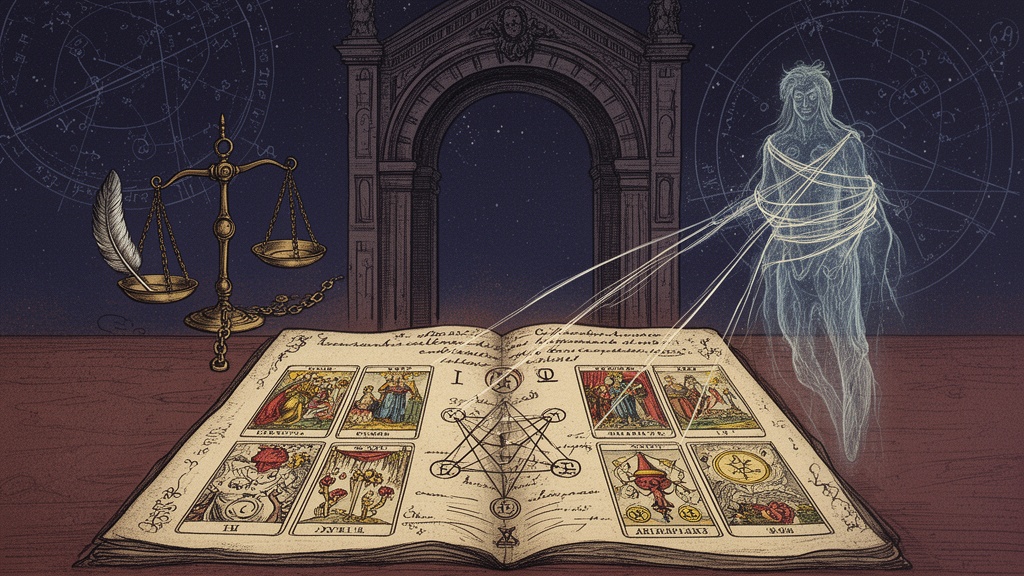
If you are letting a deck mediate your deals with spirits, you are already doing contract law—just without a theory of what counts as breach, appeal, or jurisdiction.
Most of us backed into this sideways. First it was “Should I do this working with X spirit?” Then “Is X satisfied with the last offering?” Before long, the oracle is not just commentary on the relationship; it is the procedure by which the relationship is run. You do not move without pulling cards. You do not escalate without a throw. You do not exit without “checking” if you are allowed to.
At that point, you are no longer merely divining. You have built a constraint device and handed it power. The question is whether you know what you have built.
Contract law without a court
Let’s draw the distinction sharply before a sceptic does it for us.
Human contract law rests on institutions: courts, enforcement, precedent, third‑party witnesses, written codes. None of that exists, in any straightforward way, in solitary spirit work. There is no magical equivalent of the Court of Appeal that will enforce your pact with a Goetic duke because the tarot said so.
So when we talk about “contract law” here, we are talking about structure, not ontology. We are borrowing the machinery of contract thinking—jurisdiction, breach, remedies, renegotiation—not claiming that your altar is now a miniature Chancery Division.
The binding force in this context is twofold:
- It binds you by pre‑commitment. You deliberately restrict your own future freedom to reinterpret or ignore certain oracular outcomes.
- It may bind the spirit insofar as that spirit chooses to operate within the protocol you have established. Whether that is metaphysically “real” or a very effective way of talking to yourself is not something this article can settle; it is also not necessary to settle in order to make the practice sharper.
The value of the contract frame is that it forces you to say, in advance, what counts as a yes, what counts as a no, who is allowed to decide, and what happens if someone cheats. Most people are already gesturing at this with “I’ll ask the cards”; they just have not made the rules explicit.
Oracles as constraint devices
A constraint device is any structure you set up so that, later, you cannot easily lie to yourself.
In mundane life: putting savings in an account with penalties, telling a friend to hold you to a deadline, writing a will. In magic: planetary hours, electional rules, oaths, and—relevant here—divinatory vetoes.
The moment you say, “If I pull the Tower in this position, I will not proceed with the rite,” you have turned the oracle into a constraint device. You have tied your future action to a randomised, symbolically interpreted event that you do not fully control.
The usual objections arrive immediately:
- “Isn’t that just obeying my own projection?”
- “What if I shuffle in a way that gets the result I want?”
- “How can something so interpretive function as a ‘binding’ anything?”
The answer is that the constraint is engineered, not given. You are not discovering an objective court of cosmic law in your deck; you are building a procedure that is hard for your future, tempted self to wriggle out of.
That means design matters. Vague spreads and ad hoc interpretations do not constrain much. Clear protocols do.
Jurisdiction: who gets to decide what?
In law, jurisdiction is the question: which court has the right to hear this case? In pact work: which oracle, under which conditions, is allowed to rule on which issues?
Most practitioners treat this sloppily. One day it is tarot, next day it is pendulum, then a dream, then a random song on shuffle. If you are serious about using oracles as constraint, that promiscuity has to stop.
You can specify jurisdiction in a pact the way you would specify it in a contract:
-
Scope of questions.
“This deck has authority only over questions of timing and offerings. It does not decide whether the pact continues or ends; that jurisdiction is reserved to [another method / ritual divination / direct negotiation].” -
Domain of spirits.
“The bones speak with authority in matters involving the dead of my line; for other spirits, they are advisory only.”
Or conversely: “For this pact with X, only throws cast on X’s altar, with X’s sigil present, are binding.” -
Procedural preconditions.
“No reading is jurisdictionally valid unless I have fasted for a day / banished / cast the usual circle.”
This is not mere fussiness; it is how you keep ‘quick pulls on your phone in the bus queue’ from retroactively claiming the same status as ritual hearings.
You can test jurisdiction the same way you test spirits: by asking the oracle about its own authority at the outset of a working relationship. That might look like a dedicated spread:
- Position 1: “What can you legitimately decide between us?”
- Position 2: “What is outside your remit?”
- Position 3: “Under what conditions will your rulings be recognised?”
The point is not that the cards will hand you a constitution. The point is that you are forcing the question of scope into symbolic form, where you can see your own fantasies about authority and fairness, and negotiate them—both with yourself and with the spirit.
Externalisation and the third thing
Psychologically, this entire manoeuvre is an act of externalisation and triangulation.
Instead of a hot, often confusing dyad—“me and the spirit”—you introduce a third, symbolic authority: the oracle. You project into it qualities you need: fairness, consistency, a vantage point outside your personal craving or fear. That projection is not a bug; it is the mechanism.
In psychoanalytic terms, the oracle is standing in for an internalised judge or mediator. It holds your anxiety about betrayal, your hunger for approval, your ambivalence about obedience, and gives them a face: Justice upright, or the High Priestess reversed, or a particular throw of shells.
That third point in the triangle does several things:
- It gives you a holding environment for volatile material. Instead of acting out your fear that the spirit will punish you, you can ask, “Has there been breach?” and give that fear somewhere symbolic to land.
- It allows for containment of shadow projections. Your need for a punishing superego can be spotted when every minor infraction “just happens” to pull the Ten of Swords in the ‘consequences’ position.
- It makes renegotiation thinkable. If the oracle can say “terms have become unfair” or “this clause no longer serves”, then you do not have to frame every change as betrayal.
This is also why the practice is dangerous. You can just as easily build an internal tyrant and call it “the cards”, or abdicate responsibility entirely: “The deck said I had to.” Treating the oracle as contract law does not exempt you from ethics; it amplifies whatever ethics you already carry.
Designing clauses into spreads
Once you accept that you are building procedure, not receiving it, you can start designing spreads that function as explicit clauses rather than vague check‑ins.
Take a simple year‑long artistic pact with a muse‑like spirit: you promise weekly offerings and a completed body of work; the spirit promises inspiration and openings.
You could write into the pact:
-
Monthly status hearing.
On the first new moon of each month, you perform a fixed three‑card spread: -
Card 1 – Obligation status (me): Have I fulfilled my side since the last hearing?
- Card 2 – Obligation status (spirit): Has the spirit fulfilled theirs?
- Card 3 – Renegotiation trigger: Does anything require adjustment?
You pre‑define, in writing, how to read these:
- If Card 1 is from an agreed list of “deficit” cards in a negative dignity, you owe a compensatory offering.
- If Card 2 is “deficit” twice in a row, you call a separate renegotiation rite.
- If Card 3 is reversed Major Arcana, renegotiation is mandatory within a week.
The key is that you decide all of that before you are in the moment, tempted to fudge because you really want to keep going or are scared to confront that the spirit is not holding up their end.
- Automatic escalation and de‑escalation.
You might add: “If three consecutive hearings show mutual fulfilment and no renegotiation trigger, offerings may be reduced by one unit for the next month.” Or conversely, if there are repeated breaches, certain operations are suspended.
The spread is no longer “guidance”; it is operational code. You have built a little machine that takes symbolic input and outputs required actions.
Notice what this does to your reading style. You cannot get away with “it feels like a bit of a wobble but mostly fine.” You need pre‑committed thresholds. That alone is a profound discipline.
Breach and enforcement when there is no bailiff
In human law, breach triggers remedies: damages, specific performance, injunctions. In spirit pacts, there is no sheriff to enforce the judgment. So what does “enforcement” mean here?
Practically, three things:
-
Enforcement against yourself.
If the oracle signals that you are in breach, you have already agreed what happens: extra offerings, temporary abstention from certain workings, even dissolving the pact. The enforcement mechanism is your own commitment to honour that agreement, plus whatever you believe about magical consequences. -
Enforcement against the spirit.
This is where ontology bites. You cannot sue a spirit. You can, however, build into the pact:
- Clear exit conditions: “If the oracle shows spirit‑side breach at two consecutive hearings, I am released from my obligations and will perform a formal licence to depart.”
- Sanctions: “In case of repeated breach, I will withdraw worship and remove your image from my working space.”
- Escalation: “I will appeal to [patron / higher spirit / ancestral court] via defined ritual if breach continues.”
Whether the spirit cares about any of this is an experiential question. Many practitioners report that spirits do seem to respect clearly stated protocols, especially when backed by a wider cosmology. Others find certain entities simply ignore the structure. In either case, the oracle‑mediated enforcement at least gives you a way to stop gaslighting yourself.
- Symbolic enforcement.
Even if you adopt a fully psychological frame, enforcement still has teeth. If you treat “spirit breach” as “this imaginal configuration is no longer serving”, a repeated negative result in the ‘spirit obligation’ position is a structured prompt to withdraw from a harmful internal pattern. The consequences you enact—ending the pact, changing ritual focus—shift your psyche and your practice.
The sceptic’s objection here is obvious: all you have really done is formalise your own thresholds for staying in or leaving a relationship, then dramatised them through cards. Yes. That is exactly the point. Formalisation and dramatisation are how we make difficult decisions bearable.
Appeals and second opinions
No contract system is complete without appeal. What happens when you do not like the ruling?
If you have not designed this in advance, appeal degenerates into “I will keep pulling until the deck tells me what I want.” That is not appeal; that is shopping.
You can instead specify:
-
Who hears appeals.
“Appeals are heard not by the same deck, but by [geomancy / another reader / a specific ancestor].”
Or: “No appeal; the first throw stands.” That is a harsh discipline but sometimes appropriate for high‑risk workings. -
Grounds for appeal.
“Appeal is allowed only if the reading shows [specific chaotic indicators] suggesting interference.”
Or: “Appeal is allowed once per quarter, not more.” -
Scope of appeal.
“Appeal can modify the remedy but not the finding of breach.”
For example: the oracle confirms you are in breach, but the appeal oracle can lessen the required forfeit.
In communal contexts, a literal second reader can function as an appellate court. In solitary work, you are often both lower court and appeal judge. Designing procedure is how you stop that collapsing into self‑indulgence.
Lineage, infrastructure, and the solitary problem
In Ifá, in certain grimoires, in ATRs, the combination of pact and divination is not new. There are fixed repertoires of odù or lots; there are communal norms about what happens when you draw them; there is reputational and sometimes physical enforcement. “Binding” there has teeth.
Most of us reading this are not operating inside such a lineage. We are improvising in apartments, online, with decks and dice and spirits we met ourselves. To pretend that our private protocols are equivalent to Ifá’s institutional depth would be arrogant nonsense.
So let’s be precise:
- In lineage systems, divinatory‑pact structures are infrastructural in the full sense: socially enforced, multi‑generational, backed by cosmology and community.
- In solitary work, “infrastructure” is procedural scaffolding: step‑by‑step sequences you build for yourself, which shape behaviour over time but are only as strong as your commitment.
That does not make them trivial. A scaffolding can still stop you falling. But it does mean that when we say “binding”, we are mostly talking about self‑binding, not an externalised institution.
The legal analogy is useful here again. A private contract between two individuals, unenforceable in practice because no one will sue, still disciplines behaviour if the parties choose to act as if it matters. The fact that the state is not involved does not make the obligations meaningless; it just changes the enforcement landscape.
Shadow, abdication, and the temptation to hand everything over
There is a particular shadow that shows up when we import legal metaphors into magic: the desire to be overruled.
If the oracle is “the court”, then you can say “the court has spoken” and avoid owning your own ambivalence. You become a litigant pleading for a ruling, not a co‑author of the pact.
Watch for these patterns:
- Every difficult choice is handed to the deck, even when you already know what you want.
- You design baroque spreads and clauses, but never actually confront the underlying fear—of abandonment by the spirit, of your own inconsistency, of wanting out.
- The oracle’s “voice” becomes increasingly punitive, mirroring an internal superego you have not worked with directly.
On the other side, there is the illusion of total control: if only you nail down every clause, specify every card, you can prevent surprise, betrayal, or loss. That fantasy of total risk management is itself a defence against the fact that living relationships—human or spirit—are unpredictable.
The most honest use of oracular contract devices, then, is double‑sighted. You treat the protocol as real in the magical sense and you remain aware that it is also a map of your own complexes around law, obedience, and trust. When the ‘breach’ card keeps falling in your own position, that is not just a sign you missed an offering; it may be your psyche telling you that you do not actually want this deal.
Spread design after you admit you are writing law
Once you see your spreads as clauses, some of the usual design habits become untenable.
-
Position labels have to be operational.
“Advice from the spirit” is not a clause. “Required action within seven days if in breach” is.
A position called “Jurisdiction: is this question even valid for this oracle?” will change the way you sit with ambiguous issues. -
Outcome categories must be pre‑defined.
You cannot leave “good/bad/neutral” to vibes. If certain cards in a certain position trigger specific remedies, you need those lists written down. -
Temporal structure matters.
A one‑off spread is less contract‑like than a recurring one. “We will do this reading every dark moon for the duration of the pact” is materially different from “I’ll ask when I feel like it.” -
Exit and review need their own layouts.
Design a “dissolution spread” that you only use when considering ending or radically changing the pact. Define in advance what combinations mean “stay and renegotiate” versus “close and cleanse”.
None of this requires you to be a lawyer. It does require you to stop pretending that “pulling some cards about it” is neutral. You are either letting the oracle decide, or you are not. If you are, you owe it the dignity of clarity.
Why this matters now
In the last decade, at least in the online and non‑grimoiric spaces many of us inhabit, there has been a visible rise in public talk about pacts, spirit marriages, and ongoing relationships with non‑human intelligences—often without the buffering structure of established traditions. Alongside that, there has been a proliferation of “check in with the deck” habits around those relationships.
We have practice outpacing theory. People are effectively running their spirit lives through oracles as quasi‑courts, but without articulating what that means, or how to do it safely.
You do not need demographics to see the risk. When someone on a forum says, “I asked my deck if I’m allowed to leave this pact and it said no,” what exactly has happened there? What authority has been invoked? What counts as “allowed”? Where is the appeal?
Bringing contract thinking into this is not about making magic respectable by dressing it up in legalese. It is about naming the structures already in play so they can be handled deliberately rather than unconsciously.