
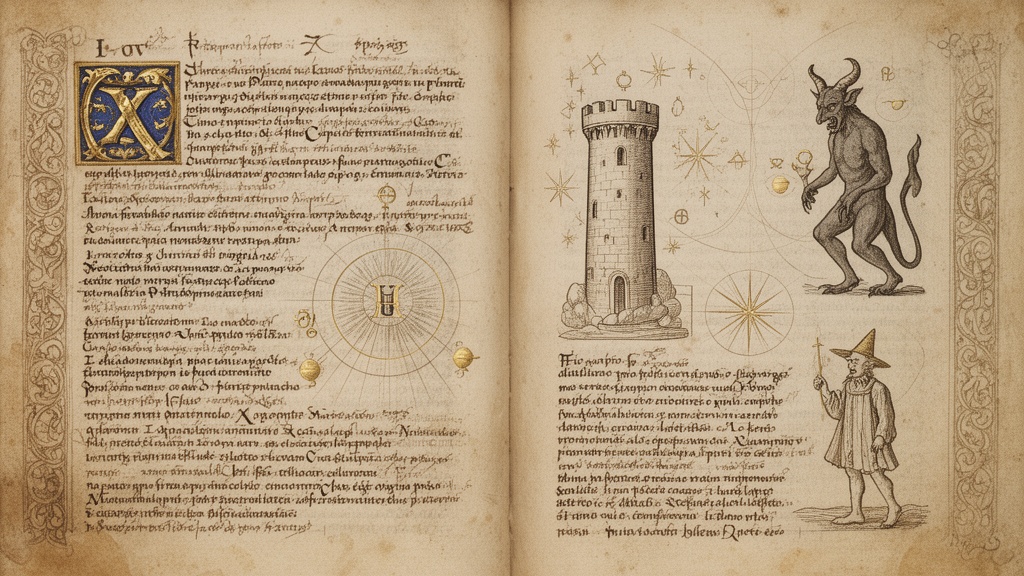
Some of the most destabilizing things the tarot has to say about itself are written in hands that never expected to be read, squeezed into margins that were never meant to be important.
Those hands are starting to show up on our screens.
We are not dealing with a lost master-treatise on “the original tarot system.” The surviving material is thin, local, and stubbornly human. But it is just coherent enough to pressure-test the Golden Dawn → Marseille → RWS consensus, and to force an uncomfortable question: if early readers were already glossing the cards in ways that don’t line up with our inherited scaffolding, how tightly are we willing to hold that scaffolding?
This isn’t an attempt to resolve that question. It’s an attempt to sit in it with the evidence on the table.
What We Actually Have: The Narrow but Stubborn Corpus
There is no vast medieval commentary tradition on tarot hiding in some monastic vault. What we have, in terms of early, text-bearing sources that can be plausibly tied to tarot images, is a small, scattered, but increasingly accessible set of documents:
- Late-15th to early-16th century account books, pattern books, and rule-texts from Northern Italy and adjacent regions, some of which include trump sequences or references to trionfi decks.
- A handful of sermon and moralizing texts that paraphrase or allude to trump series (the “Steele Sermon,” Biblioteca Universitaria, Bologna, MS 2702, ff. 80r–81v, c. 1480–1500, is the best-publicized).
- A few workshop or owner’s manuscripts where trump-like images or sequences appear alongside notes in Latin or vernacular, usually in cramped margins or between lines.
The change in the last fifteen years is not that these documents have suddenly been “discovered,” but that large-scale digitization has made them accessible beyond specialist networks. The Vatican Library’s DigiVatLib project, the BnF’s Gallica portal, and regional initiatives like the Biblioteca Comunale di Ferrara’s manuscript scans have shifted the terrain. Materials that were effectively private—reachable only via physical travel and institutional access—are now a URL away.
Within that narrow corpus, a subset of manuscripts contains marginal or interlinear notes that clearly refer to trump-like images or sequences. Not all of those notes are esoteric. Some are boringly practical (“novus ludus, admodum placet,” “new game, very pleasing,” in an early 16th-century Bolognese account book). Some are moral (“memorare finem,” “remember the end”) in a generic Christian way.
The project here is more modest and more interesting: within that already small set, there are notes whose language, technical vocabulary, and placement strongly suggest that they are not just pious asides or rule-clarifications, but deliberate attempts to deepen or redirect the symbolic charge of the images. Those are what I mean by esoteric glosses.
Operationally, an esoteric gloss in this context is a marginal or interlinear note that:
- Is keyed to a specific trump or pip (by rubric, symbol, or explicit reference).
- Uses technical language from contemporaneous esoteric or philosophical currents (astrological terms, Neoplatonic emanation language, kabbalistic sephiroth, Hermetic “occult virtue,” etc.).
- Or explicitly marks itself as hidden, inner, or secondary meaning (verbs like intelligitur, significat occulte, vernacular equivalents like “per chi sa,” “for those who know”).
When those features show up in the same breath as trump identifiers, we’re not just listening to someone reminding themselves of the rules of the game.
One Gloss in Full: The Tower That Isn’t
Criteria are only as good as the example they can survive.
One of the clearest comes from a late-15th-century composite manuscript—accounts, short devotional pieces, and gaming notes—now in the Biblioteca Comunale Ariostea, Ferrara (MS Classe I, 347, c. 1475–1490). On f. 23r, in the outer margin of a folio otherwise devoted to debts, runs a short sequence of trump names in Italian, partially abbreviated. Next to the entry corresponding, by order and a crude sketch of a crenellated structure, to what we’d call the Tower, appears a cramped Latin gloss in the same hand:
“Domus turbata, non ira Dei sed casus regni. Significat ruinas potentium et mutationem siderum in rebus humanis.“
(Ferrara, Bibl. Comunale Ariostea, MS Cl. I, 347, f. 23r)
A working translation:
“The troubled house, not the wrath of God but the fall of the kingdom. It signifies the ruin of the mighty and the change of the stars in human affairs.”
This is not a sermonizer’s generic memento mori. Note the moves:
- It explicitly rejects a straightforward “wrath of God” reading: non ira Dei.
- It frames the image politically: casus regni, the fall of the kingdom.
- It invokes an astrological frame (mutationem siderum), and not as background determinism but as an interpretive key for res humanae.
Is that “esoteric”? The vocabulary of “stars” in human affairs is standard in late medieval astrology and Neoplatonic moralizing. But here it’s being pinned to a specific image in a trump sequence, and it’s explicitly marked as signification, not just decoration: significat.
We can contrast that with a non-esoteric note in the same hand, a few lines below, keyed by a small horned doodle to the trump we’d call the Devil:
“Hic ludus est difficilis, cave ne perdas omnia.“
“This part of the game is difficult, beware lest you lose everything.”
Same scribe, same page, same ink. One note is about gameplay. The other is clearly about what the image means beyond the game.
This does not overturn our Tower. But it does complicate the clean line that runs from “Maison-Dieu” through “divine wrath” to the RWS lightning-struck tower as spiritual crisis. In this scribe’s milieu, the tower is already being read as political catastrophe under shifting stars, with divine wrath explicitly bracketed.
That’s the sort of pressure these glosses exert: not a new system, but an early, situated counterweight to later standardizations.
Plural Beginnings, Not an Ur-System
The least interesting move we could make with material like this would be to pretend it reveals “the” original esoteric intent of the tarot.
The historical record doesn’t support a monolithic program. From the earliest decks we can see, imagery and sequence vary by city and workshop. Tarot begins as a game whose trumps are thick with moral, political, and cosmological allusions, but there is no single, demonstrable occult architecture behind them in the fifteenth century.
The marginalia underline that pluralism rather than resolve it.
In a Tuscan miscellany now in the Biblioteca Nazionale Centrale di Firenze (MS Magliabechiano XXV.406, c. 1490–1510), a gloss on a circular world-figure with four corner emblems reads in Italian:
“Qui si mostra il cerchio perfetto, che è il ritorno di tutte le cose al principio invisibile.“
“Here is shown the perfect circle, which is the return of all things to the invisible principle.”
(BNCF, Magl. XXV.406, f. 41v)
Principio invisibile is not parish-priest language. It’s straight out of a Neoplatonic or Hermetic playbook circulating in Florence at the time. The same manuscript, however, glosses the Pope simply as “il buon consigliere,” “the good counselor,” with no trace of esoteric ambition.
In another notebook, probably from an Augustinian environment in Emilia (Modena, Biblioteca Estense, MS α.X.2.15, c. 1500), a gloss on the Fool reads:
“Stultus iste significat animam ante legem, errantem sine regula.“
“This fool signifies the soul before the Law, wandering without rule.”
(Modena, Bibl. Estense, α.X.2.15, f. 12r)
Nothing “occult” there, but a neat bit of moral theology.
These are local programs layered onto a shared image set. One scribe leans Neoplatonic on the World, another leans political-astrological on the Tower, another moral-theological on the Fool. None of them are the system. All of them are early, concrete instances of people doing with the cards what we still do: bending them to the questions and languages that matter in their world.
If anything, the glosses argue against a single origin myth. They show us a card language from the start capable of hosting multiple esoteric and moral projects. The Tree of Life, the astrological attributions, the alchemical sequences—those are later overlays. What the marginalia tell us is not “the original overlay,” but that overlaying itself is original.
The Psychological and Shadow Dynamics of Reading the Margins
Working with these fragments changes how the psyche meets the deck. When you spend time with a hand like the Ferrara notary’s, you temporarily step out of your own interpretive era. Instead of “The Tower = Mars + Peh + sudden upheaval,” you’re confronted with “not the wrath of God but the fall of the kingdom” in a cramped humanist Latin. The familiar matrix loosens.
That loosening has consequences. The card you thought you knew becomes strange again. The mind starts to test new angles: “If the Tower is political catastrophe under changing stars, what does that do to my reading of this querent’s job loss? Is this about their personal crisis, or about the end of an institutional order they’re caught inside?”
Because the glosses are fragmentary and context-poor, they’re perfect projective surfaces. They attract fantasies of lost wisdom, anxieties about being “wrong,” and the very contemporary desire to be the one with access to the hidden thing. They also provoke resistance: “Why should I care what some fifteenth-century clerk thought?”
There’s a shadow dynamic in both directions.
On one side, the temptation to idealize: to treat any scrap of Latin next to a trump as more authentic than what we’ve inherited, simply because it’s older. That’s just a different way of dodging responsibility for the meanings we choose to work with now.
On the other, the temptation to dismiss: “It’s just one guy’s note.” That’s a defense against having one’s hard-won system shown to be contingent. If a notary from Ferrara could read the Tower as political ruin under mutable stars, maybe your Mars attribution is less inevitable than it feels.
The more interesting stance is to let these marginal voices sit at the table with you. Not above you, not beneath you. Just present, complicating.
The canonical esoteric tradition (Golden Dawn onward) has selectively remembered certain lines of development and forgotten others. The margins are where some of that forgetting becomes visible. Your system is one layer. These glosses are glimpses of earlier ones. Psychologically, that’s a kind of shadow integration at the system level—an acknowledgment that what you know is one powerful, late-developed way of organizing the cards, not the inevitable telos of their imagery.
Esoteric or Just Pious? Drawing the Line Honestly
Not every intriguing note is an esoteric gloss, and inflating everything interesting into “occult commentary” only muddies the water.
Criteria matter. “Memento mori” scribbled next to Death is not an occult key; it’s devotional reflex. “Remember the end” is not a technical term.
By contrast, a gloss that reads, in a small Italian notebook now in the Archivio di Stato di Bologna:
“VII denari: probatio fidei, sicut aurum in igne.“
“Seven of coins: the testing of faith, like gold in the fire.”
(AS Bologna, Misc. 52, f. 9v, c. 1520)
is more ambiguous. Probatio fidei is biblical rhetoric; “like gold in the fire” echoes 1 Peter. In a context where the other pips are unglossed, picking out the Seven of Coins as “testing of faith” in explicitly trial-by-fire language suggests an attempt to spiritualize a mundane card. Is that “esoteric”? It depends how tightly you define the term.
We can stiffen our judgment by triangulating with non-tarot texts from the same milieu. If principio invisibile on the World matches language in, say, Ficino’s translations or a local Neoplatonic sermon, the odds that our scribe is pulling from that technical vocabulary go up. If mutationem siderum appears as a term of art in contemporary astrological manuals, we’re on firmer ground reading the Tower gloss as more than poetic flourish.
Even then, some identifications will remain provisional. The honest stance is to say so: “This looks like an esoteric gloss because X, Y, Z. It could also be read as A. Here’s why I lean this way.” We already live with layered, ambiguous symbols in our readings; we can extend that tolerance backward into our source work.
How This Pressures Contemporary Practice
What do you actually do with this at the table?
If you take the marginalia seriously—not as commandments, but as early evidence of how the cards were being used—they become additional lenses you can choose to bring into a reading.
You already operate with layered meanings: Golden Dawn attributions, Marseille iconography, RWS scenic narratives, your own gnosis. A reconstructed gloss is another layer, with a different kind of authority: not metaphysical, but historical.
Consider a Five of Coins gloss from a small 16th-century Italian notebook in the Biblioteca Trivulziana, Milan (MS Triv. 2150, f. 67r, c. 1530):
“Quinto numero: probatio fidei in rebus vilibus.“
“At the fifth number: the trial of faith in lowly matters.”
There are no glosses for the other pips in that suit. This is not a system. But it’s a clear signal: someone, somewhere, was reading this configuration as “trial of faith,” specifically in “lowly,” material affairs.
In a reading about a friendship under strain, you pull the Five of Pentacles in the “Past Influences” position. The RWS image pushes you toward poverty, exclusion, illness. You could stay there. With the gloss in mind, you might instead (or also) say:
“There’s a historical strand that reads this card as a test of faith in humble, everyday matters—how you show up for each other when things are unglamorous and resources are thin. Was there a period where the friendship was being tested not by drama, but by sheer grind?”
If it lands, it opens a door that “you felt left out in the cold” sometimes does not. If it doesn’t, you leave it. The gloss is a resource, not a mandate.
The complications are predictable:
- Querents with some book knowledge may resist: “But the Lovers is about relationships, right?” If you bring in an early gloss that frames it as “electio ardua inter virtutem et voluptatem” (“hard choice between virtue and pleasure,” Bologna, BU, MS 3125, f. 15r), you’ll have to explain why your reading diverges from pop-tarot without retreating into “because I know Latin.”
- Some glosses are too alien to drop in raw. A World gloss about “return to the invisible principle” needs translation into the querent’s frame: “a cycle completing in a way that brings you back to something you can’t quite name, but have always been oriented toward.”
- Fragmentation means you won’t have a full set. Using two or three historically grounded glosses in a spread and then reverting to Golden Dawn for the rest can feel lumpy unless you own the eclecticism: “This card, we actually have a fifteenth-century note on; the others I’m reading through a later lens.”
Practitioners already comfortable withlayered interpretive frameworks will find this less jarring than those who have built their practice on the coherence of a single system. If your confidence as a reader rests on the idea that the RWS attributions are the meanings, the marginalia will feel like a threat. If your confidence rests on your capacity to hold multiple angles and feel for what moves, they’ll feel like an extension of what you already do.
The practical suggestion is not to rebuild your practice from fragments. It’s to carry two or three of the more resonant glosses as you’d carry any hard-won insight from your reading history: available when the moment calls for it, not imposed when it doesn’t.
What the Absence of Glosses Also Says
It would be a mistake to treat silence in the record as neutral.
The surviving material skews toward urban, literate, male, and broadly Christian environments. The account books are merchants’ and notaries’ books. The workshops are guild-adjacent. The Neoplatonic glosses emerge from contexts touched by Florentine humanism or Augustinian learning. The moral-theological Fool comes from a monastic environment.
This means the marginalia are not a window onto early tarot as a whole. They are a window onto how certain kinds of people, in certain institutional contexts, chose to annotate certain cards when they felt moved to do so.
Whom do we not hear from? Women who played the game in domestic settings and left no account books. Oral traditions that never became manuscript traditions. Card-readers, if they existed as a distinct practice in this period, who had no reason or access to write in Latin or even in a form we’d recognize as text. Working people who knew the trumps by heart but whose knowledge exists in no archive.
The silence of the margins is as telling as the text within them. Our early esoteric glosses come from men with Latin, access to philosophical currents, and enough leisure to annotate. That is not nobody, but it is also not everybody. Whatever the cards meant in the hands of the illiterate, the itinerant, or the working poor, we do not have it. Whatever the cards meant to women before they appear in the record as esoteric practitioners, we do not have it either.
Acknowledging this gap is not an act of piety. It’s an act of accuracy. The claim that early glosses reveal “how tarot was originally understood” is only ever partial, and the partiality cuts in a very specific sociological direction. We should be more suspicious of any esoteric origin narrative that conveniently flatters the very demographic who produced the surviving annotations.
Digitisation, Access, and the Changing Conditions of Research
It is worth pausing on the structural shift that makes this kind of article possible at all.
Before large-scale digitisation, working with marginal tarot glosses required fluent Latin palaeography, institutional affiliations that granted archival access, the time and money to travel to Ferrara, Bologna, Modena, Florence, and Milan in sequence, and the luck of knowing which collections to request. In practice, that meant a handful of specialists worldwide were the gatekeepers of what the broader tarot community knew about manuscript evidence.
That structure has not dissolved entirely. Palaeographic skill still matters enormously. Manuscript identifications still need to be verified against physical objects, because digitised images sometimes obscure marginalia that are faint, close to the binding gutter, or in inks that have faded unevenly. And some of the most relevant collections—small private archives, regional institutions without digitisation budgets, monastic libraries with restricted access—remain effectively unreachable for most researchers.
But the centre of gravity has shifted. A practitioner with enough Latin to work a dictionary, access to DigiVatLib, Gallica, and a few Italian institutional portals, and patience for palaeographic guesswork can now encounter primary material that would have been invisible to them ten years ago. That democratisation is genuine, if uneven.
It also creates new risks. Fragments divorced from their codicological context are easier to misread. A marginal note that belongs to a broader, secular tradition of game annotation can look esoteric if you approach it with strong prior expectations. A gloss that parses correctly in isolation may read differently when you examine the full folio and discover the surrounding text is a parodic dialogue, not a sincere commentary. Digital access gives you more material; it does not automatically give you more interpretive caution.
The responsible use of newly accessible manuscript evidence means being explicit about what you cannot verify: whether a given note is in the same hand as its surrounding text, whether an abbreviation has been expanded correctly, whether a document is what it claims to be rather than a later copy or forgery. These are questions the specialist literature engages with. Bringing manuscript evidence into tarot practice means carrying those questions with you, not leaving them at the archive door.
What We Can and Cannot Conclude
To be direct about what these glosses do and do not establish:
They establish that early, literate users of trump-bearing decks were assigning symbolic meanings to specific cards that drew on the esoteric and philosophical currents of their time and place. This is worth knowing. It counters the narrative that tarot was simply a game until the eighteenth century, at which point occultists invented its spiritual dimension from whole cloth. The spiritual and symbolic charge was being applied, locally and plurally, much earlier.
They do not establish a coherent, transmissible esoteric system pre-dating the Golden Dawn reconstructions. The material is too thin, too varied, and too demonstrably local to support that claim. The Tower in Ferrara is not speaking to the World in Florence in any way we can trace. These are independent, improvised acts of symbolic deepening, not evidence of a school or tradition.
They do not tell us what the card means. They tell us what one literate person, in one specific context, in one moment of cultural saturation by one set of philosophical influences, found it useful or interesting to say about it. That is historically significant. It is not authoritative.
They establish that the contemporary practitioner’s eclecticism has early precedent, if not early sanction. The notary who reads the Tower astrologically and leaves the Devil as a gameplay warning is doing something structurally similar to the modern reader who applies Jungian language to the Moon and straightforward suit meanings to the Three of Cups. The impulse to selectively deepen certain images while leaving others in a more mundane register is, as far as we can tell, native to the practice. It did not begin with either systematic occultism or systematic psychology.
They support a view of the tarot as what it demonstrably is: a shared image set capable of hosting many symbolic projects simultaneously, with no single project constituting its essence. That is not a limitation. For most of what the cards are used for, it is precisely the point.
Sitting in the Uncertainty
The marginalia will not settle arguments. They will not give you a firmer ground to stand on than you had before, not in any simple sense.
What they offer instead is a kind of companionship across time. The Ferrara notary squeezing his Tower gloss between debt records was doing something recognisable: finding in an image more than its surface, reaching for a frame that made the image cohere with what he knew about how power moves and stars turn and kingdoms fall. He was not building a system. He was annotating his encounter with a resonant symbol.
That is what you do at the table. That is what the glosses do in the margins.
The uncertainty about what the cards “really mean” is not a problem awaiting a solution. It is the condition of the practice, attested from almost the moment we can read anything about it. The margins say so, in cramped hands, between the debts and the devotions, in Latin no one was meant to read.
They are worth reading anyway.
Sources and manuscript references cited throughout are provided as identified; readers with access to the relevant digital archives are encouraged to verify primary materials against digitised originals where available. For palaeographic verification and questions of attribution, consult specialist literature in the history of the Italian manuscript book.