
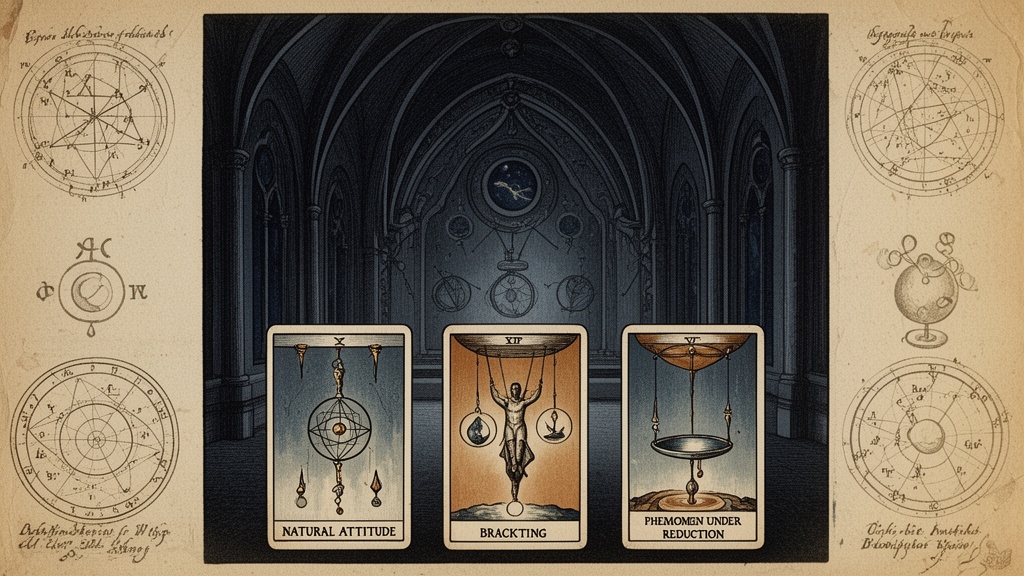
Tarot and Phenomenology: Epoché as Method, Not Metaphor
Tarot already lends itself to self-deception. The cards are ambiguous, the querent is anxious, and you are sitting there with a head full of systems and stories. Under those conditions, “don’t project” is an ethical wish, not a method.
Phenomenology gives you a method.
Not another theory of what the cards “really mean,” but a way of working with how they appear in consciousness. If you’re willing to treat your own experience as data, Husserl’s tools of epoché and phenomenological reduction can be adapted into something you can actually do at the table.
Not to make tarot more “scientific,” and not to strip out its esoteric dimension, but to hear its voice with less of your own noise on top.
What We Mean (and Don’t Mean) by Epoché
Let’s be precise before the philosophers in the room walk out.
In Husserl’s sense, epoché is the suspension of the “natural attitude”—the taken-for-granted belief that the world and its objects simply exist as we think they do. You don’t deny the world; you bracket commitment to its independent existence to focus on how it is given in experience. Phenomenological reduction is the turn from “What is this thing out there?” to “How does this appear in consciousness?”
You are not going to do full Husserlian epoché in a 45‑minute relationship spread at a noisy metaphysical shop.
What is available is a localised, practice-specific version of the same structural move:
- Suspend, for the duration of the reading, your stock meanings, your narrative about the querent, your preferred outcome, your metaphysics of how tarot works.
- Turn your attention from “what’s going to happen to this person?” to “how are these images, affects, and associations arising right now, in this situation, for us?”
That is not philosophy in the strict sense. It is a deliberate borrowing of form: methodical bracketing as a repeatable operation, not as a total worldview suspension.
The payoff is that “don’t project” stops being a vague aspiration and becomes a sequence of moves you can train.
From Clearing Rituals to Conscious Bracketing
Most serious readers already have some variation of a pre-spread ritual: grounding, centring, maybe a candle or a prayer, maybe a quick scan of your own emotional state. Intuitively, you’re trying to step out of ordinary mind and into reading mind.
Structurally, that’s very close to a light epoché.
The difference is rigour. Instead of a general “I clear myself,” you can articulate what you’re clearing and how you’ll treat it when it inevitably shows up mid-reading.
A simple protocol:
- Name the obvious assumptions. Before shuffling, quickly list—mentally or on paper: – What you think the querent wants to hear. – Your expectations about the topic (“relationship readings are always X,” “this person looks like Y type”). – Your habitual associations with the deck (“this deck is harsh,” “this deck is gentle”).
You’re not purging these; you’re making them explicit.
-
Bracket them. Tell yourself, explicitly: “For this reading, these are not data; they are background noise unless they reappear in the cards.” You are suspending their authority, not erasing them from consciousness.
-
Set a phenomenological intention. Something like: “I will treat what actually appears—in the images, in my body, in the querent’s responses—as primary. My theories and systems are secondary and must earn their way in.”
-
Re-commit mid-reading. When you feel the pull back to autopilot (“oh, Tower, here comes disaster”), you mentally tag it: “habit,” and return to the givens of the moment.
None of this requires you to abandon Golden Dawn correspondences, Kabbalah, or your spirits. It just means they enter the reading after you’ve attended to what is showing up, not before.
Intentionality: Naming Your Mode Whilst You Read
Husserl’s other gift is the notion of intentionality: every act of consciousness is consciousness of something. And each act has a mode (noesis) and an object-as-experienced (noema).
You don’t need the vocabulary at the table, but you can use the structure.
When a card lands, you are never just “seeing the card.” You might be:
- Perceiving (“a figure falling from a tower”).
- Remembering (“this looks like my last breakup”).
- Theorising (“Mars + Peh + path from Netzach to Hod”).
- Judging (“this is bad news”).
- Empathising (“I feel their panic in my chest”).
Each of those is a different mode of intending the card. The object-as-experienced shifts with the mode: The Tower as literal disaster, as archetypal crisis, as personal memory, as energetic pattern on the Tree.
The practical move is brutally simple: name your mode.
In real time, that can look like:
-
First 5–10 seconds after a card lands: “Right now I’m describing.” Say out loud what is actually there: colours, figures, directions, atmosphere. No meaning yet.
-
Next moment: Notice the first association: “I’m remembering something of my own,” or “I’m theorising using the Golden Dawn schema,” or “I’m judging this as good/bad.”
-
If the mode is not appropriate to where you are in the reading, bracket it: “That’s my personal memory; I’ll set it aside unless the querent resonates with it.” Or: “That’s the textbook meaning; let me see if the image in this position is actually behaving that way.”
You don’t have to narrate all this to the querent (though selectively doing so can be powerful). The point is to stop treating all inner movements as one blob called “intuition.”
This is phenomenology as a lightweight heuristic: separate “what appears” from “what I’m doing with it.” You will still project; you will just catch yourself sooner and more often.
Description First, Tradition Second
“Describe the card before you interpret it” is standard beginner advice. Phenomenology takes that seriously and makes it non-optional, even for advanced readers.
A three-pass discipline works well:
- Descriptive pass. Stay with what is given: – Visual: “A person hanging upside down, one leg bent, halo, calm expression, blue and grey background.” – Affective: “The overall mood feels suspended, quiet, slightly uncanny.” – Somatic: “I notice my own breath slowing when I look at this.”
No talk yet of sacrifice, Odin, path 23, or water element.
-
Imaginative variation. Briefly play: “What if this figure were struggling instead of serene? What if the rope were frayed? What if the background were fiery?” This clarifies what is structurally essential in your experience of the card right now. Maybe it’s not “sacrifice” but “voluntary stillness in the midst of potential movement.”
-
Tradition re-enters. Now you bring in the systems: – “This is the Hanged Man: reversal, suspension, path between Hod and Geburah, associated with Mem and water.” – See how those overlays interact with what was actually given. Do they amplify the felt suspension? Do they contradict it? Do they introduce something that wasn’t present but is now relevant?
The point is not to pretend you don’t know the correspondences. It’s to let the card, as this particular instantiation in this spread, have a say before the tradition speaks for it.
This addresses the obvious objection: tarot images are historically and esoterically dense. A purely phenomenological reading that never allows those layers in would be a flattening. The move here is temporal, not absolute: bracket first, then re‑admit. Phenomenological description is a phase in the process, not the whole of tarot practice.
A worked micro-example:
- Querent asks about a creative block.
- Card: 8 of Pentacles (RWS).
Descriptive pass: “A figure at a workbench, carving pentacles, repetitive motion, village in the distance, muted colours, atmosphere of focus and isolation.”
Imaginative variation: “If the village were closer, this would feel less solitary. If the figure were smiling, it would feel like devotion; as drawn, it’s more neutral, edging toward monotony.”
Tradition: “This is Sun in Virgo: skilled labour, craftsmanship, repetition, apprenticeship.”
Integrated: “What shows up here isn’t just ‘keep working’ or ‘you’re blocked.’ It’s the tension between absorbed focus and the sense of being cut off from the larger life of the village. Your creative block may be less about effort and more about isolation within your own process.”
The tradition didn’t disappear; it got filtered through what was actually given.
Building Epoché Into the Spread (Without Committing a Category Error)
The speculative move is to encode phenomenological reduction into layout design itself.
The danger is obvious: epoché is a stance, not a thing. If you turn it into “Card 2: Epoché,” you risk treating it as more content to interpret instead of a different way of attending.
You can avoid that by being explicit: the “epoché position” is not about some metaphysical entity; it is a prompt to enact bracketing in relation to what appears there.
A minimal three-card structure:
-
Card 1 – Natural Attitude. “How you (or I) are currently taking this situation for granted.”
-
Card 2 – Bracketing Operation. “What needs to be suspended or questioned to see more clearly.”
-
Card 3 – Phenomenon Under Reduction. “What the situation looks like when Card 1’s stance is genuinely bracketed by the work of Card 2.”
Walk through matters more than labels. Consider a relationship/move scenario:
- Question: “Will my relationship survive this upcoming move?”
-
Card 1 (Natural Attitude): 9 of Swords. You frame it explicitly: “This shows the assumption you’re bringing: that this move is a nightmare in progress, that you’ll lose sleep, that doom is looming.”
-
Card 2 (Bracketing): The Hanged Man. Here you do the epoché: “This card is not ‘more content about the relationship.’ It’s a way of suspending the 9 of Swords stance: pause, hang, see from another angle. For a moment, we agree not to treat your anxiety as a reliable guide.”
You might even invite a brief somatic enactment: both of you take a breath, imagine hanging the 9 of Swords on a hook behind you.
- Card 3 (Phenomenon Under Reduction): 2 of Cups. Now you ask: “Looking from the Hanged Man’s suspended perspective, with the 9 of Swords bracketed, what shows up?” The image of mutual offering, eye contact, reciprocity.
You resist the temptation to say, “See, you’ll be fine.” Instead: “When we don’t let the anxiety run the whole story, what appears is the core connection itself. That doesn’t erase the difficulty, but it changes what is foreground and what is background.”
From a strict Husserlian standpoint, this is an analogy, not a faithful reproduction of reduction. You are not claiming that Card 3 is the pure noema of the situation. You are using the spread to stage a process:
- Surface the pre-reflective stance (Card 1).
- Enact a shift in stance (Card 2).
- Attend to how the field looks under that shift (Card 3).
For advanced work, you can layer this: one row for beliefs, one for emotional habits, one for social narratives, each with their own “natural attitude / bracketing / re-givenness” triad. The caveat remains: the cards don’t do epoché for you. They remind you to do it.
Psychological Dynamics: What Changes When You Work This Way
If you actually adopt this stance, the psychology of the reading shifts.
On your side:
-
Ego functions are interrupted. The reflex to organise, explain, and reassure has to pass through a descriptive gate. That opens space for material you would normally filter out—odd somatic flickers, fleeting images, the querent’s micro-reactions—to register as data.
-
Projection becomes visible. When you train yourself to ask, “What here is given by the card, and what am I adding?” you start catching the overlays: your Tower-as-disaster reflex, your Lovers-as-True-Love bias, your personal complexes around money when Pentacles appear.
-
Your mode of consciousness becomes more fluid. You can notice when you’ve slid from empathising into moralising, from describing into preaching, and choose to step back.
On the querent’s side, if you bring them into the process even a little:
-
Their defences loosen. When you say, “Let’s first just describe what you see in this card,” you’re not attacking their story; you’re inviting them into a shared act of seeing. That can allow affect to surface without immediately being captured by the usual narrative.
-
Transference is moderated. You’re not the all-knowing oracle handing down verdicts; you’re someone attending carefully to what appears, including their own reactions. Authority is still there—you’re holding the frame—but it’s a different flavour.
In the shared field:
- Ambiguity is tolerated rather than patched. A phenomenological stance forces you to sit with “I don’t yet know what this means, but here is how it is showing up.”
This has a shadow side. The performance of openness can become its own defence: “I’m being so phenomenological” as a way to avoid taking any interpretive risk. Or the bracketing rhetoric can mask unacknowledged biases that keep slipping back in. Epoché itself can become an ego ideal.
If you’re serious about this, you have to include your discomfort with not-knowing as part of what is being observed.
Esoteric Irreducibility: What Phenomenology Can’t Touch
Everything above can be read in purely psychological terms: tarot as a projective device, phenomenology as a way to make projection conscious.
That frame is useful, but it’s not exhaustive.
Many of us also work from the conviction—experiential, not dogmatic—that something other is in play: synchronicity, spirits, a daimon of the deck, the strange fact that the cards say things no amount of cold reading would predict.
Phenomenology, by design, brackets metaphysical claims. It doesn’t tell you whether “tarot’s voice” is an internal complex, an external intelligence, or a field phenomenon. It only disciplines how you report the experience of being addressed.
From that angle, phenomenological work can be seen as purification: clearing the channel of your own static so that whatever speaks—psyche, spirit, or both—comes through with less distortion. It can’t adjudicate what that “whatever” is.
If anything, it can make the uncanny clearer. When you’ve done your bracketing, when you’ve slowed your interpretive reflexes, and something still lands with that numinous precision that makes the hair on your arms rise—that remainder is harder to wave away.
Why Bother?
You already know how to read. You have your systems, your spirits, your results.
So what does phenomenology add that you don’t already do by feel?
- It turns ethical platitudes (“don’t project,” “stay present”) into techniques you can practise and refine.
- It gives you a language to parse your own inner movements, so “intuition” stops being a black box.
- It lets you hold tradition and immediacy in tension: neither collapsing into “the book says” nor dissolving into pure subjectivity.
- It foregrounds the reading as a lived event, not just a delivery mechanism for content.
The risk is that you’ll lose some of the easy authority that comes from fast, declarative readings. The gain is that your work becomes more transparent—to yourself, to your querents, and perhaps to whatever looks back at you through the cards.
The deeper question, once you start working this way, is uncomfortable and hard to shake:
If I systematically bracket what I think these cards should say, what remains that still insists on being heard—and whose voice is that, really?