It’s a late‑medieval European card game that, somehow, became a brutally efficient carrier for patterns that also live in West African, Islamicate, and East Asian divinatory machines—without giving us a clean historical line from any of them.
If you’re still hunting for a single origin, that’s maddening. If you care what the trumps are actually doing, it’s the most interesting thing about them.
Because once you stop needing tarot to “come from” somewhere exotic in order to be serious, you can ask a better question:
Why does this particular 22‑card structure rhyme so hard with oracles that never touched it?
And what does that do to the way you read?
1. Influence, parallel, correspondence: keeping the lines clean
The comparative move is cheap. “The Fool looks like Eshu.” “The High Priestess is basically a sibyl.” “The Tower is hexagram 23.” You can do that all day.
The fact that you can see a parallel tells you nothing about what kind of seeing you’re doing.
If you want non‑Western systems in tarot’s origin story without turning the whole thing into fan‑fic, you need three categories kept absolutely distinct.
Historical influence
This is the only one that actually changes the history books: documented or at least plausible pathways of transmission—trade, conquest, translation, shared technical vocabularies, shared workshops.
- The Mamluk deck feeding European playing cards lives here.
- Arabic ʿilm al‑raml becoming Latin geomancy lives here.
- Toledo and Sicilian translation programmes shovelling Arabic astrology, philosophy, and magic into Latin Europe live here.
If there’s no plausible corridor, you don’t get to claim influence. Full stop. You can speculate privately; you don’t get to smuggle it in as history.
Structural parallel
Here we’re talking about architectures designed to solve similar divinatory problems:
- Finite symbolic alphabets that model an effectively infinite field of situations.
- Ordered or exhaustive cosmologies (odu corpora, hexagram sequences, trump series).
- Procedural ways of interrogating time, fate, and decision.
Ifá and the I Ching belong here in relation to tarot. No contact required. Human nervous systems keep reinventing certain machines when they want to talk to the invisible.
Symbolic correspondence
This is where most working readers actually live:
- Veiled guardians of restricted knowledge.
- Tricksters at thresholds.
- Lightning‑struck towers.
- Hermits, judges, world‑encircling figures.
Motifs that rhyme across systems, regardless of whether anyone borrowed them. It’s the layer where amplification works—and where projection and wishful thinking go feral.
Collapse these three, and you get:
- “The Fool is obviously Eshu, therefore tarot is African.”
- “The trumps encode the I Ching, therefore tarot is secretly Taoist.”
- “The Popess is clearly the High Priestess of Isis, therefore the deck is Egyptian.”
If you’re trying to critique Eurocentric histories without just writing a different fantasy, you don’t get to relax your evidentiary standards because the new myth is more satisfying.
So the honest questions become:
- Where do we actually have historical influence on the cards’ emergence?
- Where are we seeing structural parallels between independent divinatory machines?
- Where are we simply noticing that certain images don’t respect cultural borders at all?
Most of what follows lives in the second and third categories. The history is thin. The patterning is not.
2. The Mamluk deck and the myth of a sealed European container
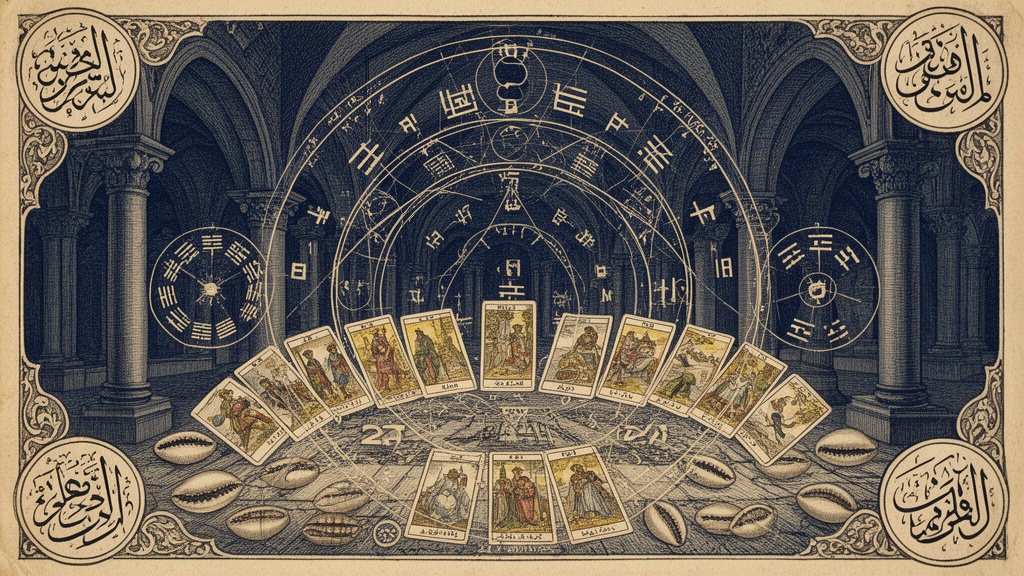
You already know the Mamluk fragments: 14th–15th century, four suits, three court cards, calligraphic medallions where European decks later put faces. No trumps. Clear ancestor to European playing cards, and by extension to the Minors.
What usually gets flattened into a footnote is the world those cards came from.
They’re products of an Islamicate milieu dense with:
- Arabic reworkings of Greek philosophy and astrology.
- Islamic cosmology and angelology.
- ʿIlm al‑raml as live geomantic practice with North African and pre‑Islamic roots.
- Sufi metaphysics and imagery circulating alongside exoteric legal‑theological currents.
By the time Italian courts are commissioning hand‑painted trionfi, Europe has been breathing that air for centuries:
- Crusades and counter‑crusades.
- Venetian and Genoese trade into the Levant and North Africa.
- Jewish and Muslim scholars in Christian courts.
- Translation movements in Iberia and Sicily moving Arabic technical literature into Latin.
What we don’t have is a smoking gun: “In year X, artisan Y in Ferrara copied motif Z from a Cairene manuscript onto a trump card.” That fantasy belongs on the same shelf as “the tarot is a secret Egyptian Book of Thoth.”
What we do have:
- A documented Islamicate ancestor for the suit structure.
- A Mediterranean esoteric ecology where astrology, magic, and philosophy cross between Arabic, Hebrew, and Latin.
- Visual and intellectual traffic between Italy and North Africa that art historians can track in ornament, architecture, manuscript illumination.
That’s enough to say: the soil out of which tarot grew was never a pure European loam. Even if the gardeners were Italian Christians, the nutrients in the ground were already mixed.
Historically, that’s influence at the level of conditions, not trump iconography. It doesn’t make the Major Arcana African, Islamic, or Sufi in origin. It does kill the idea that the trumps arose in a sealed Christian allegorical terrarium, untouched by the long Afro‑Eurasian conversation about fate, cosmos, and image.
Once you accept that, comparative work with non‑European oracles stops being exotic garnish. It starts looking like a way of noticing what that mixed soil has been doing all along—mostly below the threshold of the surviving record.
3. Ifá and the trumps: divination as negotiation with pattern
Ifá is not “African tarot.”
It’s an oracular complex with:
- 16 principal odu yielding 256 configurations.
- A vast oral‑textual corpus of verses, proverbs, prescriptions.
- A theology of àṣẹ (efficacious power) and destiny.
- A ritual and initiatory infrastructure centred on babalawo as stewards of that corpus.
The cowries on the tray or marks in the dust are just the visible edge of a dense symbolic and ritual stack.
From a historian’s perspective, there is no credible line from Ifá into 15th‑century northern Italy. From a structural perspective, certain facts are hard to ignore:
- Both Ifá and tarot use a finite set of stable signs to speak to any possible situation.
- Both tie those signs to a corpus of narrative and counsel (odu verses; accumulated card lore).
- Both frame divination as a negotiation between a fixed symbolic field and a contingent moment.
At that level of function, some correspondences stop being cute and start cutting into what you think tarot is.
Threshold / Trickster
- Tarot’s Fool is structurally anomalous: numbered or unnumbered, inside and outside the sequence, always threatening to scramble any tidy progression from I to XXI.
- Ifá’s Eshu‑Elegba is the indispensable intermediary: guardian of crossroads, opener of the way, divine messenger. No consultation without paying him first, because he governs the channels along which meaning travels.
Both systems insist that access to oracular truth is mediated by a disruptive, boundary‑crossing principle. Whether or not any Italian painter had heard of Eshu is irrelevant. The pattern is the same: before wisdom, mischief; before order, a force that delights in ambiguity.
Read that back into tarot and the Fool stops being the “inner child” or bohemian free spirit. He becomes the card that marks the risk in any consultation: the way desire, fear, and cunning can twist what the spread is trying to say.
Custodian of a restricted corpus
- The High Priestess sits veiled between pillars, scroll in hand, at the threshold of a sanctum. She is not “vibes”; she is gatekeeping.
- Orunmila, in Ifá, is the witness of destiny. His wisdom is encoded in the odu and mediated through priests obligated to memorise and correctly deploy an enormous textual body.
Through that lens, the High Priestess is less “mystical feminine” and more the office of initiated stewardship: carrying dangerous knowledge without diluting or weaponising it.
So when she appears, a serious reader can ask: what bodies of knowledge am I actually accountable to here? Which lineages, texts, or communities constrain what I’m allowed to tell this querent?
Catastrophic correction
- The Tower is the forced collapse of a structure struck by a higher voltage—often reduced to “sudden upheaval” or “ego death.”
- Several odu (lineage‑dependent) articulate situations where only radical disruption—illness, loss, public exposure—can break a life pattern that has drifted too far from àṣẹ.
Within that logic, catastrophe is not random. It is remedial: the only available intervention when a configuration has become too rigid or corrupt to heal incrementally.
Read The Tower that way and it stops being a generic “bad event.” It becomes the card that says, “This pattern is so misaligned with the deeper current of rightness that the only medicine left is collapse.”
None of this proves historical influence. What it does is expose how thin some of our inherited frames are:
- The “psychological tarot” that treats every card as an inner state without external obligations.
- The Christian‑allegorical tarot that domesticates everything into sin, repentance, grace.
Ifá’s insistence on lineage, obligation, and ritual context throws an unflattering light on the way tarot is often sold as a frictionless personal tool—something anyone can “download” from intuition with no accountability beyond their own sincerity.
There’s also an ethical edge here. Ifá is a living, initiated tradition. Treating orishas as archetypes to paste onto your deck is not decolonial; it’s extraction with better branding. The responsible move is to let Ifá’s structure and ethic interrogate your tarot practice, not to mine its iconography for new spreads.
4. The I Ching and the architecture of flux
Where Ifá confronts tarot with ritual density, the I Ching confronts it with structural ruthlessness.
Sixty‑four hexagrams. Binary permutations. Trigram theory. Judgement texts and line statements layered with centuries of commentary. A complete, portable symbolic machine for thinking about change.
Historically, there’s no serious case that Zhou‑era divination manuals or Song commentaries made their way into quattrocento card workshops. The Silk Road moved many things; it did not put the Yijing into the hands of Ferrara artisans.
So we are firmly in structural parallel and symbolic correspondence. That’s exactly why the comparison bites.
Finite alphabets, infinite fields
- Tarot’s 22 trumps form a closed set that readers treat as sufficient to model any psychic or situational configuration.
- The I Ching’s 64 hexagrams do the same for processes of emergence, decay, transition.
Both are bounded totalities designed to speak to unbounded experience. The difference is resolution and explicitness.
Once you’ve lived inside the I Ching’s combinatorics, it becomes harder to see the trumps as a loose stack of allegories. They start to look like a deliberately chosen basis set: not exhaustive, but sufficient to generate a surprisingly fine‑grained descriptive space through position, combination, and sequence.
Ordered but non‑linear universes
- Occultists have tried to make the trumps into everything: ladders, spirals, Trees, mandalas. The “Fool’s Journey” is only one imposed narrative.
- The hexagrams have the King Wen sequence, trigram structures, nuclear hexagrams, pairings. They invite multiple overlapping orders rather than a single linear story.
The I Ching’s genius is its refusal of closure. Hexagram 63 is “After Completion”; 64 is “Before Completion.” Completion is precarious. As soon as something is fully formed, it begins to rot. As soon as it is almost formed, it is in danger of never quite cohering.
Put that beside Judgement (XX) and The World (XXI), and the familiar eschatological reading starts to wobble. Are these really “the end of the journey,” or phase changes between cycles?
Some specific rhymes sharpen that pressure:
- Wheel of Fortune (X) resonates with hexagrams like 24 (Return) and 49 (Revolution). The point is not random luck but timely turning: knowing when a reversal is ripe and at what scale.
- Death (XIII) echoes 23 (Splitting Apart) and 28 (Great Exceeding). These hexagrams are blunt about structural failure: beams bend, supports crack, forms can no longer carry their load. Death becomes the card of necessary disintegration, not a romanticised “transformation” you can aestheticise away.
- Judgement (XX) and The World (XXI) rhyme with 63/64. They mark apparent completion, yes, but read through the I Ching they also warn: at culmination, the seeds of the next imbalance are already present.
Again: no influence claim. The value is in how the I Ching refuses to let you domesticate the trumps into a neat spiritual autobiography. It pushes you to read them as states in a field of ongoing flux rather than rungs on a moral ladder.
For practice, that matters. It changes how you time advice, how you gauge the durability of a configuration, and how you talk about “outcomes” at all.
5. Decolonising the story without inventing new myths
There’s a version of “decolonising tarot” that just swaps one origin myth for another: not Egyptian this time, but Yoruba; not Kabbalistic, but Taoist; not Christian allegory, but Sufi gnosis.
It feels transgressive. Structurally, it’s identical to what it’s rebelling against.
If you actually want to loosen tarot from Eurocentric captivity, the work is more awkward and less cinematic.
Widen the archive; stop where the evidence stops
- Take the Islamicate and North African context of early playing cards seriously instead of treating Mamluk decks as curiosities.
- Track how Arabic astrology, magic, and geomancy enter Latin Europe, and how their problem‑space overlaps with what the trumps seem built to address.
- Then stop when the trail goes cold—as it does, quickly, for direct trump iconography. No “must have” or “surely.”
You don’t need the Popess to be a Sufi sheikh in drag for the Islamicate milieu to matter. Context is not the same as origin.
Relinquish automatic Greco‑Christian primacy
- A veiled figure with a book is not automatically Mary, Ecclesia, or Isis. Guarded knowledge is a global motif.
- A trickster at a threshold is not automatically Hermes or Loki. Eshu, Legba, and others sit at that crossroads too.
This does not mean every card “really is” an African or Asian figure. It means you stop treating European mythic and theological references as default and everything else as decorative analogy.
Refuse to instrumentalise living oracles
Ifá and the I Ching are not there to make tarot feel more exotic or profound. They are autonomous systems with their own initiatory economies and ethical frames.
A decolonial stance doesn’t licence you to raid them for archetypes. It asks you to:
- Let them critique the assumptions you bring to tarot—about who gets to read, what training means, what a diviner owes a client.
- Acknowledge where your competence ends. A few translations of odu verses don’t make you part of Ifá. A year of coin tosses doesn’t make you a Yijing adept.
There’s shadow material here that belongs to the practitioner, not the historian:
- The fear that if tarot is just one expression amongst many, your chosen system—and by extension, your authority—becomes less special.
- The temptation to sprinkle orisha names or hexagram numbers into readings to signal depth without doing the work.
- The discomfort of realising how much of your “universal” symbolism is European provincialism with good PR.
You’ll see that shadow show up in spreads—under The Devil, The Hierophant, The Tower—long before you resolve it in theory.
6. Amplification, the cultural unconscious, and what the trumps become
Anyone who has done real Jungian amplification knows the move: take an image, surround it with myths and motifs from elsewhere, and watch it thicken into something more than the sum of its references.
Do that with the Major Arcana and non‑Western divinatory figures, and the cards refuse to stay put.
Take The Hermit. He will not stay a Christian ascetic or Diogenes‑type cynic if you sit him beside:
- The Daoist recluse who withdraws from a corrupt court to preserve his mandate.
- The babalawo who steps back from everyday entanglements to hold the odu corpus cleanly.
- The “hidden worthies” of Chinese political thought who wait offstage until the time is right.
He becomes a node in a global pattern of withdrawal as responsibility, not escape. The lantern is not self‑care; it’s the minimum light you owe the world when you choose to stand apart from it.
At that point, you’re not just brushing against a collective unconscious. You’re running into a cultural unconscious: the sedimented hierarchy of whose symbols are allowed to be “universal” and whose are dismissed as local colour.
The Marseille trumps have been granted universal status by default. Cowries, odu, hexagrams have not. Put them side by side as peers—as equally sophisticated symbolic machines—and that hierarchy starts to shake.
Which brings the question of “origins” into sharper relief.
Once you see tarot as one crystallisation of a widespread human preoccupation—building finite symbolic devices to interrogate pattern, necessity, choice—the demand for a single, pure origin looks less like historical curiosity and more like a control fantasy.
If there is One Source, then there can be:
- one authoritative lineage,
- one correct esoteric overlay,
- one proper way to “complete the deck.”
If there isn’t—if the Major Arcana are a late, local arrangement of motifs that have been thinking themselves through Ifá trays, yarrow stalks, sand figures, and other media for a very long time—then your job as a reader shifts.
You’re no longer the custodian of a fragile European relic with a singular pedigree. You’re a participant in a much older, broader experiment: how small, portable sets of images mediate between human contingency and whatever you mean when you say “fate.”
The trumps will still answer when you lay them down. The spread will still cohere.
The question that doesn’t go away is quieter, and harder to domesticate:
When you listen to them, which larger field of divinatory intelligence do you allow them to belong to—and how does that choice bend what you hear?