What if your deck isn’t just mirroring your psyche, but inviting you into a field of mind that was never “yours” to begin with?
Most of us read with at least an implicit depth-psychological model: cards as mirrors of complexes, patterns, unconscious motives. Useful, often precise, sometimes surgical. But if you’ve read enough spreads, you’ve seen something else creep in: readings that are too big for the personal story that summoned them. A Tower that doesn’t just describe a breakup, but a wholesale reality collapse. A Star that doesn’t just mean “hope,” but a quiet, annihilating peace that has no interest in your goals. A World that feels less like “completion of a cycle” and more like the end of the idea that there was ever a separate “you” doing the cycling.
Transpersonal psychology is one of the few modern languages that actually tries to take those states seriously without immediately pathologising or theologising them. Tarot is one of the few symbolic systems that can hold them imagistically. Putting those two in dialogue is risky, conceptually messy, and—if done with some rigour—extremely fruitful for practise.
This is not about turning tarot into amateur therapy. It’s about recognising when the deck has stopped talking to the ego and started speaking in the voice of something larger, and knowing how to work there without getting lost or dragging your querent into your own metaphysics.
What kind of “map” are we talking about?
Before we start matching cards to anything, we need to clean up our terms or we’re just playing correspondence bingo.
For this article:
-
Transpersonal states are treated phenomenologically: recurring clusters of lived experience that feel “beyond” or “larger than” the ordinary ego—mystical unity, ego dissolution, death–rebirth, numinous awe, encounters with “presences,” etc. This is James, Jung, Grof territory: careful descriptions of what people report, not lab-validated entities.
-
Collective unconscious is taken in a Jungian sense as a way of talking about shared symbolic patterns and archetypal motifs that show up across individuals and cultures. Whether that’s literally a psychic field or a deep structure of culture is left open; the point is that it’s not just personal memory.
-
Tarot archetypes here are the historically layered symbolic condensations we work with, especially in the Majors: not hardwired brain modules, but culturally emergent figures that have proven themselves resilient and fertile as carriers of archetypal content.
And “map”? Not a topographical chart of the noumenal realms. A symbolic schema that helps us orient to, and make sense of, experiences that feel larger than the personal ego. When I say “The Tower maps a kind of ego-dissolution crisis,” I’m not claiming the 16th trump is an fMRI signature of spiritual emergency. I’m saying: this image, and its network of mythic associations, gives us a way to recognise and navigate a family of experiences that transpersonal psychology has also tried to describe.
So the “correspondence” in view is conceptual and phenomenological, not empirical. We’re asking: where do the patterns described in transpersonal work and the patterns embodied in tarot imagery resonate strongly enough that treating them as facets of the same archetypal process becomes useful?
If you want a hard ontology—”does tarot really access transcendent realms?”—you won’t get one here. What you’ll get is a framework that works whether you think the collective field is “just” psyche or an actual metaphysical domain.
From projection to participation: archetypal resonance
In a standard depth frame, the card is a screen. You project; you see yourself. That’s not wrong. But in a transpersonal register, the card is less mirror and more mediator.
The psychological mechanism is something like archetypal resonance. You sit down, shuffle, set your intention. Your consciousness is already slightly altered: focused, liminal. A Major hits the table—say, The Hanged Man. On the personal level, you might see “stuckness,” “sacrifice,” “reframing.” But if you let the image work on you, it starts constellating a different layer: Odin on the tree, Christ on the cross, shamans hanging between worlds, yogis inverted. The card is no longer just about your client’s job dilemma. It’s humming with the archetype of surrender to a larger order.
At that point, the psyche isn’t just rearranging personal memories. It’s tuning into a field phenomenon—a pattern that doesn’t belong to anyone in particular. The querent might feel a bodily shift: vertigo, spaciousness, dread, relief. The ego’s usual problem-solution loop loosens. There’s a sense of participating in a story, rather than having a story.
Transpersonal psychologists would call this a brush with the Self, or a movement from personal to collective layers of the unconscious. Esotericists might call it contact with a current, an egregore, a deity. Both are descriptions of the same fact: the symbol has gone live.
Tarot may be particularly suited to this work because it is both fixed and polysemous. The 12th trump is always The Hanged Man, but what that image constellates can range from banal delay to full-blown mystical crucifixion. The structure gives you a container; the ambiguity gives the archetype room to move.
The Majors as thresholds, not just “themes”
Most experienced readers already sense that the Majors tend to show transpersonal weight. The move here is to sharpen that intuition: not “Majors = big stuff” but “Majors = thresholds into archetypal fields that can include transpersonal states.”
A few concrete examples, not as rigid mappings but as orientation points:
-
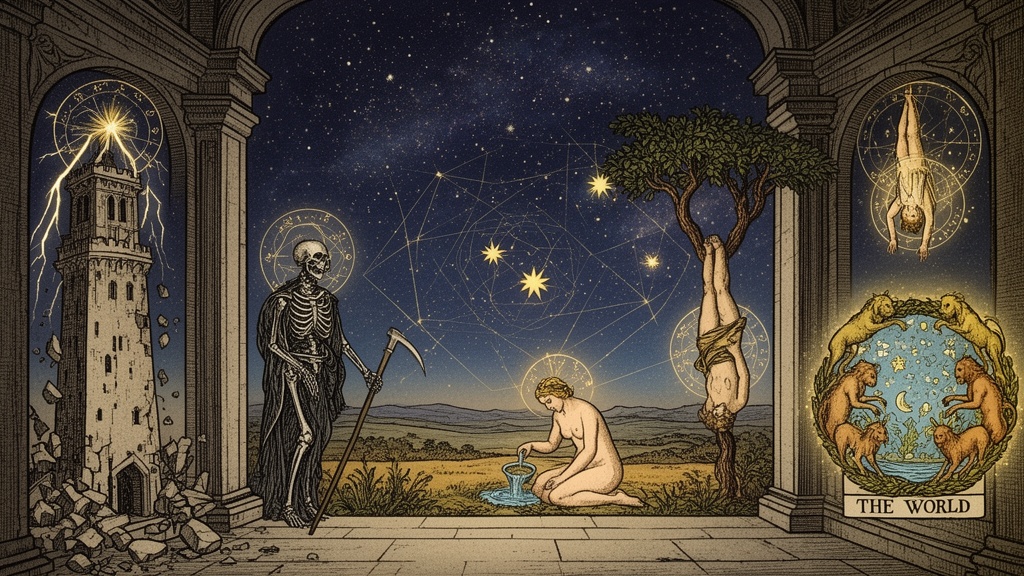
The Tower (XVI) as symbolic orientation for spiritual emergency / ego collapse.
In Grof’s work on spiritual emergencies, reports cluster around sudden, overwhelming breakdowns of meaning: reality feels unreal, identities disintegrate, the previous life-structure becomes untenable. The Tower’s imagery—lightning strike, crumbling edifice, figures falling—captures this more precisely than any DSM label.
In a reading, recognising Tower as a transpersonal crisis archetype shifts the frame from “your relationship is ending” to “your current reality-tunnel is being forcibly deconstructed.” That doesn’t romanticise the pain; it situates it in a lineage of death–rebirth processes described in mystical and initiatory traditions. -
Death (XIII) as initiatory death–rebirth, not just “change.”
Transpersonal literature is full of sequences where a felt “death” of identity precedes a larger, more inclusive sense of self. The skeletal reaper, the scythed field, the procession of figures in RWS-style decks are not just about externals ending; they’re imagistic condensations of that inner passage. When Death appears in a spread about a spiritual crisis, you’re allowed to say, “This isn’t only about losing X; something in you that thought it was the whole story is dying.” -
The Star (XVII) as post-collapse numinous quiet.
After Tower experiences, many describe a strange clarity: not triumph, not resolution, but a bare, luminous okayness. The Star’s naked figure, the water poured out, the quiet sky—this is the phenomenology of what transpersonal work calls unitive or grace states. It’s not “optimism.” It’s contact with a layer of being that doesn’t need your narrative. -
The Hanged Man (XII) as ego suspension / surrender to process.
In accounts of meditation breakthroughs, psychedelic ego-loss, or deep prayer, there’s often a phase of being “hung”—unable to go back to the old identification but not yet stabilised in the new. The Hanged Man’s inversion, halo, and passivity are a near-perfect glyph of that liminal suspension. -
Judgement (XX) and The World (XXI) as awakening and integration.
Judgement’s trumpets and rising dead echo the moment when a more encompassing awareness “calls” the fragments of life into a coherent pattern. The World’s encircled dancer, four living creatures, and wreath suggest a stabilised participation in a larger whole—a phenomenological cousin to what Wilber calls nondual or “always already” awareness.
These aren’t “this card equals that state” equations. They’re working hypotheses: when this card appears, it can be read as a doorway into that class of experiences, if the rest of the spread and the querent’s state support it.
A worked example: The Hanged Man in practise
Take the scenario from the brief: a client asks, “What is keeping me from feeling whole lately?” Celtic Cross, Position 6 (Near Future) is The Hanged Man.
Personal-level reading: you’re going to feel stuck, you might need to sacrifice something, change perspective, wait it out.
Transpersonal-level reading, step by step:
-
Phenomenology check.
You ask: “When you say ‘not whole,’ how does that show up? Is it depression, numbness, anxiety, something stranger?” Suppose they describe experiences like derealisation, time feeling odd, a sense of watching their life from outside. (You’re not diagnosing—you’re listening for phenomenological markers that might suggest liminal or dissociative states worth exploring symbolically.) -
Archetypal amplification.
You bring in the image: “This figure is suspended, not by choice, between worlds. Gravity still works, but not in the usual way. His old orientation is literally inverted.” You might mention myths of hanging on the tree for knowledge, or initiatory trials of surrender. -
Transpersonal hypothesis (held lightly).
You say something like: “There’s a way to hear this as more than ‘you’re stuck.’ It can point to a phase where the usual sense of self is being held in suspension so that something larger can come into view. That can feel like disconnection or unreality, but it’s also a known phase in deeper spiritual processes.” -
Invite participation, not imposition.
Instead of declaring “You’re having a spiritual awakening,” you ask: “Does that language of being ‘held’ or ‘surrendered’ to something bigger resonate at all, or does it feel off?” You track their response. If they light up, you can go further. If they look confused or scared, you dial back to more grounded language. -
Anchor it ethically.
You add: “Whether we call this spiritual, psychological, or both, it’s intense. Tarot can help us name the pattern, but if this gets overwhelming or you find yourself unable to function, it’s important to have support—friends, perhaps a therapist who’s open to this territory. This card doesn’t mean ‘do nothing’; it means what’s being asked is deeper than a quick fix.”
Notice what you didn’t do: you didn’t bypass their pain by rebranding it as “ascension,” you didn’t diagnose, and you didn’t collapse the transpersonal into metaphor only. You held the archetypal field open and let them step into it to the degree they could.
Shadow: inflation, bypass, and the bright side of the dark
The moment you start reading transpersonally, the shadow grows teeth.
-
Spiritual bypassing.
The obvious trap: “Your childhood trauma? Just part of the collective Wounded Healer archetype.” This is a defence, not insight. The fact that Chiron exists as a myth doesn’t mean your client can skip trauma work. When a card clearly points to personal material, don’t drag it into the transpersonal just because you’re bored with inner child narratives. -
Archetypal inflation.
Identifying with an archetype feels powerful. The querent is The Magician, The High Priestess, The Chosen One. If you start consistently casting people in mythic roles, you’re feeding potential grandiosity. Transpersonal psychology has watched plenty of “I am the Cosmic Christ” phases go badly. In tarot terms: when you see The Sun in someone’s spread, remember it shines on everyone, not just them. -
Dissociation disguised as transcendence.
Some states that look “transpersonal” are actually the psyche checking out. Numbness, flatness, “nothing is real” can be trauma freeze as easily as nondual awareness. The cards won’t make that differential diagnosis for you. If you’re out of your depth, say so and refer. -
Light without shadow.
Every archetype has a night-side. The Great Mother nurtures and devours. The Magician channels and manipulates. The Star’s serenity can shade into passivity or spiritualised avoidance. When you read transpersonal themes, explicitly name the shadow potential. It grounds the experience and keeps you honest.
Tarot can both expose and conceal these dynamics. A skilled reader uses the system to metabolise projection, not to amplify it. If you notice yourself consistently casting querents as Heroes in your private cosmology, that’s your work, not theirs.
Ethics: where tarot stops and therapy begins
Once we’re talking about ego death, spiritual emergency, and altered states, we’re flirting with clinical territory whether we want to or not. Some lines need to be explicit.
-
Tarot is not treatment.
Using the deck to explore the meaning of transpersonal experiences is not the same as treating psychosis, PTSD, or major depression. If someone is in acute distress—can’t sleep, can’t function, self-harm ideation—your role is not to reframe it as “a necessary Tower initiation.” Your role is to ground, normalise seeking help, and, if appropriate, refer. -
Stay in your lane.
If you’re not trained clinically, don’t use diagnostic language. You can say “this looks like a profound crisis of meaning” without saying “you’re having a spiritual emergency, not a psychotic break.” You don’t know that. You can say “this pattern shows up in mystical literature” and still encourage them to talk to a professional. -
Consent for transpersonal frames.
Not every querent wants their breakup read as a karmic pattern in the evolution of collective consciousness. Before you go there, test: “Would it be useful to look at this not just in terms of your life, but as part of a larger human pattern?” If they say no, respect that. -
Beware of minimising pain.
“Your suffering is part of a bigger process” can be deeply consoling or deeply invalidating. Watch their body language. If they look relieved, you’re on track. If they look shut down, you may have just floated away from their actual experience.
The transpersonal frame is powerful precisely because it can redeem experiences that feel meaningless or mad. That power cuts both ways. Used carelessly, it becomes another way to not feel.
Working with the field: spreads as ritual containers
Once you accept that readings can open into transpersonal territory, the layout itself becomes more than a diagnostic grid. It’s a ritualised way of stepping into the archetypal field.
A few practical adjustments that keep this grounded:
-
Name the level you’re reading at.
You can explicitly distinguish layers: “On the personal level, this looks like X. On a larger, archetypal level, this sequence—Death, Tower, Star—describes a classic death–rebirth arc that many people report in spiritual literature.” This helps the querent track what’s “about them” and what’s “about the pattern moving through them.” -
Use positions for transpersonal questions.
Add slots like “What larger pattern am I participating in?” or “What is being asked of my soul, beyond my preferences?” to spreads designed for this work. Cards landing there are framed from the outset as transpersonal indicators. -
Allow altered states, but hold a frame.
Sometimes, especially in longer sessions, the querent will drop into a light trance, tears, or a sense of presence in the room. You don’t have to interrupt that. But you do keep time, keep language precise, and help them reorient at the end: “Take a breath. Feel your feet. You can revisit this state later; for now, let’s make sure you can drive home.” -
Integrate, don’t just reveal.
If a reading has clearly touched transpersonal depths, close by asking: “What, if anything, do you want to do differently in light of this?” Otherwise you risk leaving them high on archetypal contact with no bridge back to life.
Why bother with this at all?
Sceptically, one might ask: why drag in Grof, Wilber, Jung, when tarot already has a perfectly serviceable esoteric cosmology? Because the overlap in phenomenology is too strong to ignore, and the psychological language adds a kind of precision that can be a relief in a space often dominated by vague “spiritual” talk.
Transpersonal psychology catalogues, with some care, the ways humans report encountering what feels like the beyond: the terror, the ecstasy, the weirdness. Tarot gives you a portable, visual grammar for those same motifs. When you put them together, you get something like this:
-
A querent having panic attacks that feel like impending death draws Death, Tower, and Star. Instead of “you’re cursed” or “it’s just anxiety,” you can say: “You are in a pattern that many mystics and psychonauts have described: death of an old identity, collapse of certainties, then a quieter, deeper trust. Let’s explore both the psychological supports you need and the larger meaning this might hold.”
-
A long-term meditator hits a void state and freaks out, pulls The Hanged Man, 4 of Swords, and The World. You can frame it as: “Suspension, rest, and a glimpse of totality. This is textbook transpersonal territory. It’s also destabilising. How can you titrate your practise so you’re not blowing out your nervous system?”
In both cases, tarot isn’t proving any metaphysical thesis about “higher realms.” It’s providing a symbolic framework that legitimises experiences that might otherwise be dismissed as madness or inflated into messianic delusion. That, by itself, is no small thing.
And of course, if your ontology leans more esoteric—if you do believe the deck is literally an interface with nonhuman intelligences or a Tree of Life in cardboard form—none of this psychological framing negates that. Jung never thought the collective unconscious was “just” metaphor. He treated it as an objective layer of reality, differently accessed. You can hold both: tarot as a psychological technology and as an oracular instrument. The map works either way.
The more interesting question is not whether tarot “really” maps transcendent consciousness, but what happens to your practise when you let it. What changes when you stop asking only, “What does this mean for me?” and start asking, “What is moving through me?” When a querent sits down, and you lay out the Majors, are you willing to entertain the possibility that the spread is not just a snapshot of their psyche, but a momentary cross-section of the larger pattern in which both of you—and the deck—are already immersed?
At that point, the cards cease to be flat images. They become doors. The real decision is how far you’re prepared to walk through them, and whether you can find your way back with something worth carrying.