
When a working feels potent — vivid dreams, sharp synchronicities, strong presence — but your bank balance does not move, the compiler model gives you a blunt diagnostic question: did you ever constrain the oracle’s output to the financial domain, or have you been compiling for a different target all along?
Once you start asking that, a lot of “right but useless” readings and impotent workings stop being mysterious. The oracle has produced output that is valid in one language, and you have tried to execute it in another.
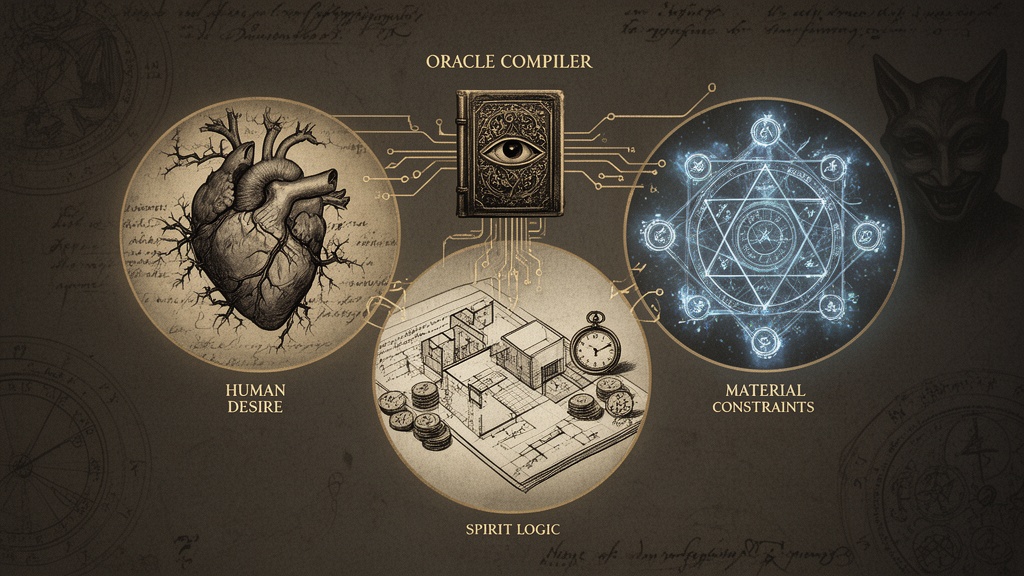
The proposal here is straightforward: treat the oracle as a compiler sitting between three mutually suspicious languages — human desire, spirit logic, and material constraints — and many familiar problems start to make structural sense. More importantly, they become debuggable.
This is not a claim about how reality is in itself. It is a modelling choice. But it is a modelling choice that, if you actually use it at the table, changes what you do when the cards are “right but useless”, or the ritual is intense but the rent is still overdue.
Three languages, one pipeline
Before dragging in compiler jargon, it is worth being explicit about the three “languages” in play. These are not empirically proven strata of the cosmos. They are abstractions practitioners already use, usually without naming them.
- Human desire
The language of the querent’s stated question and unstated motive. Messy, self‑contradictory, full of wishful thinking and defensive reframing. It is also the only entry point: all oracular work starts with some human asking for something, even if that something is “show me what I’m not seeing”.
- Spirit logic
Whether you treat this as literal spirits, autonomous archetypes, or simply the internal coherence of a divinatory system, this is the “other side’s” way of thinking. It is not bound to ego comfort; it tends to optimise for pattern, initiation, relational field, and long‑arc correction rather than short‑term gratification. It is also where trickster dynamics live.
- Material constraints
The reality principle in its most boring form: money, time, law, bodies, infrastructure, other people’s consent, the fact that you cannot be in two cities at once. This language is unforgiving. It will happily crash any beautiful astral script that asks it to violate basic causality or logistics.
You can collapse these if you like. Call it all psychology, or all spirits. But you lose explanatory power. You have no clean way to distinguish:
- a reading that is emotionally precise but factually wrong
- a spell that produces wild synchronicities and dreams but no change in the court case
- a spread that is “right” about the querent’s pattern but useless as advice because it ignores their actual constraints.
Keeping the three languages distinct gives you somewhere to locate the failure.
The oracle, in this framing, is a compiler that parses human desire, negotiates it through spirit logic, and outputs something that is supposed to be executable in the material world.
When a reading is half‑right, one of those compilation passes has misfired.
Borrowing from compilers without hand‑waving
If you actually write code, you are right to be suspicious of occultists throwing around “type error” and “runtime exception” as if that settles anything. So let us be precise about the mapping and then keep it consistent.
- Syntax: the formal structure of the operation. In divination: how the question is framed, what spread or casting pattern you use, how you delimit the temporal and topical scope.
- Static type checking: what kinds of answers are even admissible before you draw a single card. “Yes/no vs process”, “within six months vs ever”, “about their behaviour vs your choices” — this is the pre‑reading validation of shape and domain.
- Semantics: how symbols mean in your system. Not just “Three of Swords = heartbreak”, but how this Three of Swords, in this position, for this querent, in this tradition, gets interpreted.
- Runtime: the actual execution of the plan or spell in the world after the reading. What happens when the code leaves the temple and hits the office, the courtroom, the kitchen.
- Type error: asking the system to do something incompatible with the declared types. In our case: trying to compile a spirit‑level instruction directly into a material outcome it was never designed to address; or asking for a result that your constraints simply cannot hold.
- Runtime exception: the thing that only shows up when you run it. External shock, black swan, your own failure to act, other agents’ free will.
There is no literal AST, no formal type system. This is not a one‑to‑one technical mapping. It is a disciplined analogy to structure the failure modes we already see, so we do not have to keep reinventing “well, sometimes the cards are metaphorical”.
A worked example: business, Magician, and the missing type check
Take a scenario most of us have seen some version of.
The querent: “Will my new business venture succeed this year?”
You lay a Celtic Cross, or whatever your house spread is. Outcome: Magician. Advice: Eight of Pentacles. The field feels good. You see skill, initiative, capacity to manifest. You tell them: there is strong potential, but it will require focused work. They leave buoyed.
Six months later: the business is still a side project, the income negligible. The querent says: “The reading was wrong.”
Run this through the compiler model.
- Syntax: The question “Will my new business venture succeed this year?” is already malformed. “Succeed” is not typed. Turnover? Profit? Personal satisfaction? Survival? “This year” — calendar year, twelve months from now, before they run out of savings? You let that ambiguity compile.
- Static type check (material): You did not ask about their capital, market, time. You did not know that they had three hours a week to devote to this, no runway, and no experience. You allowed a question whose implied material type (“significant stable income in a year”) was incompatible with their actual constraints.
- Spirit logic: The Magician + Eight of Pentacles is perfectly valid spirit‑level output. It says, roughly: “Yes, you have the inner resources and the craft to make this into something real. Here is the posture you need to take.” That is a coherent response to the desire to create.
- Material constraints: Completely unaddressed. The compiler never got to run a pass that asked: “Given this life, this market, this time budget, what does ‘success’ even mean?”
The result is a classic type error. You compiled valid spirit‑logic advice as if it were a material guarantee. The reading is “right” in the archetypal register and wrong in the world.
Debugging this in practice is not complicated, but it requires you to care about the layers:
-
After reading the main spread, you pause and explicitly ask yourself:
– What is this saying in spirit logic?
– What is the human actually asking for?
– What does the material situation look like? -
You then draw separate cards or cast separately for material constraints. “Show me the mundane environment for this business in the next twelve months.” You get Five of Pentacles and Ten of Wands. Suddenly the picture changes.
-
You can now say, truthfully:
“There is real creative and magical potential here. The spirits / the pattern are behind you. But the current material stack will not support the version of ‘success’ you are hoping for in this timeframe. If you want money, not just growth, we need to debug the constraints: time, capital, maybe change the question.”
Notice what has happened. You have not retreated into “it will work in the astral”. You have identified that the oracle answered a different language than the one the querent thought they were speaking, and you have corrected for it before they bet the rent.
Where the compiler metaphor earns its keep
The model becomes interesting when you stop using it to rescue old failures and start using it up front.
At the table, you can treat each reading as passing through three compilation stages, each with its own error profile.
- Human → Oracle: input parsing
This is where projective identification and shadow do their thing. The querent says: “Will he come back?” The real question is: “Can I tolerate being alone?” or “Will I have to admit I drove him away?”
If you accept the surface string as valid source code, you have already lost. The oracle will faithfully compile the wrong programme.
Debugging here looks like:
- Refusing ill‑typed questions (“Can you tell me what she is thinking?”) and re‑casting them into self‑addressed forms.
- Checking for hidden secondary agendas: “If the answer is no, what are you going to do?”
- Being explicit about temporal and domain scope: “We are looking at the next six months, and we are focusing on your actions, not predicting theirs.”
This is static type checking at the human interface. It is not glamorous, but it prevents a lot of nonsense.
- Oracle ↔ Spirit: semantic negotiation
However you model “spirit”, there is a layer where the system’s own logic asserts itself. This is where the Trickster lives. It is also where a lot of “the spread answered the question I should have asked” phenomena sit.
Here, errors look like:
- Inflating archetypal content into literal prediction (“Death = someone will die this month”).
- Taking initiatory or corrective messages as green lights for concrete plans.
- Missing that the system has declined to answer the question and has shifted to something else entirely.
Debugging here is about semantic literacy and relationship with the oracle:
- Knowing the difference, in your system, between predictive and initiatory configurations.
- Having protocols for “no‑answer” or “refusal” patterns.
- Being willing to say: “This is a spirit‑layer response about your path, not a forecast of the event you asked about.”
The compiler metaphor reminds you not to force that into a single literal channel.
- Oracle/Spirit → Material: code generation
This is the stage most magical writing hand‑waves. We are very good at describing inner transformation and spirit contact; we are much less rigorous about how that is supposed to land in the rent, the diagnosis, the court date.
Errors here include:
- Assuming that a strong energetic or visionary experience guarantees material outcome.
- Designing workings whose material effects are undefined (“more abundance”) or impossible (“win the lottery tomorrow” with no ticket).
- Ignoring other agents’ free will, legal frameworks, and basic logistics.
Debugging this requires mundane literacy and honesty:
- You track different outcome channels separately: symbolic shifts, subjective experience, and timed, externally verifiable events.
- Before the working, you define what would count as success in each channel. “Within three months, an increase of £X in income from sources that are plausibly connected to this path.”
- If, after repeated trials, you get only inner shifts and no external movement, you do not keep saying “it worked in the astral”. You downgrade confidence in your ability to compile into the material and adjust your model.
This is where the sceptic’s demand for falsifiability has teeth. If every failure is rescued by saying “ah, but it succeeded in another language”, your compiler model is worthless. A functioning compiler flags some code as invalid.
So you draw a hard line: sometimes the reading is simply wrong. Not “right in a hidden layer”; wrong. You misread, or you cold‑read, or the oracle glitched, or your model of how it maps to the world is broken. The compiler metaphor should make you more willing to say that, not less.
“Working in the astral” without hand‑waving
The phrase “it worked in the astral” is usually a post hoc rationalisation. Something intense happened subjectively, nothing happened externally, and the practitioner wants to salvage meaning.
The compiler framing does not magically legitimise that move. It forces you to be specific about what you mean by “astral success”.
There are at least two distinct things hiding under that phrase:
- Psychological / symbolic effects
- Shifts in perception, emotional state, self‑concept
- Dreams, synchronicities, altered relational patterns
- Resolution of inner conflict, increased agency
These are real. They matter. They are also squarely in the human‑psyche language. You do not need to posit literal spirits to account for them.
- Operational magical events
- Clear sense of presence or communication from entities
- Non‑trivial synchronicities that seem to respond to specific offerings or pacts
- Phenomena that you, in your practice, treat as evidence of spirit‑side activity that is not reducible to your own psychology
Whether you treat these as ontologically real is your business. The compiler metaphor does not settle that. It simply says: if you are going to talk about “spirit logic” as a distinct language, you should track its outputs separately from both inner shifts and outer events.
Practically, this means:
- Before the working, you note:
- What would count as an inner/psychological success?
- What would count as a spirit‑layer success (if you work with spirits)?
-
What would count as a material success?
-
Afterwards, you do not collapse them. “I feel calmer and had vivid dreams” is a hit in one register and a miss in another. You do not smuggle the miss into “it worked in the astral” unless you had defined that as a valid target beforehand.
Over time, this gives you a profile of your own stack. You may discover that you are excellent at compiling from human desire into inner and spirit‑level transformation, and poor at bridging into the material. That is not an insult. It is information. It tells you where to study: perhaps you need better mundane strategy, or a different class of spirits, or a more constrained way of asking.
Avoiding the rationalisation trap
The main sceptical worry with any layered model is that it can explain everything and therefore nothing. If every failed prediction is “right archetypally”, if every non‑event is “a lesson”, then you have built a hermetic bubble.
To keep the compiler metaphor honest, you can impose some discipline:
- Pre‑declare domains: When you sit down, you decide explicitly: “This reading is about material outcomes in the next three months”, or “This is about my initiatory path, not events.” You do not move the goalposts afterwards.
- Set minimal falsifiability: For predictive or practical readings, you define at least one clear, time‑bounded, externally checkable criterion that would count as failure. If that criterion is not met, you do not rescue it by saying “it was right in spirit language”. You log it as a miss.
- Differentiate true translation failures from misreads:
- Translation failure: The oracle gave a coherent message in one language that could not be implemented in another because of constraints. Example: “You are called to leave your job and pursue art full‑time” when you have dependants and no savings. The message may be valid at the level of vocation, but you cannot compile it into your current life without catastrophic side‑effects.
- Misread / nonsense: The cards said “big money within a month”, you defined that as at least £X, nothing even close happened, and there is no plausible way to re‑type that as a spirit‑layer success you had specified. That is not a translation glitch. That is error.
- Allow downgrades: If you run the same class of operations repeatedly and they only ever “succeed” in retrospect, symbolically, you treat that as evidence against your model. You either stop making hard claims about material outcomes or you change your technique until the hit‑rate improves.
In other words: use the compiler frame to cut down on rationalisations, not multiply them.
Debugging with three passes
Once you adopt this frame, “half‑right” readings become invitations to locate which pass failed instead of woolly “mixed messages”.
Take a common case:
- The cards accurately describe the querent’s emotional situation and patterns.
- The prediction about the external event (job offer, reconciliation, etc.) fails.
- The querent says: “It was right about me but wrong about what would happen.”
Under a single‑layer model, you either defend the oracle (“it’s right in a higher sense”) or disown it. Under the compiler model, you can say:
- Human desire → Oracle: parsing was fine; the reading locked onto the real issue.
- Oracle ↔ Spirit: semantics were coherent; the pattern description is accurate.
- Oracle/Spirit → Material: the code generation failed. Either you over‑literalised an archetypal pattern, or you assumed causality where there was only correlation.
You can then adjust: for this querent, in this area, you trust the oracle as a mirror and therapist, not as a forecaster. Different oracles, different spirits, different spreads may have different strengths. The model lets you profile them.
Why not just call it psychology?
You can run this entire argument inside a purely psychological ontology. Replace “spirit logic” with “autonomous archetypal dynamics” and “astral” with “unconscious”. The compiler still compiles between conscious desire, unconscious patterning, and external reality.
The oracle becomes a structured way of letting the psyche talk to itself about the constraints it faces.
You do not need literal spirits for the model to work. But if your practice includes them, the model gives you a clean way to hold both the psyche’s use of the oracle as transcendent function and the possibility that there is a genuinely other agency speaking through the same symbols, without collapsing one into the other. It keeps you answerable to a logic that is not just your own wish‑fulfilment, whilst refusing to pretend you know exactly what, or who, is on the other end of the line.
If you sit with that double accountability long enough, the question of what is really happening starts to look less like a problem to be solved and more like one of the things the oracle is quietly asking you back.