
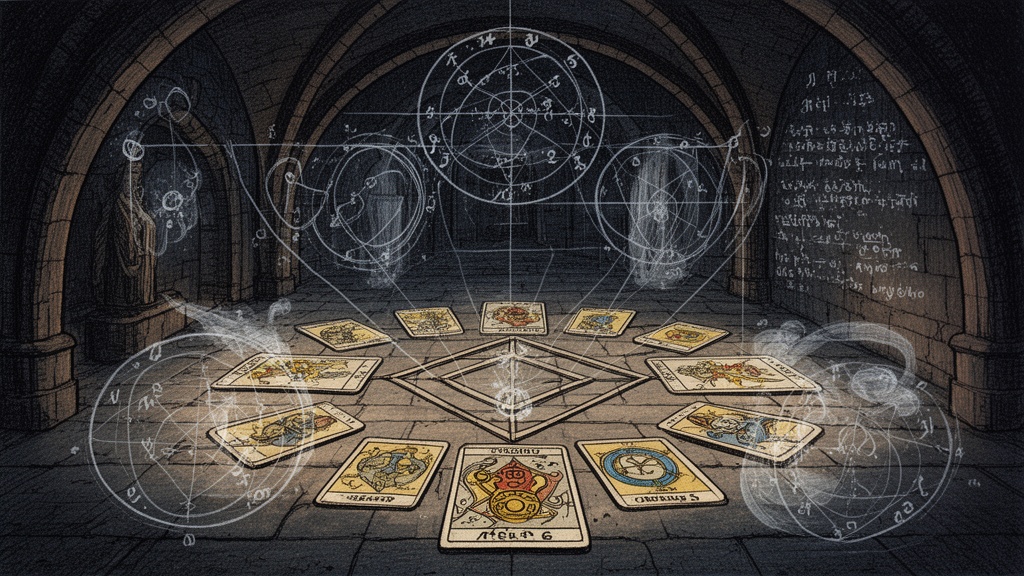
Once you know the situation is actively hiding itself from you, the cards are no longer telling you what is true. They are telling you what cannot be faked cheaply.
That shift may sound abstract until you are sitting with a whistleblower who knows their email is monitored, reading about a war you are only allowed to see through propaganda, or negotiating with a spirit that lies as a matter of principle. In those conditions, the usual divinatory posture — “map the situation, forecast the likely line of events” — quietly collapses. The world is not merely unknown; it is under denial.
In that environment, treating tarot, geomancy, the I Ching, or whatever you use as a neutral map is a category error. You are no longer decoding a blurry signal. You are working against a channel that is being jammed, spoofed, and sometimes rewritten as you look at it. The question stops being “What will happen?” and becomes: “Given that every surface is lying, what patterns are still forced?”
From answers to constraints
Most readers, once past the beginner phase, already do a kind of informal Bayesian updating. You walk in with priors — what you believe about the querent, the situation, the world. The reading shifts those beliefs. Under ordinary uncertainty, you let the oracle move you towards a more detailed picture.
Under deliberate denial, you do almost the opposite. You coarsen your picture on purpose. You stop asking for detail and start asking for structure. You behave less like a seer and more like an intelligence analyst who assumes some of their sources are compromised.
The key move is this: stop treating the spread as a description of “what is really going on,” and start treating it as a tool for bounding the space of the possible.
Think in terms of constraints:
- Structural constraints: Given what is already known, what families of scenarios are still live, and which are ruled out?
- Operational constraints: Given the denial regime, what moves are available to the querent that do not depend on privileged knowledge?
- Psychological constraints: Regardless of which external story is true, what is the querent’s nervous system actually capable of enduring or doing?
If you want to keep the metaphors from information theory: in a friendly world, you treat the oracle as a high-resolution channel and read it for content. In a hostile world, you treat it as an error-correcting code — redundancy and pattern are more important than any single card “message.” The oracle is not telling you the secret; it is sketching the hard edges around it.
Not all liars are alike
“States, corporations, spirits” is a rhetorically satisfying list, but it is also uselessly broad if you are actually trying to read under fire.
The denial regime matters. Who or what is shaping what you are allowed to see?
A few crude but workable types:
- Closed bureaucracies Ministries, militaries, internal corporate processes. Information is siloed, documents classified, leaks punished. The denial here is mostly absence: you hit walls. Hard data stops at a certain depth.
Hard constraints tend to be budgets, logistics, physical limits, and institutional inertia — what this machine simply cannot turn on a dime to do.
Side channels include procedure (who has to sign what) and timelines (how long things must take, even under cover).
- Disinformation ecosystems Propaganda, PR, social media astroturfing. Here the problem is not absence but saturation: too many stories, mutually inconsistent, all loudly asserted.
Hard constraints are things that would be expensive to fake across platforms and time, and baseline material reality: bodies, infrastructure, legal filings.
Side channels include what is never mentioned and sudden narrative pivots coordinated across sources.
- Gaslighting interpersonal fields Abusive relationships, cults, high-control workplaces. The denial is intimate. The querent’s own memory and judgement have been systematically undermined.
Hard constraints are observable behaviour patterns over time and the querent’s bodily and emotional responses, which are harder to gaslight than narratives.
Side channels include third-party observations and behaviour under stress or when “off duty.”
- Trickster and opaque spirits Entities that lie, misdirect, or answer sideways as part of their nature or function. Here the denial is ontological: you are dealing with an intelligence that is not bound to linear narrative at all.
Hard constraints are your own oaths, protections, and red lines, and the broader pattern-field — convergences across independent workings.
Side channels include repetition of motifs across different oracles and operators, and physical-world synchronicities that echo or contradict the working.
Each regime has different “cheap fakes” and different “expensive truths.” In a propaganda field, it is cheap to flood you with emotionally charged images; it is expensive to change physical casualty numbers across jurisdictions. In a gaslighting relationship, it is cheap for the abuser to spin a story; it is expensive for them to maintain a consistent mask under prolonged scrutiny.
Your spreads should be designed to probe the expensive bits.
What divination can and cannot infer here
Before we get into architectures, it is worth stating the epistemic ground.
We do not have a Shannon-style model of divination. There is no agreed alphabet, no known channel capacity, no way to quantify “bits of truth” in a Celtic Cross. We cannot prove that a spread “recovers the message” from a jammed channel.
So when I say “infer constraints from noise,” I am not claiming that the oracle is a cryptographic decoder for state secrets.
What we can do, honestly, is narrower and still useful:
- Use the oracle to stress-test narratives: what stories about the situation hang together symbolically, and which fall apart under the pattern pressure of a reading?
- Use it to map ignorance: where the cards go foggy, generic, or self-contradictory in a consistent way, you have located a denial zone.
- Use it to shape action under uncertainty: even if you cannot know which of several stories is true, you can often see that some actions are dominated — bad across all plausible branches.
The “constraints” here are mostly structural and operational, not “this specific fact about the secret meeting on Tuesday.” You are narrowing the scenario space and identifying safe or unsafe regions within it, not decrypting a dossier.
If you believe that oracles tap a real pattern-field that includes denied variables, you can layer that ontology on top. If you do not, you can still use the same techniques as disciplined abductive reasoning tools. The protocols work either way; what changes is how far you think they reach.
Spread architecture for hostile channels
The architectures below are disciplined heuristics, not formal protocols with guaranteed outputs. They are useful because of the questions they force you to ask, not because they replicate the rigour of an error-correcting code. Once you stop asking “What is happening?” and start asking “What cannot be avoided, given that I am being lied to?”, you stop using most stock spreads. They assume a basically honest environment. You need layouts that build in redundancy, cross-checks, and explicit modelling of deception.
A few architectures that have proved their worth:
1. Constraint Mapping Spread
Seven positions; works with tarot, Lenormand, geomancy houses, or mixed systems.
- Surface narrative — What is being presented as the story?
- Denied variable — What is most actively hidden or distorted?
- Hard constraint — What cannot be faked cheaply in this situation?
- Cross-check — What, if it appeared, would disprove the surface narrative?
- Integrity check — Is this reading itself being distorted or co-opted?
- Projection field — What of this is mainly the querent’s fear, hope, or bias?
- Robust outcome band — Across live scenarios, what type of outcome is structurally forced?
You do not read position 1 as “the truth.” You read 1 against 2 and 4. If 1 and 2 are in open contradiction — say, 1 is 10 of Cups, 2 is 7 of Swords — you note that the very discrepancy is the message: the environment is selling harmony over a theft.
Position 3 is often the only place you are allowed to take as semi-solid. In a corporate fraud case, that might be a Pentacles card in a legal or institutional slot: whatever the PR says, there is a paper trail, an audit, a ledger.
Position 5 is not a magical lie detector. It is a ritualised moment of meta-awareness: if you get The Moon, 7 of Cups, or a geomantic Via there, you slow down, maybe rephrase, maybe take a break. Under trickster spirits, you might stipulate in advance that certain cards in 5 mean “stop, renegotiate terms.”
Position 7 is where you compress. You are not asking “Will you win the case?” but “Is this an outcome characterised by rupture, by slow attrition, by stalemate?” You are looking for the type of endgame that appears across scenarios.
2. Competing Hypotheses Layout
Adapted from intelligence tradecraft’s Analysis of Competing Hypotheses.
You lay out three or four explicit scenario hypotheses across the top, each with a card:
- H1: “Management is ignorant and incompetent, not malicious.”
- H2: “Management is complicit in fraud.”
- H3: “External actors are driving this; management is trapped.”
Under each, you draw cards for the same set of factors:
- Motive
- Capability
- Risk to querent if Hx is true
- Observable indicator that Hx is live
You then read horizontally across factors, not vertically as mini-spreads. Where the patterns are self-consistent, you have a live hypothesis. Where the symbolism collapses or contradicts itself, you downweight that branch.
This does not “tell you which is true.” It tells you which stories your symbolic field can support without strain. Often you end up with two live hypotheses and one that simply does not cohere. That is already a constraint: you can plan for the intersection of H1 and H2, and stop expending effort on H3.
3. Control and Integrity Questions
When you know you are in a jammed channel, you can use the cryptographer’s trick of chosen-ciphertext: ask the oracle questions whose answers you already know, to probe the channel’s integrity.
You do this sparingly. For example:
- Before the main spread, ask: “What was the main event in my life last week?” or “What is my current living situation?” If the answers are wildly off and symbolically thin, treat the channel as degraded.
- Embed a control position in the spread: “Show me a clear symbol for [known fact X].” If that position is consistently off in multiple readings, treat everything else as suspect.
This is not about “testing the spirits” in a naïve sense. It is about checking your own state, your relationship with the system, and whether you are in a psychological place to read at all. Under gaslighting, for example, querents routinely misreport their own history. A control question can sometimes reveal that the distortion is in the narrative coming into the room, not in the cards.
4. Cross-oracle triangulation
If you are serious about reading under denial, you should have at least two systems that do not share symbol vocabularies: say, tarot and geomancy, or I Ching and playing-card cartomancy.
You ask the same constrained question of each, relatively close in time, and you look for:
- Convergences: repeated figures of blockage and delay across systems. Treat these as higher-weight constraints.
- Divergences: where one system gives you detail and the other collapses to archetype. That asymmetry is often a map of the denial zone.
Again, this is not proof. It is redundancy. You are building an informal error-correcting code out of different symbol sets.
Compression and its artefacts
When the denial regime is strong and your own bandwidth is low — time pressure, fear, spiritual interference — you are forced into lossy compression. One-card draws, three-card bands, single geomantic figures.
Under that kind of compression, you will see artefacts: repeated cards, flattened narratives, everything collapsing into a handful of archetypes: Enemy, Betrayal, Tower.
It is tempting to mystify this — “The Tower keeps coming up, therefore catastrophe is fated.” It is equally tempting to dismiss it as bad reading.
A more disciplined stance is to treat “compression artefact” as a hypothesis with criteria, not a default excuse.
Some working rules:
- Rule out the obvious first: fatigue, intoxication, badly scoped question (“What is really going on?” in a multi-layered war zone), querent withholding basic facts.
- Look for pattern over time: a single vague spread proves nothing. Recurring flattening across multiple sessions, with different questions and good hygiene, is more telling.
- Check specificity: if only readings on this topic collapse into Moon/7 of Cups/Tower, whilst love and health spreads remain nuanced, you are probably mapping a denial zone, not your general incompetence.
- Cross-check across oracles and readers: if you and another practitioner, using different systems, both find that corporate-legal questions reduce to the same blunt archetypes, you can start to treat that as a structural artefact of the environment.
It is worth being explicit: “compression artefact” is a speculative interpretive lens, not an established category. It should not become a ready excuse for every unsatisfying spread. The discipline that tests whether the lens is tracking reality — rather than rationalising fog — is journaling: record what you took to be an artefact, note the question and conditions, and compare against later-known facts. If the pattern of flattening genuinely preceded and mapped the shape of a denial zone, you have evidence. If it was just a bad session, you have learned something equally useful.
What does an artefact mean in practice? Not “ah, profundity.” It means: the question as posed is beyond the resolution of your current vantage point. You need to re-scope.
Instead of “Is the CEO personally directing the fraud?”, you ask “What range of outcomes can I expect if I act as though the fraud is centrally directed?” You stop trying to peek behind the wall and start designing moves that are robust whether or not the wall hides a Minotaur.
This is the apophatic move in divination: you learn the situation by the shape of what refuses to resolve.
The psychological minefield
Reading under denial does not just stress your technique. It stresses your psyche.
Once you accept that some of what you are seeing is weaponised misdirection, hypervigilance is almost inevitable. Every ambiguous card can become “proof” of conspiracy. Every false positive can be read as a spirit attack or a state psyop. The line between disciplined suspicion and paranoia is thin.
A few guardrails help:
-
Make your priors explicit before you read. Write down, literally, “I currently believe X is 70% likely; I am afraid of Y; I desperately want Z.” This drains some of the projection out of the spread. When the 7 of Swords lands, you can ask: is this new information, or just my 70% suspicion in drag?
-
Dedicate positions to your own bias. In hostile environments, add a “What am I projecting?” slot to every significant spread. If that card is loud — Devil, 9 of Swords, reversed Court that you strongly identify with — assume your interpretive field is contaminated and discount your more baroque storylines.
-
Distinguish external denial from internal fog. A gaslit querent may unconsciously sabotage clarity because clarity would force action. A trickster spirit may answer perfectly consistently whilst your own fear turns every answer into a threat. Not every difficulty is “them.” Some is you.
-
Accept non-answers. Under heavy denial, the most ethical and accurate thing you can sometimes say is: “The pattern I am seeing is how the situation refuses to be seen.” That is not failure. It is data.
Where scepticism bites, and what survives it
A technically literate sceptic will point out, correctly, that all of this leans heavily on metaphors from information theory and cryptography without the underlying rigour. There is no way to calibrate “channel capacity” of a tarot deck, no proof that redundancy in a spread actually recovers hidden variables.
If you treat the metaphors as literal, you are lost. There is no proof that a 7-card constraint spread “works” the way a Hamming code works.
The value is elsewhere:
- The act of designing spreads as if you were dealing with an adversarial channel forces you to ask better questions: “Where are the cheap fakes? What would be expensive to lie about here? What am I assuming?”
- The discipline of reading for constraints rather than stories keeps you from overfitting every card to your favourite conspiracy.
- The habit of treating fog, repetition, and flattening as possible structural signals — tested against time and cross-oracle comparison, not taken on faith — gives you a way to learn from your failures instead of handwaving them away.
Even if you believe divination is “only” a projection screen, these protocols still bite. You are training your own pattern-recognition under pressure, your tolerance for not knowing, your ability to act under partial information without lapsing into either paralysis or delusional certainty.
If you believe the oracle is more than projection, then you are giving that “more” a cleaner, more interesting set of questions to answer.
Reading the wall
Most spreads quietly assume that reality is at least trying to tell you the truth. Under deliberate information denial, that assumption is gone. You are reading a wall that does not want to be read.
In that situation, the temptation is always to push harder: more cards, more systems, more elaborate protocols to “beat” the secrecy. There is another move available: accept that under compression, the oracle’s job is not to smuggle you the missing file, but to sketch the outline of the vault.
Which constraints are hard? Which futures are ruled out? Which actions are safe across scenarios? Where does the pattern repeatedly collapse into archetype, and what does that say about the shape of the lie?
Once you start treating the fog, the walls, and the artefacts as part of the message, the question of “What will happen?” becomes less interesting. The live question is more demanding: “Given that this situation is actively editing what can reach me, what kind of seer can I afford to be?”