
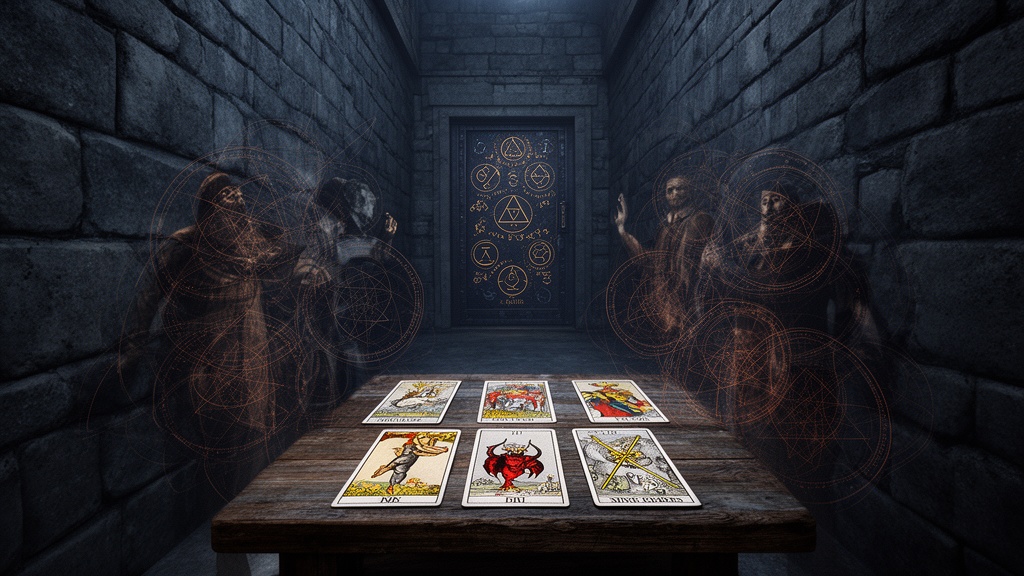
Most spreads quietly assume your querent can walk away. “Stay or go?”, “Path A / Path B”, “What happens if I say yes?” — structurally, they’re decision trees. But what happens to your oracle when there is no tree, just a wall?
Not metaphorically. A prison sentence with decades left. An abusive partner who controls the money, the documents, the children. A state where dissent is not a lifestyle choice but a chargeable offence. You sit down with cards, coins, shells, or figures — and the obvious exit is not on the table because, in any realistic sense, it doesn’t exist.
If you read for other people, you will meet this sooner than you want to. Many of us already have. And it is here that the hidden architecture of our systems shows itself, sometimes beautifully, sometimes in ways that are frankly cruel.
Agency is not a metaphysical given; it’s a design assumption
Divinatory systems are not neutral mirrors. They’re technologies with embedded expectations about what a human life is and what can be done inside it.
You can see this most nakedly in spread design. Take a standard tarot decision spread:
- Card 1: Option A
- Card 2: Option B
- Card 3: Advice / likely outcome if you choose A
- Card 4: Advice / likely outcome if you choose B
- Card 5: Underlying lesson
This is a decision-support tool. Its implicit model of the querent:
- You have at least two viable options.
- You are free to pick one.
- The oracle’s job is to illuminate consequences and help you choose.
Now transpose that into a carceral context. Your querent is on remand. Deportation proceedings are underway. Or they’re in a domestic situation where “leave” is not a meaningful option without catastrophic risk.
“Option A vs. Option B” collapses. What you get instead is a kind of structural gaslighting: the spread keeps showing you doors that aren’t actually there.
This is what I mean by “malfunction”, and it’s worth being precise. The oracle hasn’t stopped “working” in any metaphysical sense. The cards or hexagrams or figures will still fall. But the tooling — the spread, the question, the interpretive habits built for people who can walk away — no longer fits the field. The design goal (support a decision) and the situation (no real decision possible) are mismatched.
Most of the time, we don’t see this because our clientele can, at least in principle, leave the job, end the relationship, move cities. The assumptions hold well enough. Under occupation, literal or structural, those assumptions are stress-tested to failure.
Divination as projective technology under constraint
Strip away the metaphysical arguments for a moment and look at divination as a ritualised way of throwing down structured ambiguity and inviting psyche to constellate around it.
In “normal” conditions, a lot of that projection is ego-organised: How do I get what I want? Which path is better? What’s the timing? The oracle is an aid to planning and future-orientation. Even in more spiritual frames, “What is my soul asking?” still presumes some capacity to reorient behaviour in response.
When agency is radically constrained, the psychic task changes. The future is not a field of open possibilities; it’s a corridor with locked doors. If the outer situation cannot be altered, the psyche has three broad options: collapse into helplessness, dissociate or numb out, or seek micro-forms of agency—meaning-making, reframing, inner stance, covert resistance.
Divination in this environment does not stop being projective, but the projections change flavour. The spread becomes a container for unworkable affect: rage that cannot safely be expressed, terror that cannot be acted upon, longing that has no outlet. The reading holds it, gives it shape — or, if badly handled, throws it back at the querent as “advice” they cannot possibly follow.
This is why readings in these contexts can feel simultaneously more intense and more dangerous. The oracle is not only about “What should I do?” but “How do I survive knowing there is nothing I can do?” That is a different psychic mechanism.
The archetypes that wake up when nothing moves
Oracles are full of archetypes, but certain ones get loud when movement is impossible.
In tarot, you know these cards already: The Hanged Man, The Devil, The Tower, the Nine and Ten of Swords. The Eight of Swords, if you read it as both perceived and actual entrapment. They’re not the only ones, but they mark out the territory: suspended action, bondage, catastrophic loss of control, mental agony.
In the I Ching, hexagrams like 12 Standstill (Pi), 29 The Abysmal (K’an), 47 Oppression (K’un) and 60 Limitation (Chieh) describe conditions where pushing harder does not open the way. The counsel is often to conserve energy, maintain integrity, wait for a turn of time.
In Ifá, certain odu explicitly address situations of affliction, imprisonment, or being in the hands of others. The logic there is not “just accept” but relational: appease, negotiate with, or realign yourself in relation to orishas and forces. Sacrifice and patience are not abstractions; they’re prescribed moves in a theistic field.
Geomancy has its own figures of constraint: Carcer is the obvious one, but also Tristitia, Via reversed in some lineages, and placements of these in houses of freedom, travel, or marriage.
What these patterns have in common is not a moral about “karma” but a structural acknowledgement: there are states where the only possible transformation is internal, temporal, or relational — not directly behavioural. You cannot kick the door down. You can only decide how you will stand in the cell, how you will relate to the guard, how you will bear the next impact.
Alongside Prisoner, Victim, Martyr, another archetype tends to constellate: Witness. The part of consciousness that says: this is happening, it is not fair, and it matters. When you are reading under occupation, one of the most honest functions you can serve is to give that Witness a language.
And then there is Trickster: the one who finds micro-openings in closed systems. Not every prison has a tunnel. But every closed system has seams — in timing, in rules, in the attention of the oppressor. Oracles, especially those rich in liminal or trickster imagery (Mercury, Eshu, Loki, the Fox in Lenormand), can point to these: a conversation that can safely be had, a document that can be moved, a small refusal that will not bring the roof down.
Where systems quietly assume freedoms they don’t name
It is easy to pretend this is only a tarot problem because tarot has been psychologised into a self-help tool. But the agency assumption runs deeper.
It shows up in three main places:
-
Question templates and spread positions
“What should I do next?” “How can I improve this situation?” “What do I need to release?” All of these presuppose that there is a “next”, that “improvement” is available, that “releasing” is a live option. In a labour camp, the move might not be to “release resentment” but to retain enough anger to stay alive without letting it consume you. The verb set is wrong. -
Interpretive defaults
– The Hanged Man as “voluntary surrender” assumes you had a choice not to be hung.
– The Devil as “your own addictions” assumes you are the primary author of your bondage.
– Eight of Swords as “you can free yourself if you take off the blindfold” assumes the ropes are illusory.
In a situation of actual captivity, these readings can border on abusive if applied uncritically. The same symbol set can, of course, be read differently — but that requires conscious retooling.
- Outcome language
Many guidebooks and oral traditions lean heavily on “if you do X, then Y will happen”. That’s fine when the querent can in fact do X. In authoritarian or abusive contexts, the lever is often not connected to the mechanism. “If you speak your truth, you will be respected” is a very particular class fantasy.
Systems built in different cosmologies handle this differently. The I Ching is arguably more structurally honest about constraint: a large portion of the text is about recognising when you are up against Heaven, time, or circumstance, and the “advice” is to align with inevitability rather than override it. Ifá, with its emphasis on sacrifice, taboo, and negotiated fate, embeds the idea that you are not a sovereign individual but a node in a web of forces. “Agency” there is always relational: you can act, but only within what your orí and the orishas will actually support.
From a contemporary Western therapeutic standpoint, these can look like resignation. Within their own frames, they are strategies for survival and right-relationship when the field is not yours to command.
The point is not that one cosmology is superior, but that when you import any of them into a modern reading room, you are also importing their assumptions about what can be changed and how. If you then overlay a self-help narrative on top, you can easily end up with a hybrid that promises more freedom than the situation, or the system, actually allows.
How readings “break” under occupation
“Break” here is functional: the reading no longer does what it is supposed to do for the querent.
There are a few recurring failure modes.
1. False options
You lay a classic “stay/leave” spread for someone in a surveillance state, or in a marriage where leaving means losing custody and possibly being killed. The cards for “leave” look glorious. You talk about new horizons, self-actualisation, safety.
The querent looks at you and says, “I can’t.”
If you insist on the spread’s logic — “But the cards are clear, you should leave” — you’ve just aligned the oracle with a fantasy world in which the structural constraints do not exist. The reading offers not guidance but a taunt.
2. Spiritual bypassing
Oppression gets reframed as “a soul contract”, “a karmic lesson”, “what you chose before you incarnated”. The Devil becomes “your limiting beliefs” instead of the landlord, the cop, the abuser. The Tower becomes “necessary ego death” instead of “your house was raided at 3am”.
This is not depth work; it’s erasure. It pushes systemic violence back into the querent’s psyche as personal failure or metaphysical homework. Under prolonged occupation, this compounds trauma and learned helplessness.
3. Nihilistic collapse
On the other side, you can swing into dark realism: every spread is read as confirmation that nothing can change. Oppression cards? Of course. More Swords? Naturally. “There is no hope” becomes the meta-message.
The oracle then functions as a ritual of despair. Accurate, perhaps, in a narrow sense — but psychically deadening. The querent walks away with less capacity to endure, not more.
4. Reader projection
Your own discomfort with powerlessness starts to drive the reading. You overemphasise small openings because you can’t bear to sit with “no way out”. Or you minimise danger because you don’t want to believe things are as bad as they are.
Alternatively, if you have your own history of constraint, you may overidentify and steer the reading into your narrative rather than theirs.
All of these are “malfunctions” only in that they fail the basic divinatory ethic: to tell the truth of the situation in a way that is actually useful to the person sitting across from you.
Retooling: from macro-agency to micro-agency
If we accept that many of our default tools presuppose freedoms the querent does not have, then the work is not to abandon divination under occupation but to change how we use it.
The shift is from macro-agency (“What action should I take?”) to micro-agency (“Where is my power, however small?”).
That sounds cosmetic until you redesign spreads in practice.
Take the ubiquitous three-card Past–Present–Future. Under constraint, it tends to produce vague fatalism: “Your past led to this, your future will be that.” It invites the querent to stare down a timeline they cannot significantly alter.
Reframe the positions:
- Current Terrain — What is non-negotiable right now?
- Possible Leverage — Where, if anywhere, is there room for manoeuvre, even if only in thought or attitude?
- Core Resource — What inner quality, connection, or practice sustains you?
If Card 2 is The Hanged Man, you do not talk about “choosing to pause”. You name the lack of outer movement and ask: Within this suspension, what can shift in your seeing? What can be reinterpreted, not to make it pretty, but to make it survivable?
If Card 1 is The Devil, you do not turn to “you can walk away any time”. You talk about actual chains: institutions, contracts, dependencies. You ask whether there is any part of the binding that can be loosened — a thought pattern, a small act of refusal — without pretending the whole structure is in their control.
Similarly, in I Ching work, you might de-emphasise “Which course of action should I take?” and lean into “How do I conduct myself with integrity in this hexagram?” If the cast is 47 Oppression, the question shifts from “How do I get out of this?” to “How do I keep my centre when I can’t get out yet?” That is not resignation; it’s precision about where movement is actually possible.
In Ifá or geomancy, the same principle applies. You listen very carefully to what the odu or figure says about limitation, timing, and relational obligations. You ask: Within this pattern, what offerings, what alignments, what choices of speech or silence are possible? You don’t promise that the right ebó will erase a dictator or a prison sentence. You also don’t deny that ritual can open roads in ways that aren’t visible from a purely secular vantage.
The practical techniques are not exotic:
- Change spread positions so that none require external mobility to be meaningful.
- Make at least one position explicitly about “What cannot be changed right now”.
- Make at least one position about “Where is my power, however subtle?”
- Make one about “Witness”: What needs to be named and seen without being fixed?
This forces you, and the querent, to distinguish between fantasy options and real micro-agency.
Ethics: when hope helps and when it lies
There is an ethical tension here that no amount of clever spread design will dissolve.
Offer too much hope and you collude with the oppressive structure: “If you just keep your vibration high, the guards will treat you better.” Refuse hope altogether and you risk leaving the querent in naked despair.
One way through is to be explicit about levels.
On the psychological level: “Given what you’ve told me, leaving tomorrow is not safe. The cards are showing a lot of Wands around that, which I read as the part of you that wants to bolt. Let’s honour that without letting it get you killed. Where can that fire go inside the situation — into planning, into keeping your spirit from going numb?”
On the material level: “I am not a lawyer / social worker / activist. The oracle is not a substitute for them. If any of these cards touch on areas where mundane help is possible, I will say so, and I will also say when we’ve reached the limit of what divination can responsibly do.”
On the numinous level: “There are patterns here that feel larger than both of us. Whether you read that as fate, as spirits, as synchronicity — that’s up to you. My job is to name what the pattern seems to be saying about how to endure it, not to tell you that suffering is meaningful in some cosmic ledger unless that meaning actually emerges for you.”
You can also be very clear about what you’re not doing. You’re not declaring the situation unchangeable forever; you’re describing its present structure. You’re not attributing fault to the querent for being trapped. You’re not using the oracle to launder your political opinions, but you’re also not pretending the political field doesn’t exist.
A genuinely falsifiable claim, if you want one, would be something like: “Clients in carceral settings report more clarity and less distress when readings are framed around micro-agency spreads than when standard decision spreads are used.” That’s testable. Everything else we’re doing here is structural and phenomenological: about coherence with the system’s own logic and the lived experience of people under constraint.
Cross-system nuance without flattening
It’s tempting, in a piece like this, to line up tarot, I Ching, Ifá, geomancy and pronounce a grand theory of “how oracles handle oppression”. That would be tidy and mostly wrong.
The cosmologies differ too much:
-
In Ifá, sacrifice and resignation are not psychological postures but concrete transactions in a theistic ecology. “You cannot change this now” often means “you must change your relationship to the forces involved, and that will take time and offering.” When Ọ̀sá Méjì or Ìká Méjì speaks of affliction or bondage, the remedy is relational and ritual: appease Ẹ̀ṣù, make offerings to your orí, observe taboos. The system does not promise immediate liberation, but it does promise that right relationship with the orishas can shift what is possible over time. This is not fatalism; it’s a different model of causality.
-
In the I Ching, non-action is often the most active thing you can do: aligning with the time, biding in the dark of hexagram 2, or accepting the blockage of 12 not as failure but as part of a larger cycle. When the text says “It furthers one to cross the great water” or “Perseverance brings misfortune,” it is not describing your psychological state but the structure of the moment itself. The oracle teaches you to read the field and move—or not move—accordingly. Under occupation, this can be profoundly clarifying: the system does not gaslight you into thinking you have options you don’t. It names the standstill and tells you how to bear it without losing your integrity.
-
In modern tarot, especially post–Golden Dawn, we’ve layered a highly individualistic, therapeutic agency model onto what was originally a game and then an esoteric diagram. “What should you do?” is a very 20th-century question. The cards themselves are more ambiguous than our interpretive habits suggest. The Hanged Man can be read as involuntary suspension; The Devil as systemic bondage; the Tower as violence done to you, not a necessary ego death. The onus is on the reader to resist defaulting to self-help interpretations when the context is clearly structural.
What becomes visible when you hold these systems side by side is not that they all say the same thing, but that each has developed a vocabulary for situations where direct action is not the answer. Ifá says: negotiate with the forces. The I Ching says: align with the time. Tarot, read with care, says: name what is happening and find where your small power lives.
For practitioners working across systems, the lesson is this: do not flatten the differences, but do notice that every mature divinatory tradition has had to reckon with powerlessness. They have different answers because they arise from different worlds. But they all know that sometimes the door is locked, and the question is not how to break it down but how to live in the room without losing yourself.
Most spreads assume you can walk away. Now you know what to do when that assumption fails.