If your spread keeps being “right” about the pressure in a situation and “wrong” about the exact event, you’re probably not misreading the cards. You’re asking them for the coin toss when they’re showing you the weather.
Most of us know this in practice long before we have language for it. The Tower stalks a client for months, the job does not explode, but the marriage does. Or the marriage survives and their health collapses instead. The oracle was tracking a threshold; we insisted on a storyline.
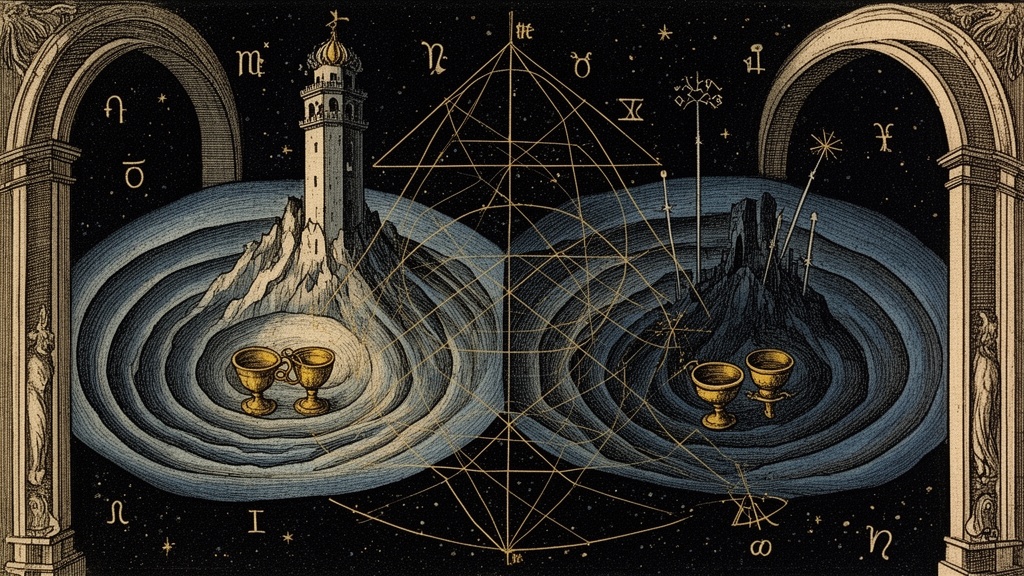
This piece is an attempt to take that seriously: to treat divination as reading probability fields and attractor basins, not as naming a single future. Not as a softening of “fate” into “free will”, but as a structural shift in what we think we’re doing when we lay cards, cast charts, or throw sticks.
From “line of fate” to attractor basin
Traditional horary and geomancy already behave as if they’re reading fields rather than certainties.
“Will I get the job?” is not answered by a single symbol. It’s answered by a configuration: significators, aspects, reception, prohibition, perfection or its denial. A chart can be “radical” or not, which is really a question of whether the symbolic configuration fits the question’s field. And the classic judgements — perfection, frustration, collection of light — are about whether the situation is already sliding into a basin of “yes”, stuck in “no”, or hovering near a boundary.
In dynamical-systems language, a basin of attraction is a region of state-space where many different starting conditions all tend to end up in the same qualitative pattern, while a bifurcation is the point where a small nudge sends the system into a different basin altogether.
In horary terms, “Are we in the basin of reconciliation or separation?” becomes “Do the significators apply to aspect with reception, or are they separating, prohibited, or in aversion?” “Is this chart radical?” becomes “Is this chart actually keyed to the bit of the state-space we care about?”
Tarot and Lenormand readers talk this way all the time without the jargon. “Everything in this spread says confrontation is coming; I don’t know whether it’s work or home yet.” That is basin talk. The cards are describing the shape of where things are tending, not the specific route.
If we name that explicitly, accuracy stops being “did event X happen?” and becomes “did the oracle correctly identify the basin and the proximity to a turning point?” If the reading says “you’re in a high-pressure conflict basin” and the next six months are placid, that’s a miss. But if the blow-up happens in a different domain than you expected, the field-level description was right and the trajectory call was off.
That distinction is not a dodge; it’s a constraint. It tells you what the tool is actually good at.
What “field” means here (and what it doesn’t)
Before we go further, it’s worth fencing off some metaphysical overreach.
When I say “probability field” or “attractor basin” in a divinatory context, I do not mean that the oracle is secretly solving differential equations in eleven-dimensional phase space. In physics, an attractor is a mathematically defined set; you can write down the equations, iterate them, and watch trajectories converge.
In divination, our “basins” are qualitative clusters of tendency: recognisable patterns of pressure and drift in a situation. “Everything about this chart screams ‘reconciliation field’.” “These cards are all clustered around burnout and withdrawal.” That is model talk, not a claim that we can compute a Lyapunov exponent for your love life.
There are three levels you can hold this on:
- Ontological: reality itself is a complex dynamical system with attractors and tipping points, and oracles literally sense that.
- Phenomenological: humans experience situations as if they had attractors and thresholds — “this is heading somewhere and it will break soon”.
- Pragmatic: treating situations as if they had basins and thresholds improves how we read and work.
You don’t need to sign up for (1) to use this. The arguments here sit comfortably on (2) and (3). If you happen to think the cosmos really is a giant phase portrait, fine; if you think this is a powerful metaphor for otherwise inchoate experience, also fine. The practice implications are the same.
What we are not claiming:
- That there is a literal, measurable “probability field” hovering over your client that the cards tap into like a Geiger counter.
- That importing technical vocabulary magically makes oracles “scientific”.
- That this reframing makes oracles unfalsifiable by letting us rescue every wrong call as “field-level accuracy”.
If anything, it tightens the screws: it gives us more ways to be wrong.
Oracles as Bayesian prosthetics (without the fake numbers)
A different but related lens is Bayesian. Strip away the equations and you’re left with a simple structure:
- You have a prior — your current sense of what’s likely.
- New information arrives.
- You update to a new picture of what’s likely, the posterior.
Human beings are terrible at doing this cleanly. We overweight recent anecdotes, underweight base rates, and cling to what we want to be true. But structurally, this is how our expectations shift.
Most multi-position spreads already behave like crude Bayesian devices. The “Current Situation” position surfaces the implicit prior: what is actually going on, beneath the story the querent is telling? “Obstacle”, “Advice”, “Hidden Influences” are constraints on the field. “Likely Outcome” is not a decree; it is a sketch of the posterior: “Given this configuration and no major intervention, this is where things tend to flow.”
The I Ching is even more explicit. Primary hexagram: current configuration. Changing lines: points of instability. Resulting hexagram: probable transformation. You can read that as, “Given this pattern and these instabilities, the field tends to evolve like this.”
None of this implies that the oracle is doing actual probability calculus. It does suggest a way to discipline our own sloppy updating. Treat “Likely Outcome” as conditional on current conditions and let the spread force consideration of futures you’d otherwise ignore. Resist the urge to assign spurious percentages; “it feels about 70/30 toward burnout” is metaphor, not a forecast from a calibrated model.
Sometimes a spread feels like a strong posterior — all the symbolism lines up, the field picture is coherent — and reality simply does something else. You misread the field. You overfitted the pattern. Or the situation was more contingent than your model could hold. A Bayesian frame doesn’t excuse that; it names it.
Tower cards and phase transitions
The phase-transition metaphor is particularly helpful for the cards and figures that stalk people before life changes.
In physics, a system can absorb change up to a point, then abruptly flip phase: water to ice, quiet discontent to revolution. As it nears the threshold, you see signatures of criticality: increased volatility, slowing recovery from shocks, flickering between states.
Now think about how often Tower, Death, 10 of Swords, Judgement, sometimes even 8 of Cups, start repeating across domains before a client’s life reconfigures. The job is shaky, the relationship is stale, their health is under strain — you see the same crisis markers in readings about all three. Then one domain finally snaps and everything rearranges around it.
If you insist on event-level mapping — “The Tower means your job will end in March” — you set yourself up to be “wrong” when the job limps on but the relationship implodes in June. If you read Tower as a phase marker — “The system you are living in cannot sustain itself; we are near a threshold” — your timing and accuracy look different:
- The cards are pointing to how the change will feel (sudden rupture, slow dissolution, karmic reckoning), not which particular domino falls.
- Repeated crisis cards tell you the system is hovering near criticality. The trigger is negotiable; the fact of a phase change is less so.
- Horary’s late degrees, void-of-course Moon, prohibitions and frustrations become markers of whether the conditions for a phase change are complete, blocked, or already passed.
In practice, this shifts your questions. Instead of “What exactly will the Tower be?” you ask:
- “What phase is trying to end?”
- “How close are we to a threshold where small actions have disproportionate effects?”
- “If this phase change is non-negotiable, where do you want the break to land?”
The model doesn’t make you infallible. If you call criticality and the next year is uneventful, you misread the phase. But you’re no longer obliged to claim prophetic precision about which brick in the wall will crack first.
Reading the phase portrait, not the trajectory
The most interesting move, for me, is to treat large or well-structured spreads as phase portraits: qualitative maps of the landscape, not forecasts of a single path.
In dynamical systems, a phase portrait doesn’t tell you where the system will be at t = 10. It shows:
- What attractors exist.
- Where the boundaries between their basins lie.
- How the flow behaves near those boundaries.
You get a picture of the whole terrain: valleys, ridges, saddles, and how trajectories tend to wander through them.
We already do a folk version of this with the I Ching‘s 64 hexagrams arranged so each differs from its neighbours by one line, and with Lenormand’s Grand Tableau. Experienced readers scan for clusters, boundaries, “hot zones”. They’re not just saying “this card = this event”; they’re reading the topology.
You can formalise that tendency without pretending you’re doing mathematics.
Take the classic relationship question: “Will we get back together?”
Instead of a linear timeline spread, you lay something like:
- Current State (where in the landscape you actually are)
- Pressure / Gradient (what is pushing, and in which direction)
- Attractor A: Reconciliation (what it looks and feels like if the field deepens into reunion)
- Attractor B: Separation (what it looks and feels like if it deepens into ending)
- Edge / Bifurcation (what it’s like right on the boundary; what would tip you over)
- Leverage Point / Advice (where a small intervention has disproportionate effect)
- Near-Term Flow (how the system is likely to move in the next slice of time, given no major magic or shock)
Now imagine the cards:
- Current State: 8 of Cups
- Pressure: Lovers reversed
- Attractor A: 2 of Cups
- Attractor B: 10 of Swords
- Edge: The Tower
- Leverage: Strength
- Near-Term Flow: Justice
Read as a phase portrait, not a verdict:
You are already in a moving away posture (8 of Cups). Emotionally, one foot is out the door. The main gradient is unresolved choice and tension (Lovers reversed). The field is split; values conflict. There is a reconciliation basin (2 of Cups), but it’s relatively shallow compared to the separation basin (10 of Swords) in this configuration. The boundary between them is sharp (Tower at the edge): this is not a gentle drift; it’s a snap once the threshold is crossed. Strength as leverage says: the place where a small effort matters is in sustained, non-dramatic courage and self-regulation. Roaring or collapsing both feed the Tower. Justice as near-term flow says the field wants to settle into some kind of decision or rebalancing. The coin will not stay on its edge indefinitely.
You have not answered “yes” or “no”. You have mapped the landscape and pointed to the ridge-line. The claim is now precise in a different way: if the next six months show easy intimacy with no Tower moment, you misread the field.
The same logic scales to a Grand Tableau, to a year-ahead wheel, to any spread big enough to show structure. You look for clusters around certain motifs (work, health, conflict, isolation) as attractors; fault-lines where the symbolism shifts abruptly as basin boundaries; repeating cards or houses as gradients, where the field is steepest; and cards sitting on the “edges” of your spread as liminal or threshold markers.
You are less concerned with “what happens in August” and more with “where are the pressure ridges in this person’s next cycle?”
Magic as leverage on the field
If you’re thinking in fields and basins, magical intervention stops being “change the future” and becomes “change the landscape.”
In a strictly event-based model, spellwork is an attempt to force or prevent a specific outcome: get this job, avert that lawsuit. In a field model, you are aiming at:
- Deepening a desired attractor: making the reconciliation basin “deeper” so trajectories that enter it are less likely to hop out.
- Flattening or disrupting an unwanted attractor: making the burnout basin shallower, so the same wobble doesn’t always end in collapse.
- Altering gradients: shifting what counts as “downhill” behaviourally or circumstantially.
- Moving separatrices: widening or narrowing the boundary region where small actions have big effects.
The point isn’t that we can literally draw the potential function of someone’s life and then engineer it. It’s that this is a cleaner way to think about what we already do. A protection working around a toxic workplace doesn’t guarantee “no bad events”. It aims to alter the field so that hostility doesn’t couple as easily into your client’s life — to flatten the “persecution” attractor. A road-opener rite before a job hunt is a way of steepening the gradients toward opportunity and making the “stuck” basin less sticky. A ritual of closure in a lingering relationship is an attempt to push the system through a phase change rather than letting it oscillate indefinitely at the boundary.
This also reframes timing. Close to a bifurcation, tiny acts and small workings matter a lot. Far from it, they mostly reinforce the existing basin. Saying “now is a good time for magic” becomes “the field is near a threshold; leverage is high.” Saying “this is baked in” becomes “you’re deep in a basin; small nudges will just spiral you round the same centre.”
Again, the model doesn’t make you right. It does give you a more honest vocabulary for why some workings feel like they move worlds and others barely scratch the surface.
Psychological mechanics: field attunement instead of answer-hunting
Psychologically, reading fields instead of certainties recruits a different part of the psyche.
If you treat divination as “tell me what will happen”, you’re using the oracle as a defence against uncertainty. You want premature closure. The cards become a fantasy of control.
If you treat it as “map the pressure systems”, you are doing something more like field attunement. You let the symbols externalise the felt sense of flux: where there is tension, where there is slack, where something wants to break. You allow the spread to hold multiple possible futures at once without collapsing them.
Jung would call that a version of the transcendent function: symbol mediating between conscious expectation and unconscious complexity. The oracle becomes a temporary, visual model of the situation’s topology.
Of course, projection doesn’t vanish. It changes shape.
As a reader, your own risk tolerance and anxieties colour how “stable” or “critical” a field feels. You may systematically over-call Tower moments or under-call them. As a querent, you gravitate toward whichever attractor matches your desire or fear. You hear “the field leans toward separation unless you intervene here” as “you’re dumping me” or “so you’re saying it’s guaranteed if I just do X”.
Spread design can either amplify or diffuse that. Layouts that explicitly map multiple attractors and edges force everyone to sit with ambiguity. Single “Outcome” cards invite the old dynamics back in.
There is also a shadow side in the other direction: interpretive inflation. Once you have field language, it’s easy to witch the noise — to see every wobble as a phase shift, every minor stress as a critical gradient. Dressing ordinary projection in the clothes of “attractor basins” doesn’t make it less projection.
The corrective is empirical: track your own work. If you keep calling crisis fields that never manifest as anything more than ordinary turbulence, your threshold for criticality is off. If your “burnout basin” readings consistently precede actual burnout, you’re onto something. The model lives or dies in practice.
When the field model is simply wrong
A fair sceptical objection is that “reading fields” can become an all-purpose excuse. The event didn’t happen? Ah, but the pressure was right. The Tower didn’t manifest? It must have been “on another level”.
If that’s all this is, the model is useless.
So we need criteria for when a field reading fails.
For me, at minimum:
- If you describe a high-pressure attractor toward conflict, and the next months are characterised by stable ease with no significant tension in that domain or any adjacent one, that reading was wrong.
- If you call a system “near criticality” and it trundles along for years without any major reconfiguration, you misjudged the phase.
- If you map reconciliation vs separation basins and the relationship simply ambles on in the same half-alive limbo with no real pull in either direction, your whole attractor picture was off.
The field frame earns its keep when it leads you to different spread designs, different questions, different magical choices — and those differences show up in hindsight as more honest, more actionable, or simply less stupid than what you were doing before.
If it only shows up after the fact to rescue misses, throw it out.
Working differently tomorrow
If you take the field model seriously, a few things change immediately.
You stop pretending to name single futures and start designing spreads that expose multiple basins and edges. You listen less for “what will happen?” and more for “where is the pressure actually coming from, and how steep is the slope?” You time your magic not by calendar convenience but by how close the system feels to a threshold.
None of that answers the old question of how the oracle knows what it knows. It does, however, sharpen a different question: if what you are reading is not events but the shape of a living field, what kind of reader do you have to become to track that honestly?