
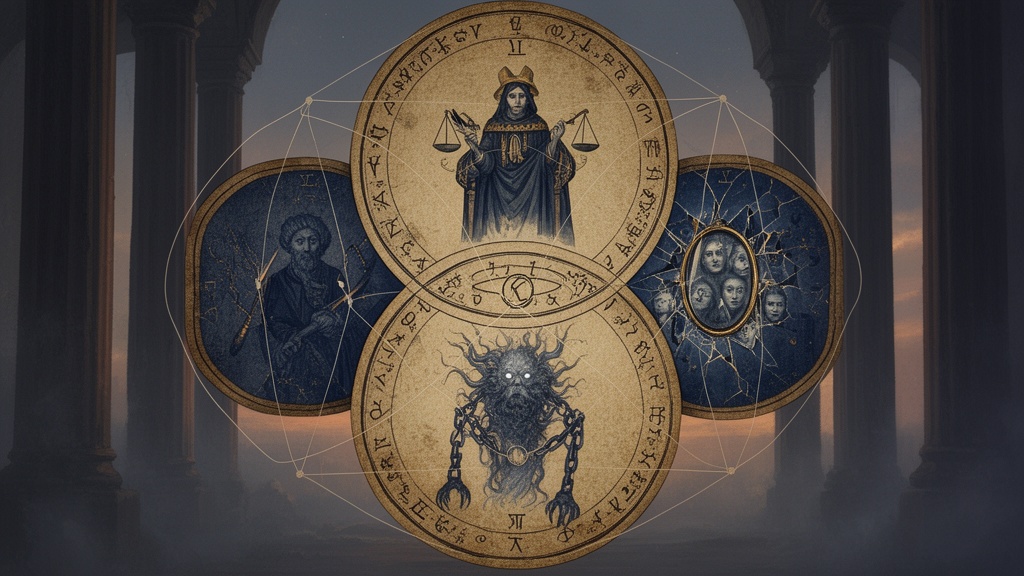
If you treat your deck like a therapist, you will get therapeutic answers. If you treat it like a suspect under interrogation, something else starts to happen.
Most contemporary tarot and oracle material leans hard on the first mode. The deck is framed as ally, guide, inner wisdom, higher self. Course descriptions promise “supportive insight,” “non-judgemental guidance,” “a compassionate mirror.” Spread positions are written like intake forms. Even when people are doing practical magic with cards, the dominant metaphor is cooperative: the system wants to help you if you show up honestly.
That is not the only way divination has ever been done.
What “adversarial protocol” actually names
The phrase is not traditional. It is borrowed from security studies and cryptography, where an “adversarial protocol” is any procedure designed on the assumption that some participant might be lying, malicious, or structurally opposed to your interests. In cryptography, an adversarial protocol is designed to function correctly even when some participants are actively trying to subvert it—Byzantine fault tolerance in distributed systems is a canonical example. We can use it as an analytic lens to pick out a family of divinatory procedures that share three structural features:
- They assume at least one potentially deceptive or misaligned agent (spirit, human, institution, even the diviner’s own wishful thinking).
- They include built-in checks, redundancies, or threats aimed at constraining that agent.
- They are designed to be used precisely when the stakes are high and trust is low.
This is not an abstract category. You can see it in the bones of very different systems.
Example 1: Ifá and structured dispute
Take one concrete pattern from Yoruba Ifá practice as it has been documented in the 20th century: divination used to adjudicate conflicting claims. Two parties bring a dispute—over land, inheritance, responsibility—to a babaláwo. The oracle is not asked, “How can we all heal?” It is asked, in effect, “Who is in the right, and what must be done?”
Several features here are structurally adversarial:
- The human situation is explicitly conflictual. Someone is lying, mistaken, or withholding.
- The casting is not taken at face value. Verses (odu) are interpreted in dialogue with probing questions, cross-checks, and sometimes repeat castings if the pattern is ambiguous or contested.
- The diviner’s authority is not purely charismatic. There is a repertoire of verses and procedural norms that constrain how far he can bend the reading towards one patron or another without being called out by peers or community.
The oracle is being used inside a social adversarial protocol: a way of resolving human conflict where distrust is assumed and managed, not wished away.
Example 2: Grimoire spirits and the lying familiar
Now look at a specific current from early modern European grimoires. Pick something like the Lemegeton or related texts. The conjurations are full of language like:
“If thou be not obedient and faithful in all things that I shall command thee, I will in the power of the Most High torment thee…”
The operator is instructed to:
- Bind the spirit by multiple divine names.
- Threaten it with confinement, burning, or erasure if it deceives.
- Demand visible signs, repeated answers, and sometimes corroboration by another spirit.
The text assumes the spirit is perfectly capable of lying, manipulating, or offering half-truths. The entire ceremonial apparatus is an adversarial protocol aimed at forcing a potentially hostile intelligence to yield reliable information or service.
Example 3: Near Eastern royal oracles and redundancy
Shift again to an ancient Near Eastern context. In the Mari and Neo-Assyrian material, oracles are consulted about political and military decisions. The king does not simply ask once and move on. You see patterns like:
- The same question being put to multiple diviners or multiple oracular techniques (extispicy, incubation, prophetic trance).
- Repetition of the inquiry over several days.
- Attention to unfavourable or ambiguous signs as grounds for delay or for seeking confirmation.
Here the adversary is not a demon but risk itself: rival factions, treacherous allies, uncertain omens. The protocol is adversarial in that it assumes the world is not transparent, that signs can mislead, and that institutional and personal interests can distort what is reported to the throne. Redundancy and cross-checking are baked in.
One family, different enemies
These three cases are not the same cosmology, and we should not flatten them. One is social, one metaphysical, one political. But structurally:
- Ifá emphasises adversariality between humans, with the oracle as referee.
- Grimoires emphasise adversariality between operator and spirits, with God’s names as leverage.
- Royal oracles emphasise adversariality between the decision-maker and the opaque world of risk and counsel, with procedure as safeguard.
“Adversarial protocol” is a way to see that family resemblance. It does not mean all these people thought of themselves as “doing security.” It means their procedures are built for environments where trust is a live, contested issue.
Modern Western tarot, in its therapeutic register, mostly is not.
Cooperative baselines and where they fail
The cooperative model has its strengths. It supports trauma-aware practice. It reduces the old obsession with “bad cards” and fated doom. It fits well with self-development work, coaching, and integration of shadow material.
It also quietly smuggles in a historically specific assumption: that the main problem in divination is the querent’s resistance to hearing the truth, not the untrustworthiness of the information channel itself. That assumption is a product of a particular moment—post-Jung, post-humanistic psychology, post-New Age—visible in the dominance of therapeutic language in popular tarot books (Tarot for Self-Care, The Empath’s Oracle) and in spreads framed around “What is my higher self trying to tell me?” rather than “Who is lying to me about this contract?”
Adversarial protocols become relevant when that baseline fails—when the practitioner has to seriously entertain that:
- A spirit contact may be parasitic, manipulative, or simply not what it claims.
- A querent (including oneself) may be consciously gaming the reading.
- An institution—employer, state, religious body—has interests that are not aligned with the people consulting the oracle.
- One’s own psyche has strong motives to self-deceive.
At that point, “the cards are my friends” stops being enough.
From historical pattern to modern protocol
The three cases above—Ifá adjudication, grimoire spirit-binding, royal oracle redundancy—were not offered as historical curiosities. Each demonstrates that adversarial structural logic has been invented independently, across incompatible cosmologies, wherever the stakes of a session were high enough to demand it. What they share is architecture, not theology.
The structural logic is portable. What we extract from Ifá, grimoires, and royal oracles is not their cosmology but their procedural architecture: assume misalignment, build in checks, constrain yourself as much as the other.
1. Designing the spread as cross-examination
An adversarial spread is not just “a normal spread but with harsher questions.” It is structured to:
- Ask the same issue from multiple angles.
- Separate claims from evidence.
- Force you to read against your preferred narrative.
For example, in a business partnership question where trust has eroded, you might build a three-pass protocol:
Pass 1: Stated surface
- Card 1: What I say I want from this partnership.
- Card 2: What they say they want.
- Card 3: What we say the problem is.
Pass 2: Unstated incentives
- Card 4: What I stand to gain if my story is believed.
- Card 5: What they stand to gain if their story is believed.
- Card 6: What the current conflict makes it easy to ignore.
Pass 3: System challenge
- Card 7: Where my perception is most distorted.
- Card 8: Where I am underestimating them.
- Card 9: What neither of us is acknowledging.
You can then add a procedural rule: you are not allowed to make any decisive move (confrontation, termination) on the basis of a single pass. You must cross-relate all three and, ideally, repeat the reading after a fixed interval or after obtaining mundane information.
The structure, not the card meanings, carries the adversarial logic.
2. Protocols for spirit contact under suspicion
If you work with spirits, guides, ancestors, or “entities” of any sort, adversarial protocols become more literal.
A minimal example:
-
Identity challenge. Have a fixed set of questions or signs that any claimed familiar or guide must answer or display consistently across sessions. This is your equivalent of the grimoire’s conjurations and names. You do not accept new entities at face value, however pleasant they feel.
-
Content challenge. Any directive that would isolate you from support, rush you into irreversible action, or inflate your specialness (“You alone…”) triggers an automatic second check: another system, another practitioner, or a time delay.
-
Revocation clause. You explicitly reserve the right, in ritual language, to terminate contact if patterns of deceit, harm, or obsession emerge. You do this in advance, not in the heat of the moment.
Again, the point is not to live in fear of tricksters. It is to treat the relationship as one in which your discernment is a live factor, not an insult to the spirits.
3. Reading against your own story
The most quietly adversarial protocol is the one you run against yourself.
One simple pattern:
- Do your standard spread on the issue.
- Before interpreting, write down your preferred outcome and your worst fear in plain language.
-
Then, add three positions to the spread:
- “What I am strongly motivated not to see.”
- “How I am currently deceiving myself.”
- “What would count, for me, as a genuine ‘no’ from the oracle?”
You read those three last, after you have done your normal interpretation. They are explicitly there to catch the ways you have massaged the reading towards your desire or away from your dread.
This is not about self-flagellation. It is about giving the system a chance to contradict you in a way you cannot easily smooth over.
Psychological risks and scope conditions
Adversarial protocols are not neutral upgrades. They change the emotional temperature of the work. They are powerful precisely because they weaponise suspicion—and suspicion cuts both ways.
There are three broad failure modes to take seriously.
1. Paranoia amplification
If you are already prone to hypervigilance, conspiracy thinking, or abuse-related patterning where everyone is a potential threat, adversarial divination can become a hall of mirrors.
- Every “difficult” card becomes proof someone is out to get you.
- Every delay or ambiguity in spirit contact becomes evidence of a hostile force.
- Every contrary reading from another practitioner is folded into a persecution narrative.
In this state, the oracle is no longer a tool for discernment; it is a confirmation engine for fear.
Scope condition: adversarial protocols are contraindicated as a primary tool for people currently in acute paranoia, active psychosis, or untreated complex trauma where reality-testing is fragile. The work demands a baseline capacity to hold “maybe” without collapsing into “definitely against me.”
2. Weaponising the oracle against others
The second failure mode is ethical rather than clinical.
- Using “the cards” to accuse a partner of cheating.
- Declaring someone a narcissist, abuser, or “energy vampire” on the basis of a spread.
- Justifying punitive or controlling behaviour because “spirit showed me your true face.”
This is adversarial protocol as inquisitorial theatre. The oracle is drafted as a prop in interpersonal power plays. The other person has no chance to contest the “evidence,” and the practitioner’s projections are given divine backing.
Scope condition: adversarial protocols should not be used as a substitute for direct communication, legal process, or professional assessment. “The oracle says” is not admissible evidence in any forum where the other party’s rights are at stake.
Concrete line-drawing helps:
- Do not use adversarial spreads to cross-examine partners.
- Do not “diagnose” friends, clients, or public figures using adversarial layouts.
- Do not treat divinatory indications of abuse or danger as sufficient grounds for unilateral drastic action without mundane corroboration.
If the cards suggest you are in danger, you take that seriously—but you also talk to a therapist, a lawyer, a shelter, a friend. The oracle is a signal, not a verdict.
3. Collapse into total scepticism
The third failure mode goes the other way. Once you start reading against everything, you may find that:
- Every accurate hit is dismissed as coincidence.
- Every uncomfortable message is chalked up to bias.
- Every spirit contact is treated as potential psychosis or parasitism.
At that point, the practice hollows out. You are left with a very elaborate way of not believing anything.
Scope condition: adversarial protocols require a paradoxical stance: you treat the system as if it can mislead because you grant that it can also tell the truth. If you do not allow for real contact with something beyond your current conscious story—whether that “something” is an archetype, a spirit, or a pattern in the field—there is nothing to be adversarial about.
Safety interlocks
Because these risks are real, it is worth building explicit safeguards into your practice:
-
Reality-check clauses. For any high-stakes adversarial reading (abuse, legal trouble, health), you write down in advance: “I will not act solely on this reading. I will seek at least one non-oracular source of information or counsel.”
-
Consent protocols. If a reading has adversarial implications for someone else (e.g. “Is my colleague sabotaging me?”), you either:
- Keep it strictly for your own boundary-setting and do not present it as evidence to them; or
- Get their explicit consent to bring divinatory material into the discussion.
-
Time delays. Build in a mandatory delay between adversarial reading and action. Even 24–72 hours can be enough for the immediate emotional charge to settle and for you to see whether the interpretation still holds.
-
Peer review. For practitioners working with clients, have at least one colleague with whom you can confidentially debrief tricky adversarial cases. Not to gossip about querents, but to check your own biases and tendencies.
These are not bureaucratic niceties. They are the equivalent of the grimoire’s circles and names: structures that keep the work from eating you or the people around you.
Cooperative and adversarial: not a binary, but a dial
It would be easy to overstate the contrast: cosy New Age decks versus hardcore grimoires. Reality is messier.
Even the most “gentle” tarot work contains adversarial moves—any time you challenge a querent’s self-story, any time you refuse to collude with their fantasy. Conversely, even the most martial grimoire work includes cooperative elements—pacts, alliances, long-term relationships with spirits that are not purely coercive.
Rather than a binary, think of adversariality as a dial you can turn up or down depending on:
-
Stakes. The more irreversible and collective the consequences (war, legal entanglements, public accusations), the more you owe it to everyone involved to use robust, adversarial protocols. A question about whether to dye your hair does not need multi-layered cross-examination.
-
Power asymmetries. If you are reading on situations involving significant power imbalance—employer vs. employee, state vs. citizen, guru vs. disciple—assume the narratives you are given are interested. Adversarial structures help you not become another vector of that power.
-
Information environment. In high-noise contexts (online drama, political propaganda, cultic environments), cooperative reading can be swallowed by the dominant story. Adversarial reading—”What am I not being told? Who benefits from this?”—is an act of hygiene.
-
Inner state. When you are raw, lonely, or hungry for reassurance, turning the adversarial dial up may not be kind. There are days when you need the deck as ally, not interrogator. Knowing which mode you are in is itself a skill.
Seen this way, the historical examples are not museum pieces. They are points on the dial. The royal oracle’s redundancy, the Ifá diviner’s social embeddedness, the grimoire magician’s suspicion of spirits—all can be translated into modern protocols without cosplaying their cultures.
Irreducibility: why “it’s all psychology” is not enough
You can explain a lot of adversarial divination in psychological terms. Projection, transference, confirmation bias, dissociation, trauma responses—these are not enemies of the work; they are part of its texture. Treating them as real factors is part of what makes a protocol adversarial rather than naïve.
But if you stop there, something important is lost.
The whole point of building an adversarial protocol is that you are trying to get at something that is not already fully contained in your current conscious psyche. Whether you call that fate, pattern, spirit, field, or the deep unconscious, you are betting that there is an outside—an otherness—that can surprise you, contradict you, and sometimes save you from yourself.
If you reduce every surprising, resistant, or challenging result to “my shadow” or “my bias,” the adversarial machinery collapses into a hall of self-mirroring. You become the only real player, arguing with yourself in increasingly elaborate ways.
Conversely, if you externalise everything—every intrusive thought is a demon, every uncomfortable card is an enemy hex—you abdicate responsibility for your own projections and motives. The adversary is always out there, never in here.
The discipline of adversarial divination sits in the tension between those two reductions. It asks you to:
- Treat the system as if it can lie, precisely because you grant it the capacity to tell a truth you do not already own.
- Treat yourself as capable of both insight and deceit, without collapsing into either self-worship or self-loathing.
- Treat spirits, patterns, and institutions as real agents with their own interests, without handing them the keys to your discernment.
That stance is uncomfortable by design. It resists closure. It refuses to tell you, finally, whether the adversary you are facing is a demon, a boss, a trauma pattern, or a god with a different agenda.
If your divination never brings you to that edge, you might ask: who, exactly, have you been reading for all this time—and who have you been reading against?